Latin America
29 April 2026
ATOME takes $665m FID on world's first green fertilizer plant
Written by Natalie Noor-Drugan
London-listed green fertilizer developer ATOME has reached Final Investment Decision (FID) on its 260,000-tonne-per-year low-carbon fertilizer plant in Villeta, Paraguay. The deal closes a total $665 million financing package from an international coalition of development finance institutions, equity investors and local partners. The decision — conditional on shareholder approval expected in May 2026 — transitions ATOME from developer into industrial producer.
The strategic logic is stark. Nitrogen fertilizer is critical to feeding over 50% of the global population, yet virtually all of it is produced using fossil fuels. Geopolitical instability — including the current conflict in the Middle East — directly disrupts energy and fertilizer supply chains, driving food insecurity and price rises. ATOME’s Villeta plant, powered entirely by renewable baseload hydropower drawn from Paraguay’s grid, decouples fertilizer production from fossil-fuel volatility entirely.
CEO Olivier Mussat said: “What started as a concept has now transformed into a bankable industrial platform set to revolutionise the global agricultural sector. Villeta is only the beginning — the green transition doesn’t need subsidies to be profitable. It needs the right commitment, engineering and partners.”
A deep financing coalition
The $420 million debt stack is coordinated by IDB Invest, the private sector arm of the Inter-American Development Bank Group, alongside the IFC, the World Bank Group’s private sector investor in emerging markets; the European Investment Bank (EIB), the EU’s financing arm; FMO, the Dutch development bank; and the Green Climate Fund, the UN’s primary climate finance vehicle for developing countries. The $245 million equity tranche is led by Hy24, the world’s largest low-carbon hydrogen asset manager, and also includes the IFC, KfW DEG — the German development finance institution — IFDK, the Danish Government Development Fund backed by the EU’s Global Gateway strategy, Sudameris, Paraguay’s second-largest bank, and ATOME itself. Natixis Corporate & Investment Banking and GKA Advisors LLP advised ATOME on the transaction.
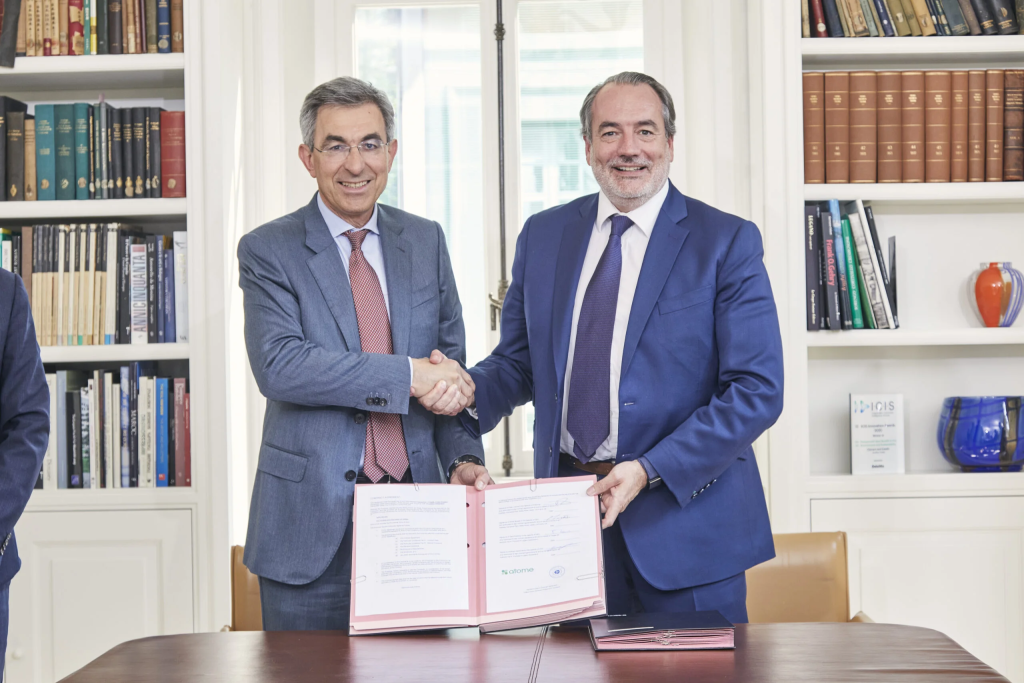
The definitive debt agreements were signed on 12 March 2026 in Asunción, during the Inter-American Development Bank Group Annual Meetings — a ceremony that confirmed the project’s technical, financial and contractual readiness to proceed. Hy24 co-founder and CEO Pierre-Etienne Franc said: “In today’s geopolitical context, sovereign, local fertiliser supply is strategic. Hy24 is proud to lead the investor consortium in supporting ATOME to build a reference project for tomorrow’s sustainable, sovereign and competitive fertiliser industry.”
Casale: A century of chemistry, One landmark contract
Swiss firm Casale is the technical backbone of the project — serving as both technology licensor and EPC contractor, with full responsibility for design, engineering, procurement and construction of the plant. Founded in 1921 and headquartered in Lugano, with over 400 professionals across Europe, Asia, and the Americas, Casale is one of the few companies in the world able to deliver the entire production chain of nitrogenous fertilisers — from ammonia synthesis through to nitric acid, nitrates and phosphates.
In April 2025, Casale and ATOME signed a fixed-price, lump-sum EPC contract worth $465 million — providing investors with full cost certainty from the outset. Casale’s proprietary process technologies and integrated engineering capabilities are central to ensuring the plant’s performance and reliability at industrial scale. CEO Federico Zardi said: “The Villeta Project is a concrete demonstration that low-carbon fertilizers can be produced at industrial scale using renewable energy. We are proud to contribute to this landmark initiative as technology and EPC partner, supporting ATOME in turning an ambitious vision into an operational reality.”
What comes next
Construction begins shortly at the Villeta site, with the plant expected to enter commercial operation by 2029. It will displace 500,000 tonnes of CO2e annually, contributing to both regional food security and the decarbonisation of the Mercosur fertilizer supply chain. ATOME describes Villeta as a replicable commercial blueprint, with a wider pipeline of 445MW of green fertilizer projects across South and Central America and its ATOME Power division separately developing renewable power generation and battery infrastructure.