Fertilizer International 527 Jul-Aug 2025
7 July 2025

Pioneering Pursell goes international
PRODUCT INNOVATION
Pioneering Pursell goes international
Pursell is a leading controlled-release fertilizer (CRF) manufacturer based in Sylacauga, Alabama. Fertilizer International sat down with Joe Brady, the company’s Chief Financial Officer, ahead of the Southwestern Fertilizer Conference in Nashville in mid-July.

The century old start up!
Joe, the roots of Pursell date back to 1904. Indeed, your founder Taylor Pursell described the company to me in 2018 as a 114-year-old start up. Could you explain more about the history and origins of Pursell?
“The Pursell family were pioneers in bringing controlled-release fertilizers into the mainstream over several decades. The Pursell name, like you say, was associated with innovation from the outset.
“Back in the day, Pursell’s focus was on consumer, golf and T&O (turf and ornamental) markets with a spirit of both innovation and hospitality. They hosted thousands of golf superintendents and would bring them in for a week’s training and entertainment at Pursell Farms, their golf resort and research facility. If you’re going to have training, that’s a great way to make it very accessible and enjoyable!
“They were building relationships; you had innovation on one hand and then meaningful interactions on the other. Those are the strengths we still have ourselves – that is an absolutely fantastic legacy to have and capitalise on.
“We still think there’s incredible room for innovation within agriculture. Yet, unlike other markets where you can run solo, ag tech needs to work in partnership with the large established incumbent companies to leverage the infrastructure they have built.
“At the same time, Pursell has a lot of quality research and development in the pipeline, some of which we have already launched. We just need to execute now on the commercialisation of those technologies.”
Bringing CRFs to row crop farmers
Pursell is specifically targeting controlled-release fertilizers at row crop agriculture – what’s your strategy here?
“There are actually a few different business models. [Yes,] we’re still focused on building a strong broad acre controlled-release fertilizer offering in Canada and the US Midwest – primarily focused on corn –and then taking that same technology into other larger volume markets like palm oil in Southeast Asia. Those are some of our goals.
“[Also,] we’ll continue to service the historical specialty market – that’s turf & ornamental, specialty agriculture, consumer – from our existing Sylacauga and Savannah plants with the name recognition and the demand already in place for this. Those plants are highly dedicated and they also hold inventory and warehousing.
“That model is better suited to the specialty market – so we are servicing a lot of the specialty market across the US and internationally from Sylacauga and Savannah.
“We also established a joint venture with Sollio [the largest agri-food cooperative in Canada], which is about 90-95% broad acre, that is now doing magnificently. That’s a totally different tolling model: Sollio brings in the fertilizer, the joint venture coats it and hands it back to them.
“That maintains very low expenses, low overheads. That’s a model where we can put a smaller footprint plant right in the middle [of the market], at distribution level, with an established partner. It minimises expense, energy, carbon footprint, and logistics.
“So, we’re looking at the JV model we have with Sollio as the model for further expansion in Canada and as we expand into the Midwestern United States.
“Then the third model is international. In Southeast Asia, it’s a hot, wet climate with nutrient-poor, sandy soils and high value crops. It’s an ideal location and part of the world for our technology. We are very optimistic about the new plant there [in Malaysia with Wastech Group] and future [regional] prospects because there’s such growing demand [for CRFs] and it really connects well with the benefits of our technology.
“There are proven yield benefits [from CRFs] and a return on investment for farmers, without the need for subsidies. We make that the primary proposition to farmers and then the environmental benefits – important sustainability benefits – flow from those as secondary benefits.
“Having a standalone financial benefit for farmers is essential. But labour [savings of CRFs] is the one we help farmers realise every time [too] – as farm owners are consistently having difficulty sourcing labour [in agriculture].”
Made to biodegrade
Pursell’s low temperature coating process enables the production of polyurethane-coated fertilizer containing microbes that can reduce the coating shell to carbon dioxide, water and organic matter – once the product has delivered nutrients to the plants in a controlled manner. How does Pursell’s patented biodegradable coating technology work, and can it actually benefit soil health?
“In Canada and the US, we’re performing field trials with a series of universities and partners – to see how the product performs – that we’re excited about. Then we’re doing biodegradation trials, working with other labs that are targeting EU regulations, in addition to the work we’re doing with the IFDC (International Fertilizer Development Center).
“The EU regulations have expanded their slate of testing, and we’re working with different labs and partners to address all of those. It does take time when accelerated tests to degrade the polymer run for 20 months and complete tests for 48 months. But we’re moving down the road and testing biodegradation as well as the performance of our product.
“But what has happened, which is exciting to us, is that we’ve been presented with different biopolymers – by some of the other partners we work with – that, with some tweaking, will also work in our existing coating systems, so we don’t have to rebuild our plants.
“The [biodegradable coatings] concept with the inclusion of microbes in the coating to degrade [the polymer] is still at the heart of what we’re doing – because it’s a lower temperature process. But the development and testing process does take a little bit of time.
“What we want to do is to keep people informed as move through the [regulatory] process, so that we can then [ultimately] build product lines, look at investments into certain areas that can really generate demand for these products, and do our best to keep the price point low by understanding what scale would look like.
“Development and testing is a multiyear exercise and we’re in the middle of this overall process. But we’re really excited and have a high level of confidence that we’ll reach our goals.”
Going international
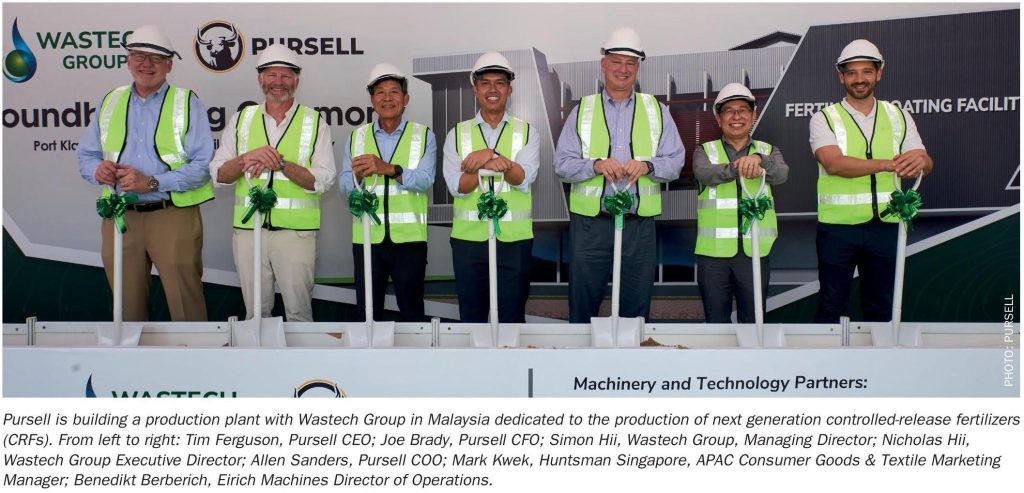
In a new partnership with Wastech Group, Pursell is building a fertilizer coating plant in Malaysia dedicated to advanced CRF production. Is good progress being made on construction of the company’s first CRF plant outside of North America – and what makes Southeast Asia a suitable site for this?
“First, Southeast Asia – its wet climate, with nutrient-poor, sandy soils and a high acreage of high value crops – is an ideal place for our technology. Second, you have a concentration in the oil palm plantations and therefore the ability to get [a lot of] product into [a localised] market.
“Where you have captive customers, they can apply CRFs in large amounts, can achieve larger savings and can understand the labour benefits at a broader level than small holders. There are also other reasons that Malaysia, within Southeast Asia, works best for us.
“We’re putting the plant right at Port Klang, which has amazing logistical benefits to receive and export product throughout the ASEAN region and further into Asia. Then there’s the [region’s current] void with controlled-release fertilizer production.
“Going back to old Pursell and Polyon, a lot of people have used this [CRF] product but imported it for years. [By producing in region,] we’re going to save the full freight rate and there will be lower production costs.
“So, we feel we are going to be able to find the right price that offers farmers a really good return on their investment. It also makes sense economically to grow the [CRF production] volumes in a very aggressive manner – that’s at the heart of it.
“Second, Wastech is a group that has strong agronomic expertise who are used to selling specialised products and understand controlled-release fertilizers and ‘educational’ sales. They can’t be treated like any commodity product – you’re not just selling urea, right?
“People really have to understand how to apply controlled-release fertilizers, how to blend [them] to get the full benefits. Yes, it’s a straightforward proposition, but you do need to educate farmers in how to evolve their practises.
“We have always sold into Central America and South America some volumes [from the US], but now we’re beginning to really explore South America, in particular, in more depth. Markets like Brazil are wonderful with great established companies there. So those will most likely be our next areas of focus for our international expansion.
“The progress we’ve made in Southeast Asia is a model of what we’d be doing with a joint venture partner and what we would pursue in other regions, such as South America.
“The Middle East is a different equation because you have production but no [in region] utilisation. So, there’s a different element of partnering with a manufacturer who is then going to send that to markets abroad. [Yes,] we would always protect our different joint venture partners in their regions, but outside of that it becomes an open market.”