Nitrogen+Syngas 374 Nov-Dec 2021

30 November 2021
Price trends
Price trends
Market Insight courtesy of Argus Media
NITROGEN
Several traders have struggled to export urea from China during October, and it is clear that, in the short-term at least, little urea will flow from Chinese ports. This provided further support to the broader urea market during mid- to late October, though price increases were generally at a lower rate than earlier in October. Liquidity continued to be relatively thin, but urea prices notably rose in Egypt (to $845/t f.o.b.) and Oman (to $760/t f.o.b.). Ammonium nitrates also saw large price increases as producers continued to take advantage of high demand from Europe to force American markets to pay up.
Recent market drivers include: Chinese export restrictions – with at least three export cargoes facing difficulties, the market is unable to count on exports from China to help meet the supply deficit; demand destruction – no region is proving immune to the imbalance between fertilizer and grain prices; and European natural gas prices – prices in Europe remain at elevated levels, though fertilizer prices have caught up enough to incentivise output from EU factories in the short-term.
The outlook for nitrogen is firm. High gas prices will squeeze marginal nitrogen supply in Europe and Ukraine, cutting production of urea and nitrates. This is lifting Europe’s call on African urea supplies. India is also in a difficult position – domestic production has lagged 2020 levels all year despite the start-up of Ramagundam. On paper, India needed 5 million tonnes of urea in the fourth quarter of this year, but only 740,000 t was bought under the last RCF tender. And while we would expect Indian purchasing to be lower than our calculated requirement on paper, India will still need to make further tenders.

Following a ban on phosphate exports, China has also announced new customs export measures, effective from November 1st, requiring inspection certificates to ship fertilizer and related materials overseas. Traders are concerned that customs officials will not issue the certificates, turning this into a potential de facto ban on fertilizer exports. China shipped 2.9 million tonnes of urea from January to August this year, and the new measures could tighten a market already facing greatly reduced availability.
In the US, UAN prices are also higher due to the ongoing investigation into alleged dumping from Russian and Trinidadian producers. The US Department of Commerce is expected to announce its initial subsidy rates for foreign UAN production in November, which may reflect equivalent tariff rates unless revised.
Urea prices per unit N are now considerably higher than for ammonia or ammonium nitrate, which may lead to some substitution in the coming weeks.
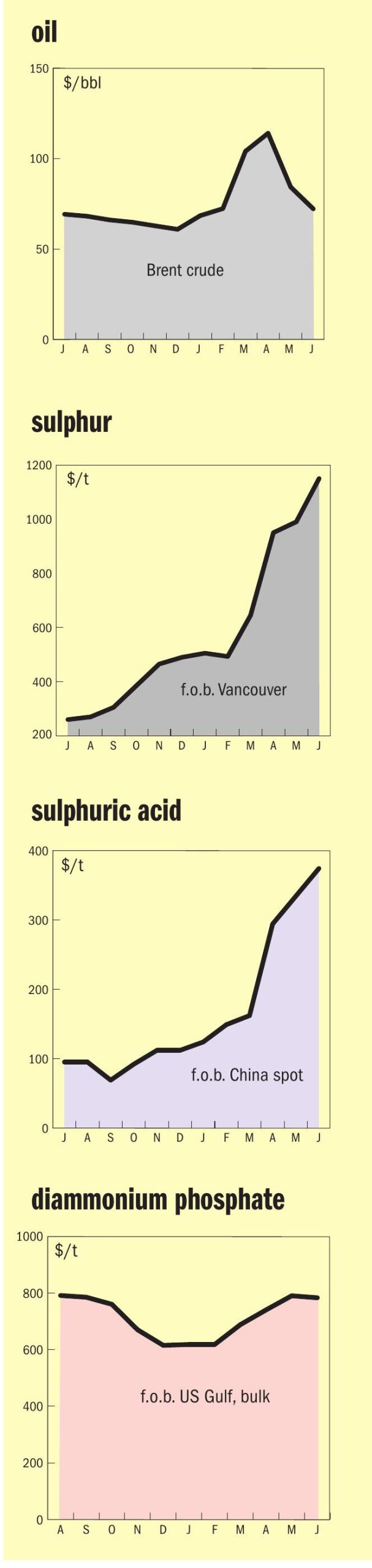
END OF MONTH SPOT PRICES
natural gas

ammonia

urea

diammonium phosphate