Fertilizer International 503 Jul-Aug 2021

Becoming more inhibited


Editorial

Becoming more inhibited

“Fertilizer producer profits, in contrast, could potentially receive a £5 million boost from UK sales of inhibited urea, if this was mandated”

In 2019, the EU fertilizer market was valued at around e17 billion, with France, Germany and former member state the UK together representing 40 percent of this total.

These three countries also provide significant demand for urea, collectively consuming four million tonnes in 2019. Although modest by global standards, Western Europe still offers lucrative opportunities for urea producers, importers and traders. Indeed, the region as a whole consumes nine million tonnes of urea annually.

Yet some are asking whether clean air policy – namely the EU’s 2013 Clean Air Programme and the UK’s 2019 Clean Air Strategy – could eventually spell the end for standard commodity urea within Europe.

“There is no doubt among agronomists and fertilizer producers that enhanced urea fertilizers and urease additives will play a bigger role in arable farming because of the need to reduce ammonia losses under Europe’s clean air goals,” Julian Meehan, managing editor for fertilizers at ICIS, commented last year. “But not every market observer is convinced.”

Germany has led the way. Despite consuming 2.2 million tonnes of urea in 2019, the EU’s powerhouse economy has introduced a new fertilizer ordinance (Düngeverordnung) outlawing its straight use. This stipulated that, from 1 February 2020, urea could only be spread as a fertilizer if a urease inhibitor was added or worked in.

The new ordinance is designed to increase nitrogen use efficiency and reduce ammonia emissions. Its introduction has already changed fertilizer trade patterns in Germany by favouring calcium ammonium nitrate (CAN) over urea.

Germany’s imports of CAN rose by 24 percent year-on-year (y-o-y) to 766,000 tonnes during July-November 2020 – the first five months of the European agricultural year. Urea imports, meanwhile, decreased by 18 percent y-o-y over the same period to 120,000 tonnes.

Now post-Brexit UK may be about to follow Germany’s lead and ban the use of straight urea too. The UK’s environment department Defra launched a three-month consultation on reducing ammonia emissions from urea in November last year. This set out three policy options for England:

  • An outright ban on solid urea, the preferred option
  • Only allowing urea treated with a urease inhibitor
  • Restricting the application period for urea.

Collectively, Britain’s farms generate ammonia emissions on a large scale. Around 87 percent of UK ammonia emissions come from agriculture of which 18 percent is attributable to mineral (inorganic) fertilizer use. Solid urea also releases more ammonia than any other mineral fertilizer – contributing some eight percent to total UK ammonia emissions.

In 2019, the UK’s Agriculture and Horticulture Development Board (AHDB) carried out its own scientific review of the nitrogen losses associated with urea use.

“Nitrogen losses from solid urea application can range from 10-58 percent,” said Dr Sajjad Awan, a resource management scientist at the AHDB. “Urease inhibitors can be added to urea to slow down this process and consequently reduce volatilisation.”

Reducing nitrogen losses from urea has the added benefit of making more nitrogen available to crops, thereby improving nitrogen use efficiency. In an economic analysis, the AHDB concluded that inhibited urea offered UK farmers a financially viable option for nitrogen fertilization, with a crop production cost (per kilo of grain) equivalent to ammonium nitrate.

The UK government calculates that mandating the sale of inhibited urea would add £70 million to nationwide farming costs over the period 20222030. This works out at an average cost per farm of £1,085, or just over two percent of average farm income. Fertilizer producer profits, in contrast, could potentially receive a £5 million boost from UK sales of inhibited urea, if this was mandated.

The UK consumes just under 600,000 tonnes of urea annually. The British government expects that England’s farmers would mainly switch to ammonium nitrate (AN) if a total urea ban was imposed.

The UK imported £207 million worth of urea in 2018, with most of this sourced from Germany, Egypt and Russia. In the short term, the extra demand for AN created by banning urea would be partly met by reducing Britain’s AN exports, these being valued at £27 million in 2018.

The UK consultation on ammonia emissions closed at the end of January and the government’s response is currently awaited. Whatever the decision, the UK and EU member states are likely to continue their shift away from standard urea to nitrates (page 28) and/or enhanced efficiency fertilizers (page 20).

Latest in Outlook & Reviews

CRU Phosphates+Potash conference focuses on sulphur

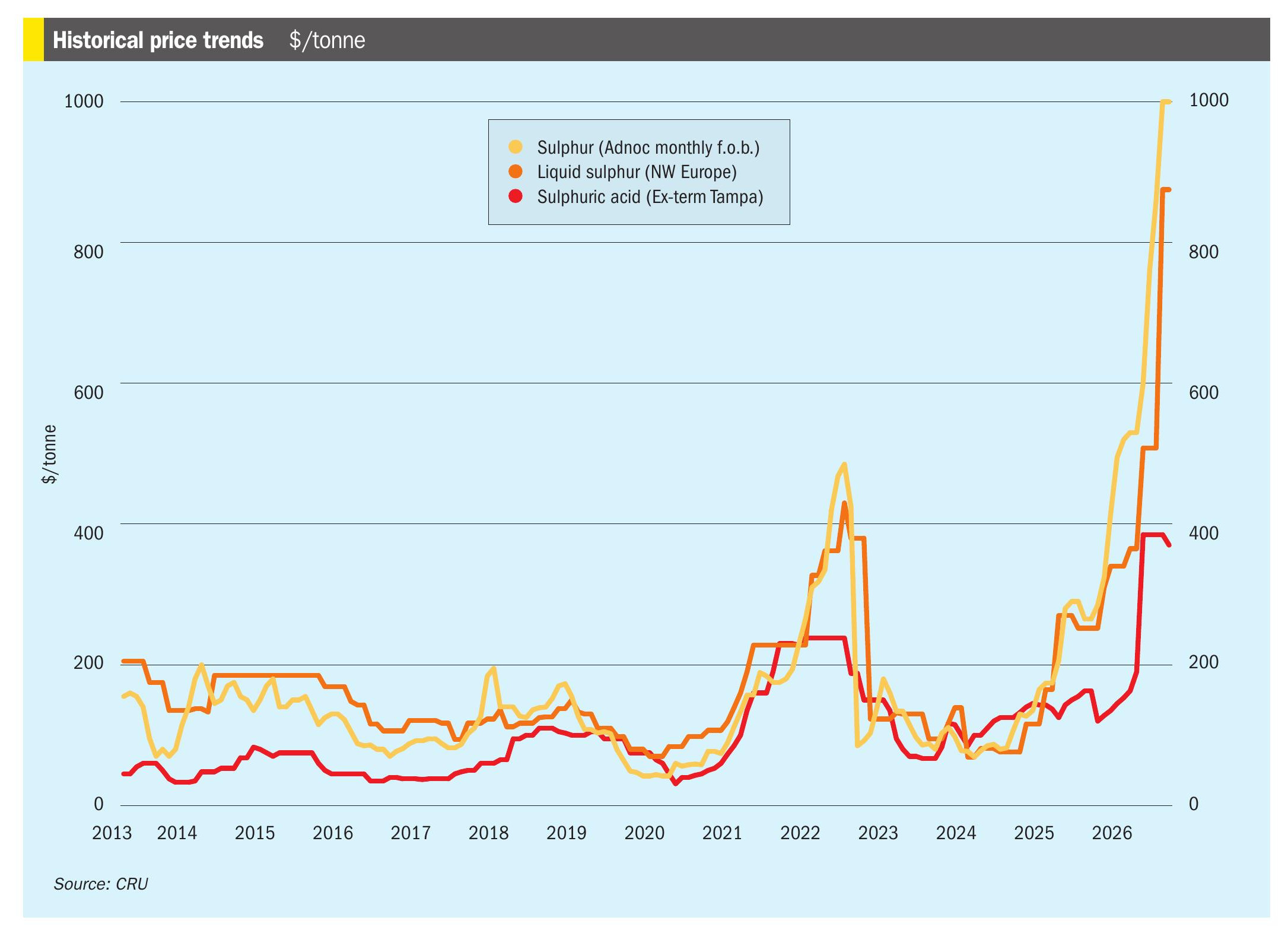
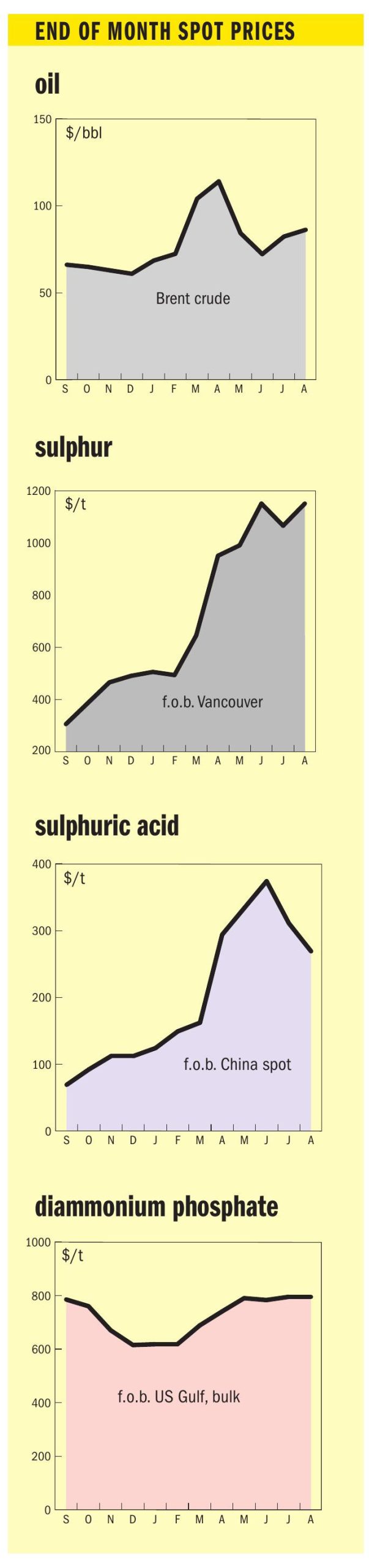
CRU’s Phosphates+Potash Expoconference was held in Paris in mid-April, with the Iran crisis uppermost in everyone’s mind. Margins are under pressure, sulphur has become a strategic constraint, and the phosphates investment pipeline is thin. CRU Principal Consultant Humphrey Knight examined the fallout from the closure of the Strait of Hormuz, noting that fertilizers have been hit harder than most bulk commodities. A large share of exportable sulphur and traded urea normally originates in, or passes through, Gulf producers. The effective closure of the strait has squeezed the traded part of these markets, where international prices are set, and pushed benchmarks up sharply. The global phosphate market is structurally tight, and the combination of Chinese export policy and Middle East logistics has pushed the traded segment into a much more fragile state.

Supply crisis worsens

It is two months on from our previous issue, and almost none of the news has been good from sulphur and downstream markets. Only three sulphur cargoes are confirmed to have transited the Strait of Hormuz since the US and Israeli strikes on Iran began, all loaded at Ruwais, with destinations in India, Tanzania and Morocco, carrying a total of 160,000 tonnes. It is believed that a couple of Iranian vessels with a total of 75,000 tonnes may also have left covertly. But in spite of some Middle Eastern sulphur making its way to Saudi Red Sea ports or Duqm on Oman’s Indian Ocean coast, around 700,000 tonnes is still trapped on ships stranded in the Gulf, and coupled with production cuts in the region, it is estimated that over 1.2 million tonnes has so far been removed from the market.