
Sulphur + Sulphuric Acid 2023
A report on CRU’s annual Sulphur + Sulphuric Acid conference, held in New Orleans, USA, 6-8 November 2023.

A report on CRU’s annual Sulphur + Sulphuric Acid conference, held in New Orleans, USA, 6-8 November 2023.

CF Fertilisers UK Limited, a subsidiary of CF Industries, says that it plans to permanently close the ammonia plant at its Billingham fertilizer complex in order to secure the long-term sustainability of its business in the UK. The Company intends to continue to produce ammonium nitrate (AN) fertiliser and nitric acid at the Billingham site using imported ammonia, as it has for the last 10 months following its decision to temporarily idle the plant in August 2022.
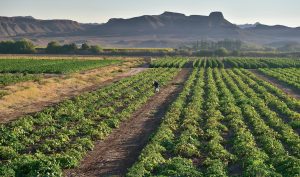
Prior to the covid pandemic, sub-Saharan Africa had been the fastest growing market for new fertilizer demand. However, the combination of pandemic related disruption, followed by the dislocations caused by the war in Ukraine, have pushed up prices and led to falling demand across the continent.

Venkat Pattabathula , a member of the AIChE Ammonia Safety Committee, reports on the American Institute of Chemical Engineers’ Safety in Ammonia Plants and Related Facilities Symposium, held in Munich, Germany, from 20-24 August 2023.
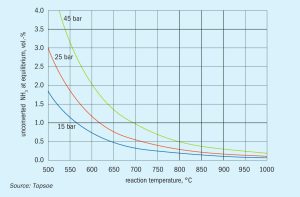
Large-scale ammonia cracking for conversion of ammonia to hydrogen is a proven technology with decades of industrial experience. Topsoe shares its experience within ammonia cracking and presents an improved and highly energy-efficient (96%) ammonia cracking technology, H2Retake™ , developed based on Topsoe’s proven technology and industrial experience.
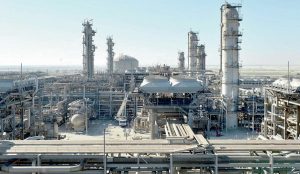
Following the completion of expansion work on the ultra-sour gas Shah field in May 2023, production has been ramped up. Occidental, which owns 40% of the Shah project and which operates the field in conjunction with ADONC Sour Gas, reported in July that it had achieved record output at Shah, with gross gas sales reaching 722 million scfd in Q2 2023 (equivalent to 1.1 billion scf/d of raw gas, which is 23% H2S and 10% CO 2 ). The expansion has taken processing capacity at Shah to 1.45 billion scf/d and forms part of the UAE’s plans to achieve gas self-sufficiency by the end of the decade. The expansion was conducted by Saipem, who were awarded a $510 million contract in 2021 to expand output from 1.3 billion scf/d to the current 1.45 billion scf/d. Work was completed two months ahead of schedule, according to Occidental.
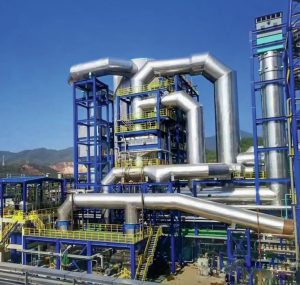
As producers and regulators become increasingly concerned about the ‘circular economy’, there is increasing focus on regenerating waste sulphuric acid for re-use.

Hydrocarbon-based production of ammonia carries an unavoidable carbon footprint. But one of the best methods for mitigating that footprint is already here: ultra-low carbon-intensity ammonia production, also known as “blue” ammonia. With blue ammonia production, a typical ammonia plant can sequester or repurpose game-changing volumes of carbon dioxide that would otherwise end up in the atmosphere. To help foster an optimal understanding of the benefits, Ameet Kakoti and Per Juul Dahl of Topsoe A/S provide an overview of the technologies that can help any ammonia operation achieve and maintain sustainable operations – sooner rather than later.
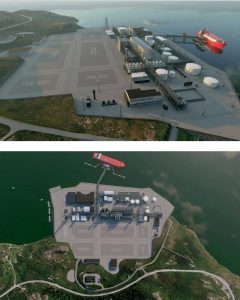
Horisont Energi has the aspiration to develop the most carbon and energy efficient blue ammonia plant in the world, an environmentally friendly plant with a focus on sustainable solutions. This article describes the main features of the Barents Blue Ammonia project, such as 99% carbon capture rate target, a high degree of modularisation, winterisation, infrastructure for ammonia and CO2 management and the provision for future expansion.
Kazakhstan’s oil and condensate output increased by 7% from 1.79 million bbl/d to 1.92 million bbl/d in early June after sour gas reinjection operations resumed at the Kashagan offshore oil and gas development following a recent outage, according to the Kazkah Energy Ministry. Reinjection of sour gas into two wells resumed on 8th June, enabling operator the North Caspian Operating Company (NCOC) to boost oil and condensate production at a large artificial island in Kazakhstan’s Caspian Sea waters. Reinjection was paused on May 20th following the detection of sour gas during routine sampling and a subsequent integrity test. Kashagan normally produces about 300,000 barrels of oil per day. Kazakhstan expects Kashsgan to raise oil production this year to 18.2 million t/a from 12.7 million t/a in 2022.