Tag: Topsoe

Sulphur Industry News Roundup

Kazakhstan’s oil and condensate output increased by 7% from 1.79 million bbl/d to 1.92 million bbl/d in early June after sour gas reinjection operations resumed at the Kashagan offshore oil and gas development following a recent outage, according to the Kazkah Energy Ministry. Reinjection of sour gas into two wells resumed on 8th June, enabling operator the North Caspian Operating Company (NCOC) to boost oil and condensate production at a large artificial island in Kazakhstan’s Caspian Sea waters. Reinjection was paused on May 20th following the detection of sour gas during routine sampling and a subsequent integrity test. Kashagan normally produces about 300,000 barrels of oil per day. Kazakhstan expects Kashsgan to raise oil production this year to 18.2 million t/a from 12.7 million t/a in 2022.

Nitrogen Industry News Roundup

BASF says that its high-pressure regenerative CO2 capture technology HiPACT ® , codeveloped by BASF and engineering partner JGC Corporation will be used by INPEX, one of Japan’s largest exploration and production companies, in its Kashiwazaki Clean Hydrogen/Ammonia Project. This is Japan’s first demonstration project for the production of blue hydrogen/ammonia from domestically produced natural gas, the consistent implementation of carbon capture, utilisation and storage (CCUS) in domestic depleted gas fields and the use of hydrogen for power generation and ammonia production. The project is funded by the Japanese governmental organization New Energy and Industrial Technology Development Organization (NEDO).

Emissions-free syngas manufacturing

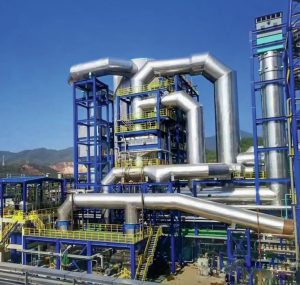
The world’s most common syngas production method remains steam methane reforming, a process which has a substantial CO2 footprint as the necessary reaction heat is supplied by combustion of hydrocarbons. Topsoe’s eREACT™ technology allows for the first-of-its-kind electrification of the traditional SMR process. The reaction heat for eREACT™ is instead generated directly by (renewable) electricity, thereby eliminating the flue gas altogether. Having gone through scale-up from bench scale to industrially relevant pilot scale the technology is now ready for industrial application.

Syngas News Roundup

ExxonMobil has awarded the contract for front-end engineering and design (FEED) of what it describes as the world’s largest low-carbon hydrogen production facility. A final investment decision for the project is expected by 2024, subject to stakeholder support, regulatory permitting, and market conditions. Technip Energies will conduct the FEED for the Baytown integrated complex, which will produce up to 1 bcf/d of low carbon hydrogen, while capturing more than 98% of associated CO2 emissions, totalling around 7 million tCO2 e/year. Offtake agreements are reportedly under discussion with third party customers. Start-up is planned for 2027-2028. The carbon capture and storage network being developed for the project will also be made available for use by third-party CO2 emitters in the area in support of their decarbonisation efforts.

Sulphur Industry News Roundup

Lithium miner Ioneer Ltd has signed a non-binding Memorandum of Understanding with Shell Canada Energy for the supply of sulphur to Ioneer for its Rhyolite Ridge lithium-boron project in Esmeralda County, Nevada. Ionner said in a statement that “securing the supply of key reagents for ore processing is an important step along the critical pathway to developing the Rhyolite Ridge project”. Under the memorandum, Ioneer will purchase up to 500,000 t/a of high-quality sulphur from Shell, which would fulfil the estimated annual sulphur requirement for the Project.