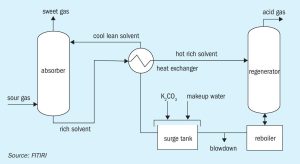
CO2 removal system analytics
Arun Murugan and Mike Antony of FITIRI and Venkat Pattabathula of SVP Chemical Plant Services discuss the COORS Analytics system for more accurate prediction of the performance of a CO 2 removal system.


Arun Murugan and Mike Antony of FITIRI and Venkat Pattabathula of SVP Chemical Plant Services discuss the COORS Analytics system for more accurate prediction of the performance of a CO 2 removal system.

MegaZonE™ is a newly introduced layered loading technology for boiling water-cooled reactors used for methanol synthesis. This new concept is one of the latest results of the long-standing collaboration between Air Liquide Engineering & Construction and Clariant Catalysts to improve the methanol process flowsheet and optimise catalyst performance in the complete reactor system.

Corrosion is one of the most critical aspects regarding sulphuric acid plant lifespan. One important cause of corrosion in sulphuric acid plants is acid condensation from the process gas due to inadequate drying. E. Almeida, B. Ferraro, N. Clark, V. Machida and V. Sturm of Clark Solutions discuss this problem and how it can be avoided with proper tower and internals design.
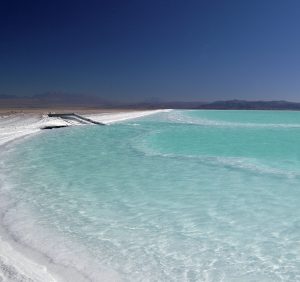
The delivery of nitrogen in nitrate form can deliver superior yields and quality in arable, fruit and vegetable crops. Because of this, production and consumption of the principal nitrate fertilizers – ammonium nitrate (AN), calcium ammonium nitrate (CAN), urea ammonium nitrate (UAN), potassium nitrate (NOP) and calcium nitrate (CN) – continue to grow.
One year on from the launch of its Farm to Fork Strategy, the European Commission is still failing Europe’s farmers, says Igor Shmidt, EuroChem Group’s head of public affairs.

We highlight the large-scale nitrogen projects that are currently under development across the globe – with a focus on ammonia and urea technology licensors and engineering contractors.

A consortium has unveiled plans to build one of the largest green hydrogen plants in the world in a bid to make Oman a leader in renewable energy technology. The $30 billion project is being developed by Oman’s state-owned oil firm OQ, green fuels developer InterContinental Energy and Kuwait government-backed renewables investor EnerTech. Construction is scheduled to start in 2028 in Al Wusta governorate on the Arabian Sea. It will be built in stages, with the aim to be at full capacity by 2038, powered by 25 GW of wind and solar energy. Two years has already been spent on solar and wind monitoring analysis for the development. According to the consortium, the site chosen has the optimal diurnal profile of strong wind at night and reliable sun during the day, and is also located near the coast for seawater intake and electrolysis.
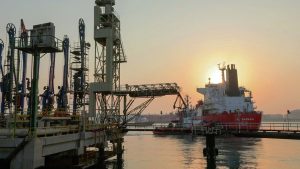
Plans to decarbonise power production and shipping are leading to increasing interest in using ammonia as a fuel, but technical and economic barriers still remain to be overcome.
The International Fertilizer Association (IFA) says that Svein Tore Holsether has been elected as its new chair of the Association. IFA said in its press release that the selection of Holsether, the president and CEO of Yara International, is a continuation of the industry’s commitment to sustainability.
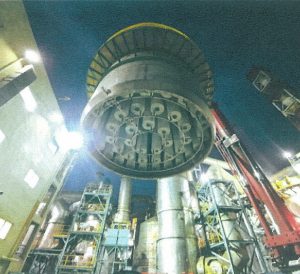
A. Goudarzi of CECO Industrial Solutions discusses the science behind NOx content and how it impacts sulphuric acid producers. In a recent project in Korea, TWIN-PAK® candle filter technology was successfully used to reduce NOx emissions in metallurgical oleum tower production. After installation of the candle filter mist eliminators the plant was compliant with environmental regulations enabling the producer to operate the plant without penalties or shutdowns.