
New potash entrants at the door
CRU’s Alexander Chreky, provides a potash market overview ahead of CRU's Phosphates+Potash Expoconference in Paris in April.


CRU’s Alexander Chreky, provides a potash market overview ahead of CRU's Phosphates+Potash Expoconference in Paris in April.
In just its first two months, 2026 had already managed to be a rollercoaster of a year, but at the start of March, the onset of hostilities against Iran by the US and Israel has managed to deliver another huge shock to markets, particularly commodities. Iran’s strategy of widening the conflict to neighbouring states, including by attacking Qatar’s massive LNG facility at Ras Laffan, effectively shutting it down, has sent the LNG market into chaos, and attacks on several tankers and other ships have paralysed maritime insurance markets and by default achieved the long-feared closure of the Straits of Hormuz.
The deficit in the sulphur market has led to a new focus on melting down and selling stockpiles of sulphur around the world. From Kazakhstan to Canada, stocks of sulphur have been shrinking.
The start of the new year has shown that 2026 is already proving to be a very eventful one, beginning with the US abduction of Venezuela’s president Nicolas Maduro, which has prompted questions over production at the country’s ailing nitrogen assets, as well as the potential for a future boost to gas supplies to Trinidad. Meanwhile the Iranian government faces its most sustained public challenge since the 1979 revolution, and possible US military intervention, threatening continued exports from the country. In Europe, the future of fertilizers’ inclusion in the Carbon Border Adjustment Mechanism (CBAM) has been thrown into doubt barely a week after the new regulations came into force, as France and Italy pushed for an exemption for crop nutrient imports.
CRU's fertilizer team provides their top calls for 2026

Could demand mandates help the build the market for green fertilizers – by placing mandatory purchasing requirements on large-scale end users?
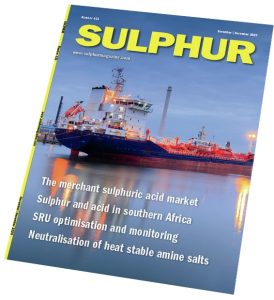
Prices in sulphur markets have been climbing rapidly for several weeks now due to short supply, reaching their highest levels for early two and a half years, since July 2022. A major cause has been widening Ukrainian drone and missile strikes against Russian oil and gas facilities. In particular, drone strikes in September on the Astrakhan and Orenburg natural gas plants led to Russian sulphur exports being cut drastically, first from around 400,000 tonnes per month to only 100,000 tonnes in October, and then to zero from the 1st of November, as Russia implemented a ban on exports of sulphur used in fertilizer production which was projected to last at least until December 31st. “This decision will stabilise shipments of raw materials to the domestic market to maintain current mineral fertilizer production volumes and ensure the country’s food security,” the government’s press service reported. The restriction applies to the export of liquid, granulated, and lump sulphur. It remains to be seen whether exports of Kazakh material from Ust Luga will be affected, but some Kazakh sulphur is now being sold via Iran.
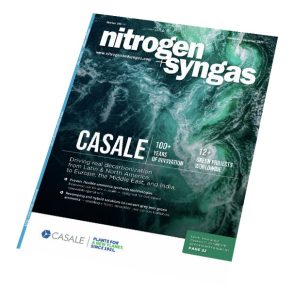
As I write this editorial, the 30th meeting of the Conference of the Parties (COP) to the UN Framework Convention on Climate Change – aka COP-30 – is taking place in Brazil. It is fair to say that the attempt to try to restrict a large greenhouse gas-driven temperature rise across the planet has become one of the defining issues of our age, and particularly for an energy-intensive industry such as our own, responsible as it is for up to 2% of global carbon and carbon equivalent emissions. The move towards lower carbon intensity production of hydrogen, ammonia and methanol, via carbon dioxide capture and sequestration, gasification of biomass or waste, or electrolysis of water using renewable power, has come to dominate our news coverage, and in this issue we also carry articles on the state of play of both ‘blue’ and ‘green’ ammonia production, as well as technology for ‘cracking’ ammonia back to hydrogen and nitrogen for its potential use as a hydrogen carrier.

At the end of this year, the European Union’s Carbon Border Adjustment Mechanism (CBAM) will move from its transitional phase into its ‘definitive’ phase, whereby the carbon costs of goods entering the EU will need to be priced in. CBAM requires suppliers to calculate the carbon emissions of their fertilizer (and other, e.g. steel) products, including indirect emissions, for example from electricity consumed in the process, and emissions of precursor or raw materials. They will then need to purchase CBAM certificates to cover embedded emissions above the established free allowance benchmark rates determined by the European Commission: 1.57 tonnes CO2e/tonne ammonia and 0.23 tCO2e/t nitric acid.

Michael Twining, Vice President of Innovation, Willard Agri-Service, explores the theme of purpose in the fertilizer industry.