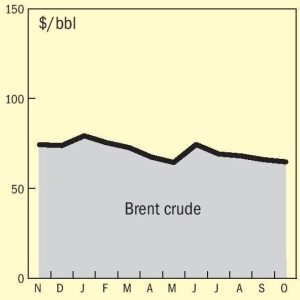
Price Trends
Sulphur prices advanced further in October, more than expected, supported by the supply towards the end of summer becoming restricted, with a number of non-mainstream sources facing logistical constraints.

Sulphur prices advanced further in October, more than expected, supported by the supply towards the end of summer becoming restricted, with a number of non-mainstream sources facing logistical constraints.

Singapore-based Indorama Group, through its Senegalese subsidiary Industries Chimiques du Sénégal (ICS), has signed a memorandum of understanding with Senegal’s Investment and Major Projects Promotion Agency (APIX) to launch a major $210 million investment, aiming to boost Senegal’s phosphate and fertilizer production capacity, reinforcing the country’s strategic role in the regional agricultural input market.

John Carr, Lei Zhang & Yu Zheng of Syensqo review currently available decadmiation techniques, including the company’s ACCO-PHOS® technology.

NextChem subsidiary MyRechemical has been awarded an engineering study contract by Altalto Ltd. for a sustainable aviation fuel (SAF) plant in Immingham, Lincolnshire, based on its proprietary NX CircularTM gasification and NX CPOTM technologies. Altalto is a company set up by Velocys to develop SAF projects in the UK. The plant is expected to be operational in 2030. Initial targets include the production of 23,000 t/a of SAF for the UK market. Feedstock will be sourced from residual municipal solid waste (MSW) and commercial and industrial waste. The project has been awarded a grant from the UK Department for Transport’s Advanced Fuels Fund to progress basic engineering design. MyRechemical will operate as a technology provider and as coordinator for other technological partners. It will also supply engineering services.

Queensland-based SMAC (Strategic:Mi nerals:Acid:Critical) Developments says that it plans to list on the Toronto Stock Exchange in December to raise $1.3 million to fund a final feasibility study. The company is attempting to develop sulphuric acid production in northern Queensland to supply local industries. The company plans to initially build a 180,000 t/a sulphur burning acid plant at a site at Cloncurry, followed by a second phase which would involve developing a pyrite roasting plant to generate 550-600,000 t/a of sulphuric acid.
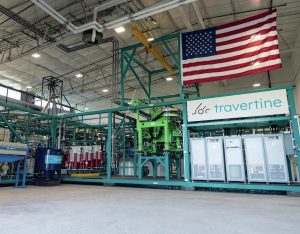
Travertine Technologies, Inc., has began operations at its demonstration plant in New York state. The core Travertine process demonstrated at this plant combines three major unit operations: salt-splitting electrolysis, caustic direct air capture, and mineralisation. This process produces sulphuric acid, calcium carbonate, and green hydrogen from waste gypsum and carbon dioxide captured directly from the air. The demonstration plant will produce 125 t/a of sulfuric acid, 125 t/a of calcium carbonate, and 55 t/a of carbon dioxide sequestration. The plant will supply sustainable sulphuric acid for local partner Sabin Metal Corporation's precious metals recycling and refining business.
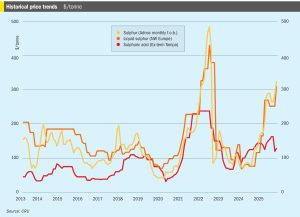
• Russia is set to impose a temporary ban on sulphur exports, covering liquid, granulated, and lump material, to ensure domestic supply. The measure will be in effect until 31 December 2025. CRU expects Russia to return to the export market in 2026 Q1. On the other hand, exports from Iranian ports are set to come back not only for Iranian production but also for Turkmenistan.

Chile’s state-run mining company Enami says that it has received an environmental permit for a new $1.7 billion copper smelter, as part of the modernization of its Hernan Videla Lira smelting facility in the northern Atacama region. The new facility will process up to 850,000 t/a of copper concentrate, and its electrolytic refinery will produce up to 240,000 t/a of copper cathodes for use in electronics, construction and renewable vehicles. Enami says that the modernisation will “ensure profitable and sustainable operations, and practically triple the capacity of the old smelter.”
A UK–based energy watchdog, the Impact Investigators Platform (IIP), has dismissed allegations that the Dangote Petroleum Refinery imported substandard gasoline into Nigeria, describing the claims as “technically inaccurate, commercially implausible, and unsupported by verifiable evidence.” The IIP said its independent assessment of shipping data, customs declarations, and refinery process documentation found no indication that the refinery imported or sold Premium Motor Spirit (PMS) with sulphur levels above Nigeria’s approved limit of 50 parts per million (ppm). The investigation followed media reports alleging that a vessel had delivered high-sulphur gasoline to the Dangote Refinery under the guise of locally refined products. However, the IIP clarified that the cargo in question was an intermediate feedstock , a raw material used for refining and not finished gasoline meant for retail.
Paradeep Phosphates Ltd (PPL) has announced a $400 million capacity expansion program, following its October 13th merger with Mangalore Chemicals & Fertilizers Limited (MCFL). This company says that the move aims to strengthen PPL's market position and enhance its production capabilities. The investment will involve increasing granulation capacity by 1.0 million t/a at the Paradeep site, as well as an additional 250,000 t/a of phosphoric acid and 750,000 t/a of sulphuric acid capacity at the company’s new Mangalore site. The expansion is expected to be completed within three years, according to PPL, and is expected to ensure 100% backward integration for fertilizer production, reduce import dependency, and enhance operational capabilities and profitability. low-contaminant phosphate concentrate that allows for easy conversion into purified phosphoric acid. The company has spent over C$100 million advancing the project and has received funding and investment from the Quebec Government.