• Skip to main content

    Category: Industrial

    Technology license for blue methanol

    Topsoe has been selected as technology provider by Sandpiper Chemicals LLC, for their new blue methanol plant in Texas City, Texas. Topsoe will license its Syn-COR™ technology, which will be combined with carbon capture & storage (CCS) for the production of blue methanol. The project, when operational will produce 3,000 t/d of blue methanol. The IEA estimates that methanol demand is expected to grow to 120-150 million t/a by 2030. Today, methanol is primarily used within the chemical industry, but growing demand is coming from the shipping industry as it looks to lower emissions.


    NextChem and Siemens to cooperate on maritime methanol fuel cells

    NextChem and Siemens Energy have signed a memorandum of understanding to cooperate on the development and commercialisation of a high temperature methanol fuel cell, based on a newly designed modularised solution. With an initial focus on the high-end yachting segment, the target market for the cooperation is the maritime industry and beyond. According to the MoU, NextChem will focus on the design and supply of the methanol fuel cell module, while Siemens Energy will leverage its expertise in onboard system integration, complete electrification and energy management with the aim of delivering a complete solution to shipyards and owners.

    Kent appointed to Yanbu Green Hydrogen Hub

    Kent, a global leader in integrated energy services, has been appointed by ACWA Power as owner’s engineer for the Yanbu Green Hydrogen Hub, a major green hydrogen and ammonia export facility being developed in Saudi Arabia. Situated in the port city of Yanbu on the Red Sea, the project will feature full integration across the green hydrogen value chain. This includes its own dedicated renewable power generation, desalination plants, ammonia production lines and an export terminal. At full scale, the facility will deliver up to 400,000 t/a of renewable hydrogen, converted into over 2.2 million t/a of green ammonia for international markets. With more than 4 GW of electrolysis capacity planned, the Yanbu hub is expected to be nearly twice the size of the NEOM Green Hydrogen Project.

    Market Outlook

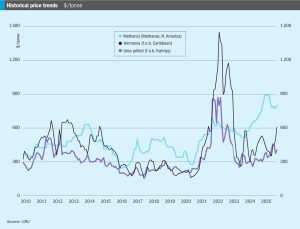
    l The market looks very tight through the end of the year, though some expect supply to improve in Q4. Prices are unlikely to ease in the coming weeks. l Woodside’s Beaumont New Ammonia Project is now 97% complete, and the producer expects production from the first train in late 2025. There is no information from Gulf Coast Ammonia on when to expect commercial production. l There was an absence of fresh confirmed business into northwest Europe. Still, producers with ammonia capacity in the region are expected to be maximising output given the favourable economics at current spot natural-gas prices at the Dutch TTF.

    Cooperation agreement for e-fuels demonstration plant

    Sasol and Topsoe have signed a cooperation agreement with the German Aerospace Centre (DLR) and EPC contractor Griesemann for the construction, operation and research and development activities of DLR’s sustainable aviation fuels demonstration plant at the Leuna Chemical Complex, Germany. The demonstration plant is currently under construction and expects to produce 2500 t/a of e-fuels, starting in Q4 2027. The e-fuels produced will comprise mainly of kerosene, using renewable feedstocks such as biogenic CO2 and green hydrogen. With €130 million of funding secured from the German Federal Ministry for Transport, the plant will be the largest demonstration and research facility globally for the production of e-fuels.

    Feasibility study on sustainable methanol plant

    NextChem subsidiary MyRechemical has been selected by Mana Group and Equinor to conduct a feasibility study for a waste-to-methanol plant at Norway's Mongstad refinery. The project will use NX Circular™ technology to convert urban and industrial waste into chemical grade syngas which will be further processed to produce low-carbon methanol. The facility is expected to produce circular methanol with a low carbon footprint, eligible under the EU Renewable Energy Directive criteria. This methanol could initially replace marine bunker fuel to meet the targets of the FuelEU Maritime regulation, exempting final users from buying ETS credits and paying penalties, and potentially later be used as feedstock for methanol-to-jet facilities to produce sustainable aviation fuel (SAF) compliant with FuelEU Aviation regulation.