• Skip to main content

    Category: Industrial

    Classification for hydrogen-fuelled tug

    ClassNK has added Japan's first hydrogen-fuelled tug Ten-Oh to its register, built by Tsuneishi Shipbuilding Co., Ltd. This vessel was developed and built under the 'Nippon Foundation Zero Emission Ships Project', a grant program by The Nippon Foundation aimed at developing ships with zero CO2 emissions. Based on discussions among the parties involved during the planning stage of the vessel, ClassNK reviewed the safety requirements and countermeasures for hydrogen-fuelled ships by applying Part GF of its 'Rules and Guidance for the Survey and Construction of Steel Ships' etc. These reviews focused on issues such as preventing explosions caused by the high ignitability of hydrogen and mitigating the potential impacts of hydrogen fuel leakage on crew members and the environment.

    Price Trends

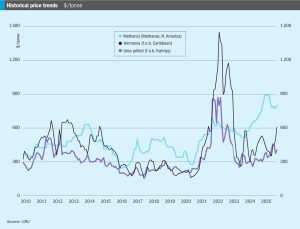
    By the end of October the ammonia market was facing an acute shortage of spot tonnage, reflected in a $60/t jump in the Tampa price for November. The benchmark Tampa price increased for the sixth straight month to its highest since February 2023 as the global ammonia supply crunch deepened. The surge at Tampa was said to be driven by good demand in the US for direct application combined with a lack of supply. Contributing factors included Nutrien shutting down its nitrogen production in Trinidad, potentially removing around 85,000 tonnes/month from the market. So far, there is no suggestion that other producers in Trinidad will follow suit, and they may even benefit from a boost natural-gas supply given the Nutrien outage, although it is unclear whether the spare gas will be directed to ammonia as opposed to other demand sources.

    Ube to close ammonia production

    Ube Corporation has accelerated closure plans for its nitrogen products in Asia as part of its Vision 2030 plan. The company says that it aims to halt ammonia and related product production at its Ube City plant in Japan by March 2028, two years ahead of its previous schedule. Production of caprolactam and polyamide materials at the same plant will end by March 2027. Post-restructuring, the facility will prioritize specialty chemicals such as polyimides, separation membranes, ceramics, pharmaceuticals, and high-purity chemicals.

    Aurubis completes major maintenance at Pirdop plant

    Aurubis says that it has successfully completed scheduled maintenance at its Pirdop plant on time. The two-month operation marked the largest planned maintenance shutdown at the site in the past 30 years. With an investment of €115 million, Aurubis says the work ensures the long-term reliability and performance of the facility. Key upgrades included a full overhaul of the flash smelter, replacement of two electrostatic precipitators, and a major modernisation of the sulphuric acid production line. This modernisation involved installing a new converter and replacing six heat exchangers.

    Lyten acquires Northvolt

    Lyten, a global leader in lithium-sulphur batteries has entered into a binding agreement to acquire Northvolt’s assets in Sweden and Germany. The acquisition includes Northvolt Ett and, Northvolt Labs in Sweden and Northvolt Drei in Germany. Additionally, Lyten is acquiring all remaining Northvolt intellectual property. The financial terms of the agreement were not disclosed. In total, Lyten’s acquisition includes assets valued at approximately $5 billion, including 16 GWh of existing battery manufacturing capacity, more than 15 GWh of capacity under construction, the infrastructure and plans to scale to more than 100 GWh, and the largest and most advanced battery R&D centre in Europe.

    Topsoe technology selected for Indiana refinery

    Topsoe has been selected as the renewable diesel technology partner for CountryMark’s Mount Vernon, Indiana refinery. Located in southwestern Indiana, the refinery processes 35,000 bbl/d of crude oil. With the addition of Topsoe’s HydroFlex technology, CountryMark aims to produce up to 250,000 barrels of renewable diesel annually. The new unit is expected to enable an emission avoidance of approximately 84,500 t/a of CO2 e. CountryMark, a farmer-owned cooperative, will use local soybean oil as the primary feedstock to produce renewable diesel, helping create a locally sourced renewable fuel economy in Indiana.