Sulphur 426 Sep-Oct 2026
18 September 2026
OXYSULF versus conventional Claus sulphur recovery
WET SULPHURIC ACID
OXYSULF versus conventional Claus sulphur recovery
KVT’s OXYSULF process converts elemental sulphur and sulphur-containing streams into high-grade sulphuric acid while achieving ultra-low SO2 emissions. Its process characteristics make it an alternative for refineries and industrial facilities seeking to improve sustainability, reduce operating costs and meet increasingly demanding environmental requirements. Robert Kahr, Sabine Kopfberger and Mathias Innerkofler of KVT Technology compare an OXYSULF plant with an equivalent-capacity conventional SRU across emissions, energy efficiency and overall performance.
Refineries face growing pressure to upgrade facilities in response to increasingly stringent regulations governing SO2 and CO2 emissions. At the same time, there is a growing need to improve the energy efficiency of refinery operations and processes.
Although the Claus process remains widely used for sulphur recovery, it has feed-related limitations, particularly with respect to H2S concentration and the presence of NH3. Ammonia is commonly present in refinery sour water stripper (SWS) off-gas and can adversely affect process performance and operating flexibility.
Conventional Claus units are also less suited to dilute sulphur-bearing gas streams or feeds with fluctuating sulphur loads, as efficiency tends to decline under these conditions. However, the ability to process variable feed compositions is becoming increasingly important as modern refineries manage a broader range of off-gas streams and operating scenarios.
The OXYSULF process, developed by Kanzler Verfahrenstechnik (KVT), provides an alternative route to sulphur recovery. It can process elemental sulphur and a wide range of sulphur-bearing feed streams from multiple industries, producing high-grade sulphuric acid.
The process combines high sulphur recovery with lower emissions, a smaller carbon footprint and improved energy recovery. Its relatively simple design can reduce operating expenditure (opex) and maintenance requirements, while supporting high operational reliability. A two-stage combustion system further enables the effective treatment of ammonia-containing feeds, ensuring reliable ammonia destruction and stable plant operation.
The following sections describe the OXYSULF process and compare its performance with that of a conventional Claus-based configuration.
The OXYSULF process
Based on wet sulphuric acid technology, OXYSULF converts a broad range of sulphur-bearing feed streams into a valuable commercial product, namely commercial-grade sulphuric acid exceeding 98 wt-%. The process consists of a multi-stage catalytic oxidation system with integrated heat recovery. Unlike conventional dry sulphuric acid plants, OXYSULF eliminates the costly and energy-intensive gas drying step by directly processing wet feed gases.
The closed-loop process design avoids the need for consumable chemicals and eliminates waste streams. Process side streams are recycled internally, supporting near-zero-waste operation and maximising resource utilisation.
High sulphur recovery and low emissions are combined with efficient heat recovery, improving overall plant energy efficiency. By producing high-pressure steam, an OXYSULF unit can displace part of a refinery’s boiler duty, reducing fossil-fuel consumption, operating costs and associated CO2 emissions.
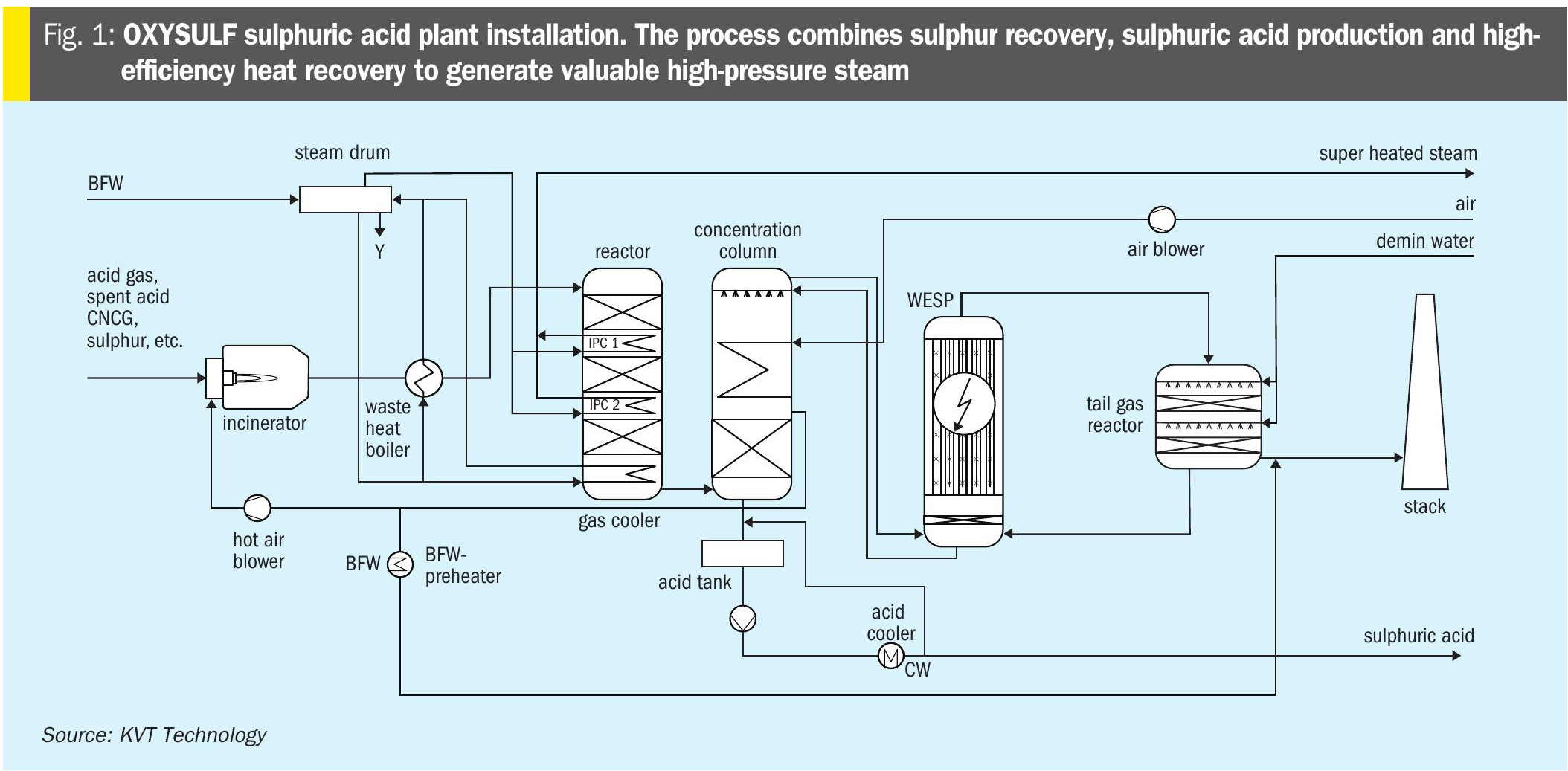
The process comprises four principal stages:
Combustion: Feed gases are fully oxidised with excess oxygen, converting sulphur species to SO2. For feeds with elevated NH3 concentrations, a dedicated combustion approach minimises NO2 formation while ensuring effective ammonia destruction.
Catalytic oxidation: SO2 is converted to SO2 in a multi-bed catalytic reactor system. This configuration provides high conversion efficiency and temperature control across the catalyst beds. KVT uses established catalyst technologies supplied by internationally recognised manufacturers.
Sulphuric acid condensation: SO3 reacts with water vapour in the process gas to form sulphuric acid, which is condensed and recovered in a specially designed, high-efficiency condensation column. The system is designed to maximise acid recovery, maintain stable operation over a wide operating range and support efficient heat integration.
Final gas purification: Sulphuric acid aerosols are removed in a wet electrostatic precipitator (WESP). The remaining process gas then passes through a tail-gas reactor, where residual SO2 is converted into sulphuric acid. This final treatment stage supports sulphur recovery of up to 99.99% and SO2 emissions typically below 15 mg/Nm³.
Low-concentration sulphuric acid streams generated during final purification are returned directly to the concentration column, where they are reconcentrated to product specification. This closed-loop arrangement eliminates liquid effluents and further improves overall sulphur recovery.
Operational benefits
Key advantages of OXYSULF are shown in Table 1 and summarised below.
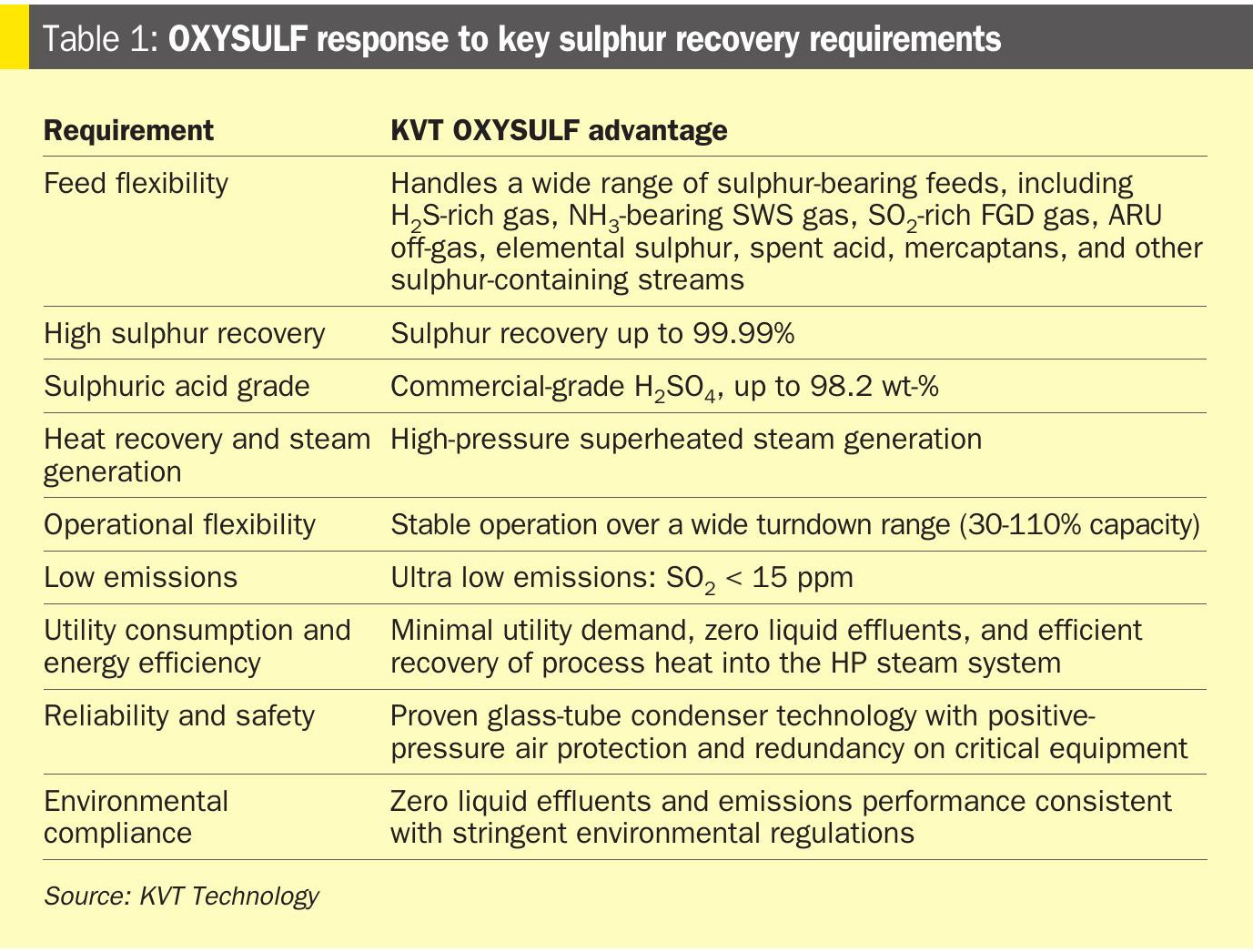
OXYSULF operates without additional chemical consumption or liquid effluent generation. Its high energy efficiency reduces fossil-fuel demand and associated CO2 emissions, while a substantial share of the process heat can be recovered as high-pressure steam.
This steam can be integrated directly into the customer’s steam network, displacing conventional boiler capacity and delivering further reductions in fuel consumption and site emissions.
The process also produces a high-value commercial product. Sulphuric acid is widely used in fertilizer production, metals processing, chemical manufacturing and battery production.
Its compact, modular design supports high availability and operational reliability, while broad feed and throughput flexibility enables treatment of a diverse range of sulphur-containing gas streams. The adapted combustion concept also addresses high NH3 feeds by ensuring complete ammonia destruction while minimising NOx formation.
OXYSULF operates at substantially lower pressure than conventional Claus units, reducing feed-gas pressure requirements, simplifying plant integration and lowering energy consumption. Together with high sulphur recovery, low emissions and strong energy integration, these features position OXYSULF as an attractive alternative for modern refinery sulphur recovery applications.
OXYSULF vs. the Claus process
Conventional Claus technology remains the most widely applied sulphur recovery process in refineries. However, stricter emissions requirements and decarbonisation targets are increasing interest in alternative technologies.
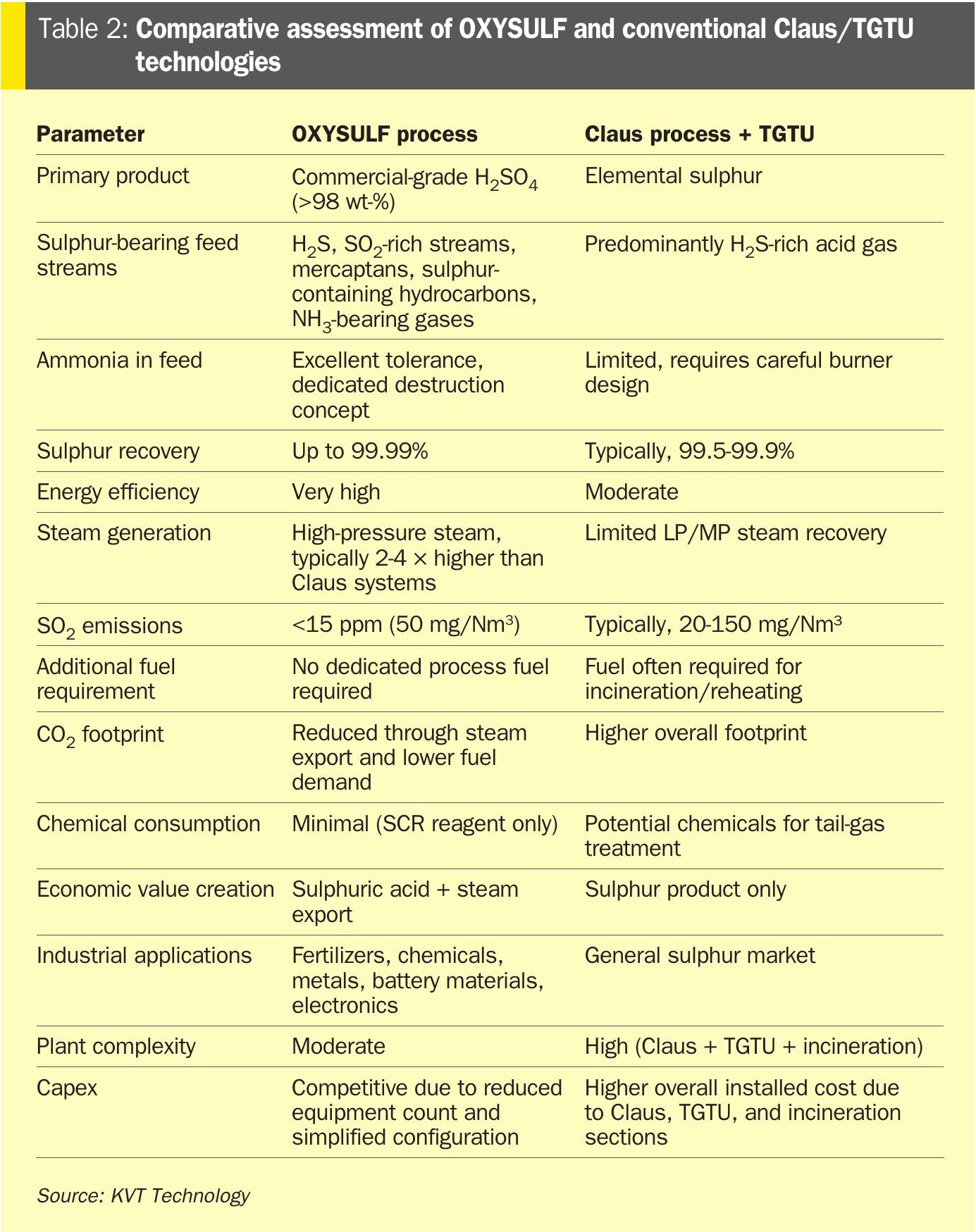
OXYSULF converts sulphur-bearing feeds directly into commercial-grade sulphuric acid while maximising energy recovery and minimising emissions. It can treat a broad range of streams, including NH3-bearing gases, SO2-rich streams, mercaptans and sulphur-containing hydrocarbons, integrating sulphur recovery, emissions control and energy recovery within one process configuration.
Product value and feed flexibility
OXYSULF converts H2S-rich gases, SO2-containing streams, mercaptans and NH3 -bearing gases into commercial-grade sulphuric acid. In contrast, Claus units are principally designed for H2S-rich acid-gas feeds and produce elemental sulphur. The ability to process a wider range of feeds while generating a commercial chemical product provides additional operating flexibility.
Energy efficiency and carbon reduction
Oxidation reactions in the OXYSULF process generate substantial recoverable heat, enabling efficient high-pressure steam generation for refinery utility systems. Compared with conventional Claus units, steam production can be significantly higher, reducing boiler-fuel demand and associated CO2 emissions which can contribute directly to refinery decarbonisation initiatives.
Environmental performance
OXYSULF achieves sulphur recovery of up to 99.99% while maintaining SO2 emissions below 15 ppm. The process generates no liquid effluent and has minimal chemical requirements, limited primarily to the SCR reagent used in the tail gas treatment system. Modern Claus systems equipped with tail-gas treatment units can also achieve high sulphur recovery; however, this typically entails greater complexity, higher utility demand and increased maintenance requirements.
Case study: Energy efficiency and decarbonisation
KVT conducted an energy-efficiency and decarbonisation assessment for a refinery operating four sulphur recovery trains, each with a sulphur capacity of 65 t/d. The study evaluated replacement of two existing Claus SRU trains with one OXYSULF unit, quantifying the effects on utility consumption, steam production, fuel use and CO2 emissions.
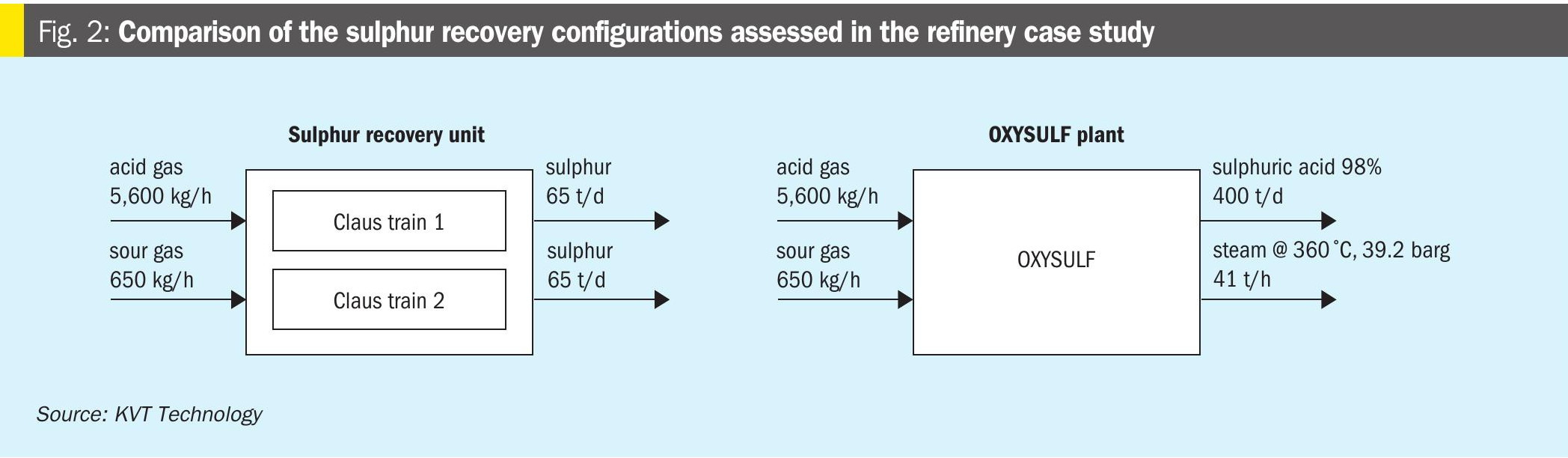
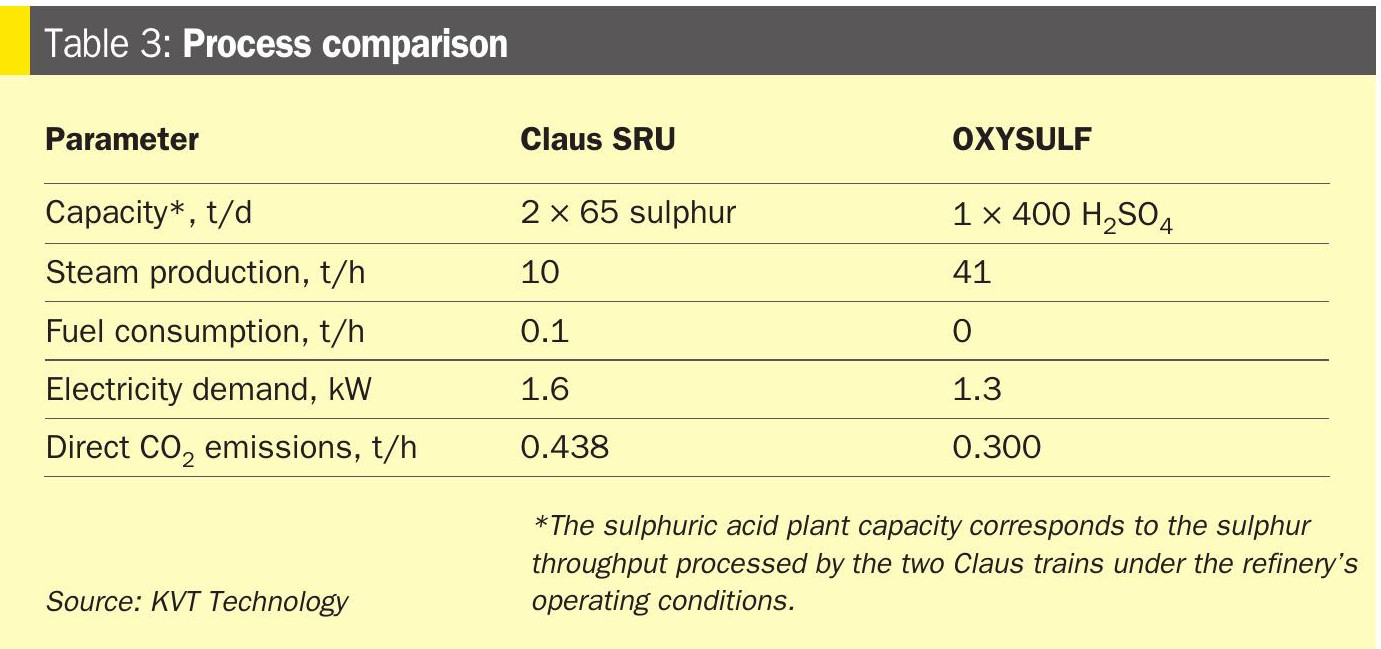
Both configurations (Fig. 2) process the same refinery acid-gas and SWS-gas feeds. The reference case comprises two Claus SRU trains producing elemental sulphur, while the OXYSULF configuration converts the same sulphur input into commercial-grade sulphuric acid and produces substantially more high-pressure steam (see Table 3).
Baseline SRU configuration
The reference configuration comprised two conventional Claus SRU trains, each rated at 65 t/d of sulphur capacity. Together, these units generated approximately 10 t/h of steam, required 0.1 t/h of fuel gas for incineration and consumed approximately 1.6 MW of electrical power. The refinery Energy Intensity Index (EII) was approximately 110.
OXYSULF configuration
The proposed installation consisted of one OXYSULF sulphuric acid plant with a capacity of 400 t/d on a dry basis. The unit generated approximately 41 t/h of high-pressure steam, required no dedicated process fuel and consumed approximately 1.3 MW of electricity. Improved energy integration reduced the refinery EII to approximately 75–80.
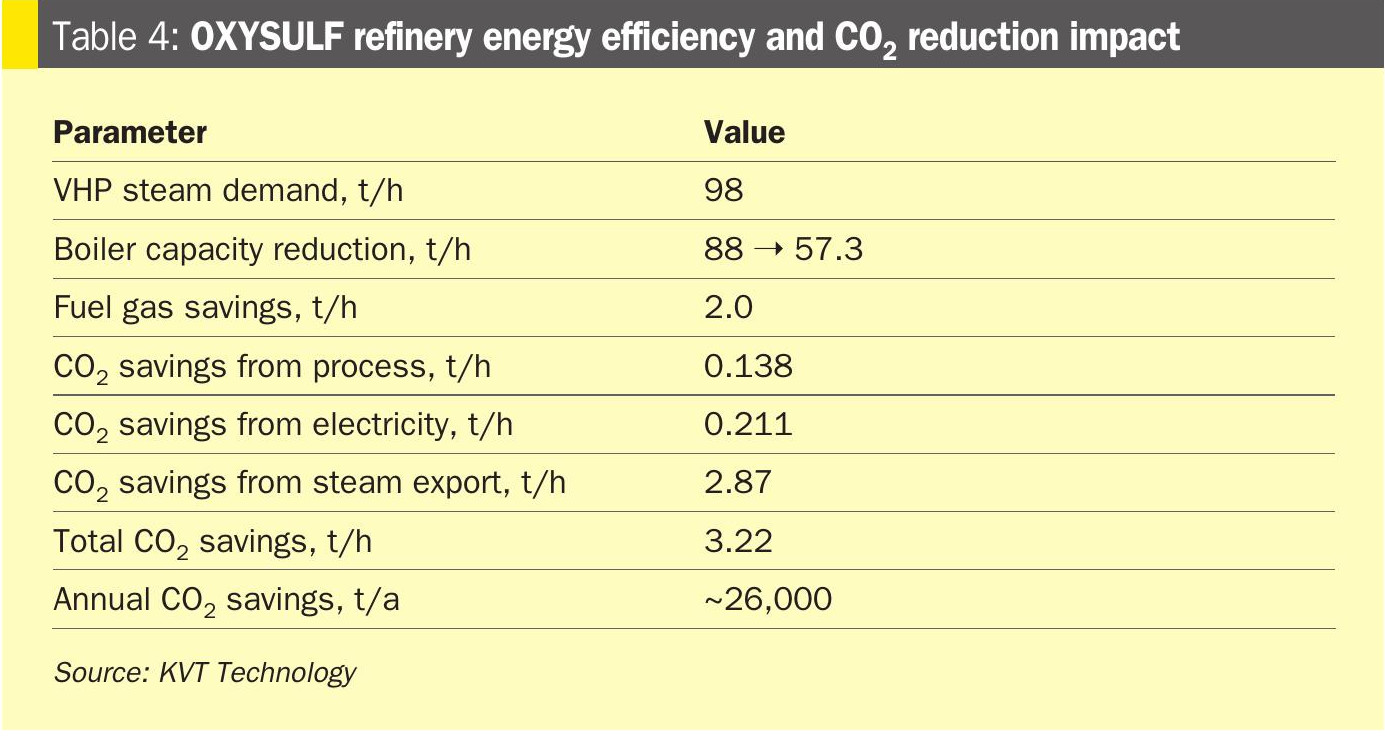
The assessment indicates that the principal benefit of OXYSULF extends beyond sulphur recovery. Higher steam production can displace significant refinery boiler capacity, reducing fuel use and greenhouse-gas emissions. In the evaluated case, the refinery EII improved from approximately 110 to 75–80, while annual CO2 emissions were reduced by approximately 26,000 tonnes (see Table 4).
Conclusion
Tightening environmental regulations, combined with the need to improve energy efficiency and reduce greenhouse-gas emissions, are increasing demand for alternative sulphur recovery technologies.
OXYSULF converts a broad range of sulphur-bearing feeds into commercial-grade sulphuric acid. The process combines sulphur recovery, acid production, emissions control and high-efficiency heat recovery within a single integrated configuration.
Sulphur recovery of up to 99.99%, ultra-low SO2 emissions (below 15 ppm), zero liquid effluents and high-pressure steam generation support both environmental performance and operational efficiency. The technology also offers broad feed and throughput flexibility, enabling treatment of diverse refinery and industrial sulphur-bearing streams.
The refinery case study illustrates the potential benefits of integrating OXYSULF into refinery utility systems. In the evaluated case, improved heat recovery and steam generation reduced the refinery EII from approximately 110 to 75–80 and lowered annual CO2 emissions by around 26,000 tonnes.
Compared with conventional Claus-based systems, OXYSULF provides a simpler and more compact configuration, greater feed flexibility, stronger energy integration and lower environmental impact. These characteristics make it an alternative for refineries and industrial facilities seeking to improve sustainability, reduce operating costs and meet increasingly demanding environmental requirements.