Author: richardhands

Topsoe and Maersk to set new safety standards for Power-to-X

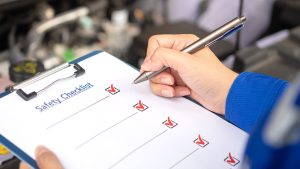
Topsoe is partnering with Maersk Training to establish safety standards that support the emerging Power-to-X industry. Topse says that Power-to-X and the production of e-fuels are critical enablers of the transition to low-emission fuels. However, no comprehensive safety standards currently exist that address the full range of risks at these sites. Together, the two companies will develop realistic simulations, competency-based training and a strong operational culture designed to strengthen safety practices across the entire value chain. As Power-to-X technologies scale to meet global climate ambitions, both companies emphasise the need for robust, realistic and forward-looking training frameworks. The collaboration builds on Maersk Training’s nearly 50 years of experience in high-risk environments.


MHI successfully produces hydrogen at ammonia cracking pilot plant

Mitsubishi Heavy Industries says that it has succeeded in producing 99% pure hydrogen by cracking ammonia using steam as the heating source. The production of hydrogen at pilot scale using the steam heating was conducted at the company’s pilot plant in the Nagasaki District Research & Innovation Centre, marking a world first. By contrast to technologies that use heat from burner combustion, MHI’s steam heating system operates at lower reaction temperatures, reducing operating costs. In addition, because a combustion furnace is not required, the system offers excellent features such as the potential for miniaturisation.

Consortium formed to look at low carbon methanol project

Oman’s Ministry of Transport, Communications and Information Technology has signed a memorandum of understanding with a consortium comprising HIF EMEA GmbH, Acciona Nordex Green Hydrogen and Al Meera Investments to jointly explore the development of a low carbon methanol supply and bunkering hub at Dhofar in Oman. This strategic collaboration aligns with Oman’s Vision 2040 strategy, supporting national decarbonisation targets and positioning Oman as a pre-eminent green maritime and bunkering hub in the Middle East.

World’s largest integrated green hydrogen-ammonia-methanol project

The first 320 MW phase of what China Energy Engineering Corporation Ltd says will ultimately become the world’s largest integrated green hydrogen-ammonia-methanol project HyFlow has officially begun operation in Songyuan City in Jilin Province. With a total investment of nearly $4.30 billion, the Songyuan project uses a “wind-solarhydrogen-ammonia-methanol” integration model, creating an industrial chain that includes hydrogen production and storage, as well as hydrogen-derived chemicals such as ammonia and methanol, hydrogen energy equipment, and scientific research. The project eventually plans to develop 3 GW of renewable energy capacity from wind and solar power, alongside a target production capacity of 800,000 t/a of green ammonia and methanol. The annual production of green hydrogen in the project’s first phase is expected to be equivalent to approximately one-fifth of China’s current total annual green hydrogen production.

Synthetic natural gas project for Nebraska

A consortium consisting of TotalEnergies, Osaka Gas, Toho Gas, and ITOCHU have signed a joint development and operating agreement, granting the Japanese companies a combined 33.3% stake in the Live Oak project – a large-scale facility to produce renewable synthetic natural gas, also referred to as e-NG or e-methane, initiated by TES and TotalEnergies and currently under development in Nebraska. Following the agreement, TES and TotalEnergies will each maintain a 33.35 % stake in the project.

Dynamic green ammonia plant starts operations

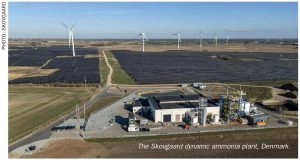
A consortium including Danish companies Skovgaard Energy, Topsoe and Vestas says that it has reached an important milestone with the startup of operations in what they describe as the world’s first-of-its-kind green ammonia plant. The plant, owned by Skovgaard Energy and located in Ramme Denmark, is a demonstrator for a dynamic approach to green ammonia production, which means that the plant will adapt to the inherent fluctuations in power output from the renewable power sources in integration with the plant’s electrolysis and ammonia synthesis loop. This, say the developers, will ensure optimal production and improve the cost-effectiveness of green ammonia, ensuring less need for costly storage solutions of green hydrogen or renewable power. Production capacity is 5,000 t/a of green ammonia, with an associated CO2 reduction of 9,600 t/a. The partnership has received euro 11 million in funding from the Danish Energy Technology Development and Demonstration Program (EUDP).