Melting sulphur
The deficit in the sulphur market has led to a new focus on melting down and selling stockpiles of sulphur around the world. From Kazakhstan to Canada, stocks of sulphur have been shrinking.
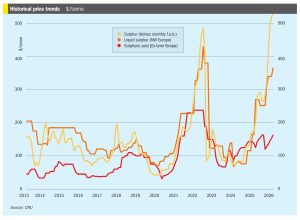
The global sulphur market’s bullish momentum from late 2025 has firmly carried over into the New Year, with prices pushing forward across most key regions despite a slow return to spot trading after the holiday break. With spot prices now past their 2022 highs and testing levels not seen since the 2008 peak, affordability has become the market’s central theme. The market remains divergent, with some buyers forced to accept the rally due to tight supply, while others, particularly in China, are showing clear signs of demand destruction.
BP plc appointed Meg O’Neill as its next chief executive office, effective 1 April 2026. Murray Auchincloss stepped down from his position as CEO and director of the Board, as of Thursday, 18 December. Carol Howle, current executive vice president, supply, trading & shipping of bp, will serve as interim CEO until O’Neill joins as CEO. Auchinloss will serve in an advisory role until December 2026 to ensure a smooth transition.
Around 1 million gallons of sulphuric acid was released from an industrial facility, some of it into the Houston Ship Channel, in late December. A pipeline ruptured when an elevated walkway collapsed at the BWC Terminals facility in Channelview, east of Houston. Two people were transported to a hospital and subsequently released, while 44 others were treated and released at the scene. BWC Terminals said in a statement the majority of the sulphuric acid released was into a designated containment area, with a smaller, unknown amount entering the ship channel.
Korea Zinc says it will partner with the US government to construct a critical minerals smelter in Clarksville, Tennessee, producing zinc, lead, and copper. Korea Zinc will begin site preparation next year, followed by phased commercial operations from 2029. The plant is planned to process around 1.0 million t/a of raw materials and turn out 540,000 st/a of finished products. Processing of gold, silver, and key strategic minerals such as antimony, indium, bismuth, tellurium, cadmium, palladium, gallium and germanium, are also planned in what is being touted as a "state-of-the-art" facility. Sulphuric acid and semiconductor-grade sulphuric acid will also be produced. The output will include 300,000 t/a of zinc production, 200,000 t/a of lead, 35,000 t/a of copper and 5,100 t/a of rare and strategic metals. Development will be through Korea Zinc’s US subsidiary, Crucible Metals.
A complete listing of all articles and news items that appeared in Sulphur magazine during 2025.
Heartland Sulphur says that it has debottlenecked its crushed bulk sulphur remelting operations, increasing capacity by 40%. Heartland says that the increase boosts the company’s sulphur handling efficiency and service capability for producers and buyers. It has also completed a full feasibility study and retained engineering partners to add an additional 1,000 t/d of sulphur remelt capacity, slated to be fully operational by yearend 2026. Heartland Sulphur can form 4,500 t/d for offshore markets, transport molten sulphur by tank car to destinations across North America, and accept and condition sulphur in both molten and solid states. The company’s existing remelt capacity stands at 700 t/d and is projected to reach a total of 1,700 t/d (560,000 t/a) by the end of 2026.
Sulphur prices have risen rapidly in recent months as the market moves into a period of deficit which is likely to last until 2028.
The Chinese ammonium sulphate industry continues to see rapid growth, with exports rising to record levels, against increasing demand coming from Brazil and India.
At the end of December, the Russian government extended its ban on the export of technical sulphur until at least the end of March 2026. The move prolongs the initial restrictions, which were first reported on 4 November and which were set to expire at the end of 2025. The initial ban was widely expected and followed early September drone strikes on the Astrakhan and Orenburg natural-gas plants. The official justification for the extension remains to “stabilise shipments of raw materials to the domestic market” and maintain production volumes for mineral fertilizers, according to the government’s press service Interfax.