Community
1 July 2026
IFA Annual Conference report — it’s Monaco, take two!
Written by Simon Inglethorpe
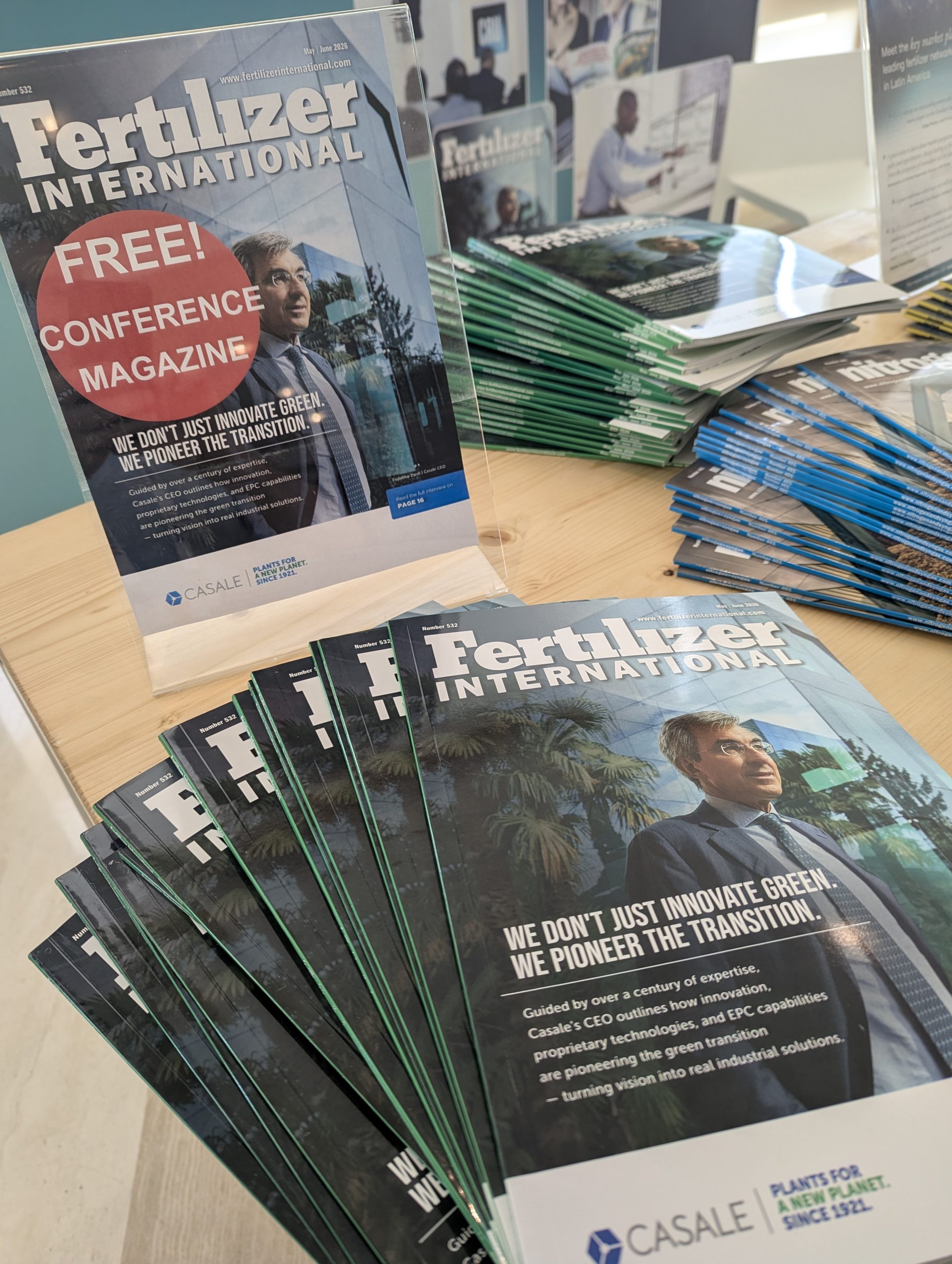
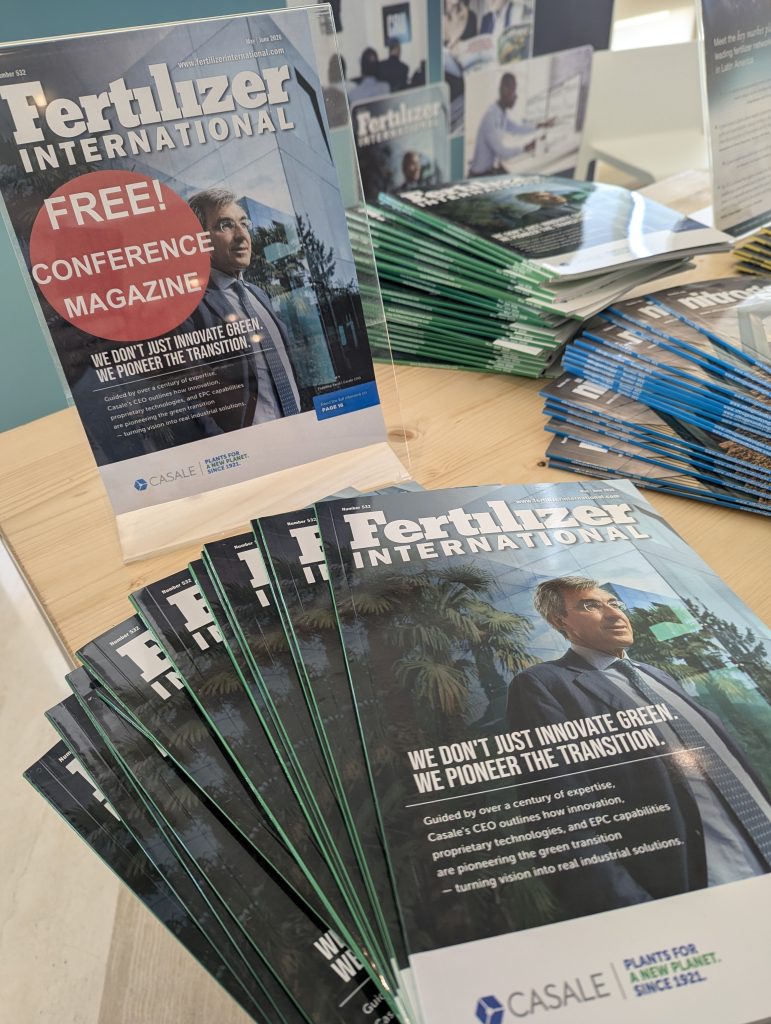
CRU distributed the May/June conference editions of Fertilizer International, Nitrogen+Syngas and Sulphur magazines to delegates in Monaco. PHOTO: CRU
Delegates could be forgiven a sense of déjà vu on arriving at the Fairmont Hotel, Monaco, the venue for the International Fertilizer Association (IFA) Annual Conference for the second year in a row. Even more strangely, with UK temperatures having hit 37°C on 26th June, the CRU team were looking forward to a Cote d’Azur cool down.
IFA’s CEO Alzbeta Klein set the scene for this year’s annual conference in an excusive editorial for CRU’s Fertilizer International magazine. In an opinion piece titled ‘The crisis behind the crisis: why fertilizer belongs at the heart of the food and energy conversation’, Alzbeta argues that energy, food, and fertilizer are three faces of the same system.
“The Strait of Hormuz made that visible to everyone in March — and it sets the agenda for Monaco at the end of June,” she writes.
Alzbeta continues: “When that waterway came under threat in March, the world saw an energy crisis. Yet it was also a food security crisis with a thirty-day delay built in. And linking the two was a fertilizer crisis.
“Five Gulf countries — Iran, Qatar, Saudi Arabia, the UAE, and Bahrain — together accounted for 34 percent of global urea trade in 2024, 23 percent of global ammonia, and 18 percent of ammoniated phosphates. The Strait, in other words, is not just one chokepoint. It is three: oil, gas, and the fertilizers those feedstocks build.
IFA has been in dialogue with both the UN International Maritime Organization (IMO) and the G7 Food Security Taskforce in recent months. Alzbeta is both passionate and eloquent in pressing for recognition and equal status for fertilizers alongside energy.
“The point we made is simple, and we will keep making it: keeping fertilizer moving through contested waters is not optional if food systems are to function. We have urged the IMO, flag-state authorities, and the marine insurance regime to recognise fertilizer cargo as essential trade alongside energy cargo, so that risk premia and routing decisions reflect that designation. And we have asked governments to resist the reflex to ban exports — a reflex that, every time it has been tried, has deepened the crisis it was meant to contain,” she argues.
This is theme IFA returned to in Monday’s opening session in Monaco.
Securing the fertilizer lifeline
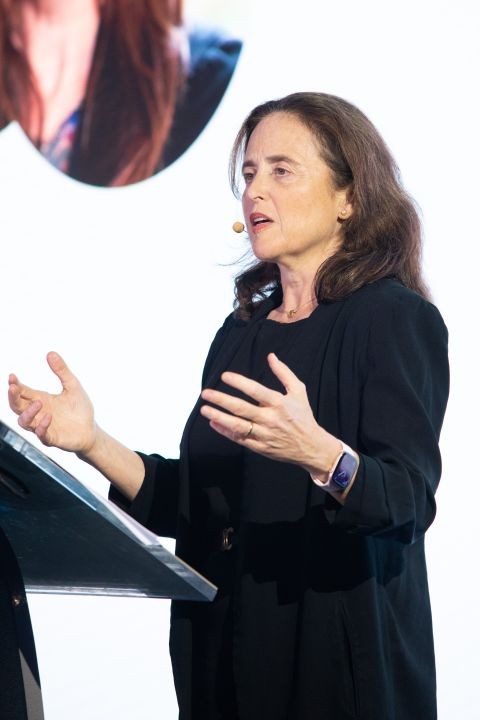
IFA’s CEO Alzbeta Klein opens the event. PHOTO: IFA
Fertilizers are not merely an agricultural input, according to Alzbeta Klein, IFA’s CEO. Opening the conference, she said: “They are a strategic resource, a key part of the food system that supports billions of people. They’re truly a lifeline — hence the title of the conference.”
When that lifeline is threatened, the consequences are not abstract. “They show up in food prices, in import budgets, in decisions that farmers take when they plant,” Alzbeta said.
Early intervention on supply disruptions is necessary, in her view.
“When this problem shows up in a food bank, it is way too late. The industry keeps the product moving: through disruptions, through uncertainty, through market conditions that no one planned for. That is not a small thing — it deserves to be recognised,” Alzbeta said.
She went on to set the theme for the week.
“What we are here to discuss this week is how we keep doing what we do, but better and more sustainably, and in a world that is not going to be less complicated. I am very much looking forward to all the conversations ahead,” Alzbeta summed up.
The risks of a one-two punch
In the conference’s opening session, Clayton Allen of Eurasia Group reviewed the panoply of risks to the world economy.
“At Eurasia Group, we specialise in geopolitical risk analysis. That’s the question we strive to answer every day. We look at this from a number of different perspectives. I focus on the United States — it’s the area I specialise in—however, we take a global perspective,” Clayton said.
“Unlike a decade ago, the United States is viewed not as a force for global stability, or the safest market, but increasingly as the largest driver of global volatility,” he suggested.
“Each year, Eurasia Group puts out our Top Risks Report at the beginning of January — essentially the 10 things we think are going to define the year to come. Each year, we rank these in order of the biggest risk to the least substantial within that top 10. For the last several years, the United States has been number one or two,” Clayton said
This year, Eurasia Group warned of ‘political revolution’ within the US — although not in sense of government overthrow.
“I mean it in terms of changing drastically, fundamentally, the way that the United States functions, both internally and in the world at large. Our view is that President Trump is trying to change every facet of US governance, every facet of the US’s role on the global stage. More importantly, though, we think that ultimately that [attempt] is unsuccessful,” Clayton said.
Looking ahead on tariffs, he said that fertilizer industry should expect the US administration to try and solidify many of the presidential trade deals struck in 2025.
“You’re going to see a focus on the creation of a tariff regime that’s durable and defensible in law. Everyone’s used to waking up and seeing that tariff rates against some country have changed massively overnight — 10% tariffs become 100% tariffs, 100% tariffs become zero — that’s not going to happen anymore,” Clayton said.
“[Instead,] the US is switching towards a different legal structure for its tariffs that the administration can defend more easily in court. What you should take away from this is that [while] tariff volatility as a major cost or headwind for business decision-making is actually going to fade a little bit, the tariffs themselves become more durable.,” he added.
Looking ahead at global risks into next year, Clayton highlighted the following:
“The war in Iran is likely to be a backdrop of lingering risks for everything else that we see. There will always be a risk that that war reignites. Shaky deal or not, we think that the GCC [Gulf Cooperation Countries], the Middle East, is going to be a more volatile place to do business moving forward,” he said.
The greatest risks confronting the global economy right now might not even be conflict-related, in his view.
“The slowing of the jet stream across the Atlantic, the looming El Niño formation in the Pacific. These are things which will exacerbate water stress, climate stress, and food cost and price stress in the US, Europe and other economies,” Clayton said.
He went on to warn that these uncontrollable natural risks could act to amplify the more controllable geopolitical risks in a ‘double whammy’.
“Those natural trends come after several years of trade volatility, conflict volatility, price increases related to the closure of Strait of Hormuz, disruption of the Red Sea, restriction of exports from Ukraine. This one-two punch is something that I think a lot of policymakers have not internalised, [but] it is it’s something that you in the audience know better than most — you see this coming years in advance,” Clayton said.
The US administration and Congress discounts these geopolitical risks — erroneously in his view — seeing them as largely being ‘in the rear view’.
“What they don’t think about is that disruptions to ag chemicals through the Strait of Hormuz have now exceeded 90 days. They will impact crop planning, not just for this year, but for next year, possibly the year beyond,” said Clayton.
“They think about the fact that, yes, food prices, grain exports have become more expensive. What they don’t think about is that crop yields are potentially going to be reduced because of restricted access to input chemicals, increased input costs, but also by weather trends and patterns that they cannot control,” he added.
Underlying risks will also remain, even as supposed stability resumes.
“This is a story that likely gets worse, even as you see the direct points of volatility we can control become more stable. Trade will be more stable, the Iran conflict may be over, you’re going to see the Russia-Ukraine conflict potentially trend towards a less destructive path. That doesn’t mean that risk goes away,” said Clayton.
While warning that fertilizers were entering a period where they will be especially exposed, he said the industry also hade a vital role to play in the way that governments respond.
“If you want to reach out to policymakers, make your case in the US and elsewhere, now is the time to do so,” Clayton said, as US policymakers are generally receptive to dialogue with the industry, in his view.
“Most people we speak to in Congress, they don’t understand these issues. But they would be very open to hearing from you exactly what risks to expect, exactly what risks are going to be coming for them,” Clayton concluded.
From just-in-time to just-in-case
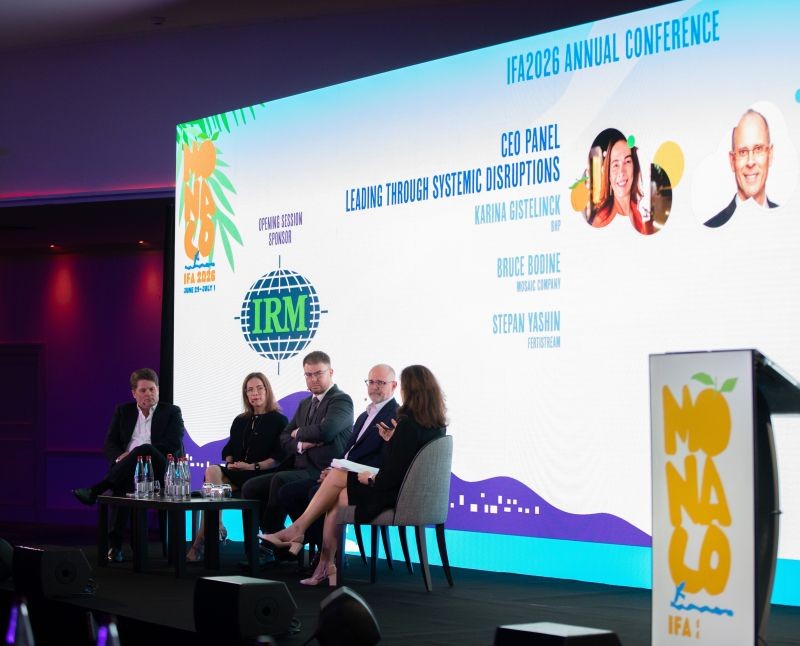
Conference panel discussion. PHOTO: IFA
A follow up debate chaired by Alzbeta Klein featured the following industry panellists alongside Clayton Allen:
- Karina Gistelinck, BHP
- Bruce Bodine, The Mosaic Company
- Stepan Yashin, CEO, FertiStream.
“Today’s panel brings together leaders from companies who span a full breadth of the fertilizer value chain, from resource extraction to production to distribution and services. Each has had to make consequential decisions over the past few months,” Alzbeta said.
She started by asking the panel about what has changed, and what has been required of them as leaders, over the past 12 weeks?
“I think what has really changed — I wouldn’t say in the last 12 weeks, but probably in the last 12 months — is that volatility is something that the fertilizer industry was used to as an acute disease. From time to time, you would get a flare-up of volatility. I think now it has become a chronic disease or a chronic opportunity. It’s structural and it’s in everything we do,” said Karina Gistelinck.
“BHP typically focuses on building the most efficient value chain, which we still want to do. On top of that we want to make it very resilient and flexible. So it’s all about building that resilience into the value chain — and the spoiler alert is you can’t do that alone. You need to work throughout the value chain with partners, with customers, with people in logistics, as well as building optionality or flexibility in the value chain,” she added.
Volatility and extreme disruption have become the new normal, according to Bruce Bodine.
“I don’t know that it’s chronic and permanent [as] it seems unsustainable. Something has to give, as there will be real consequences if fertilizer underapplication due to this extreme disruption continues to happen. So advocacy, education is something we continue to do,” he said.
Within the value chain, partnerships on market access and supply agreements are going to be key, Bodine suggested, both for building resilience and providing agility.
Some events remain hard to predict, though.
“We have experienced, in my 32-year career in this industry, extremes that we never imagined. In boardrooms and management teams, I know you do these ERM, Enterprise Risk Management, exercises. If you did, I’d love to see who would have predicted what has happened over the last three to four months as a real outcome that you were preparing for. We were not — and I don’t know many who were,” Bodine said.
“At IFA, how we see this is: we have built a world for ultimate efficiency. All of you have built companies for just-in-time efficiency and the world has changed. It’s became a world of just-in-case. I believe that just-in-case is a lot more expensive than just-in-time — I wonder who’s going to pay for it?,” said Alzbeta Klein
Having strategic conviction was what mattered for Karina Gistelinck. That’s because BHP’s 10-20 year investment cycle will always transcend the 2-4 year political cycle.
“Strategic conviction matters more. Yes, you need to build for the just-in-case, but you need to build for the just-in-case that is aligned with your strategy. For BHP, we actually doubled down on our conviction that potash is one of the most critical pillars for food security,” she said.
“[It’s about] strategic conviction, discipline and execution. Once you’ve made a strategic choice, stay the course and be very disciplined and frugal on your execution, but make sure you do it right. Last but not least, build optionality in your value chain through partnerships — because you don’t know what the just-in-case will be,” summed up Karina.
Stepan Yashin describes the last three months as having been ‘a complete mess’ from a trading point of view.
“In the past, we had efficient markets and it was relatively straightforward [as trade] flows were more or less stable. Now the market is fragmented with one-fifth of the flow going the opposite direction from what it used to be in the prior year,” he said.
Consequently, costs are going up for companies that transport crop nutrients.
“What I can definitely tell you is the cost of execution is going to be higher because of freight. It’s not just how many vessels flow out, but how many vessels enter the Strait of Hormuz. The cost structure is going up. We know that because this is the just-in-case scenario,” Yashin said.
“You’re sitting in the Strait of Hormuz and you, or the shipping companies that own the vessels, are paying charges. What are our friends in the Gulf are doing, transferring nutrients via different routes, that costs money. Those trucks going to [the Red Sea port of] Yanbu cost money. So we do know that the industry’s cost structure is fundamentally changing,” he concluded.
Coping with structural and inherent disruption
This session featured presentations from:
- Nicolas Michelon, Algan Partners
- Jean-Patrick Caumont, Eyssautier-Verlingue
- Anne-Sophie Corbeau, Center on Global Energy Policy, Columbia University
- Pierre-Marie Aubert, Institute for Sustainable Development and International Relations (IDDRI).
Nicolas Michelon described the war between the US and Iran as an asymmetric ‘David vs Goliath’ struggle. Using trade, finance and information as weapons, Iran has the ability to wage war and significantly weaken the United States, in his view,
“Militarily speaking, Iran has lost, cannot win. Yet from day one of this new conflict, on February 28th, they have already won, because they can keep fighting the way they fight now for much longer — which the United States and Israel cannot do. You have ‘grey zone’ tactics — actions in the space between diplomacy and actual military conflict — this is what we are entering into now,” Michelon said.
Insurance nowadays is becoming a financial tool, according to Jean-Patrick Caumont.
“Honestly speaking, as an insurance broker today, we are more a strategic partner, we are more a risk architect — together with you, rather than only being an intermediary as we were before. The nature of risk has changed and, actually, that’s really the point,” he said
Up to five years ago, cargoes, vessels and warehousing were mainly at risk from the weather. That has now completely changed, Caumont suggested.
“We’ve got sanctions, cyber attack, political violence, port congestion [risks] — and eventually detention due to sanctions or export bans. So insurance is no longer only protecting cargo, it protects your commercial continuity,” he said.
Anne-Sophie Corbeau compared the on/off closure of the Strait of Hormuz to Schrodinger’s cat.
“We don’t really know whether it is open. It’s a little bit like Schrodinger’s cat — which is anywhere between alive and dead. Well, the Strait of Hormuz is anywhere between open and closed,” she said.
Anne-Sophie expects a massive ‘third wave’ of liquid natural gas (LNG) capacity to arrive between 2025-2030.
“The third LNG wave is more than 400 billion cubic meters. Just to give you a comparison, global LNG trade in 2026 was about 600 billion cubic meters. So this is absolutely gigantic and is going to come to the market at some point,” she said
“The only question is really about what extent that Qatari capacity is going to be completed and whether the Strait of Hormuz is open or not. That, of course, is something very difficult to predict — but we are moving towards a massive amount of LNG on the market,” Anne Sophie added.
Consequently, she expects the US to become an even more dominant LNG exporter.
“You probably don’t really appreciate how dominant US LNG has become. It is already, by far, the largest LNG exporter [with] a quarter of global LNG exports. But if you look at everything which is under construction, that [share] is going to be more than 30%,” Anne-Sophie said.
Pierre-Marie Aubert urged EU policymakers to do better with crop nutrient interventions targeting three specific areas — which he described as “three pillars”.
“In a nutshell, we have three pillars: securing access [to fertilizers], enhancing [nutrient use] efficiency and investing in circularity [of food systems]. We need to create synergies between those three areas of intervention,” he said.
On access, Pierre-Marie said demand mandates could create a market for (and secure investment in) decarbonised fertilizers. Levelling the playing field by reviving the 2010 ‘halve nitrogen losses’ target could also spur EU member states to invest in circularity, in his view. Lastly, linking these circularity and efficiency ‘pillars’ with food sufficiency policies could also play a crucial role in reducing the overconsumption of animal protein in OECD countries, he suggested.
Market outlook ‘wrap up’
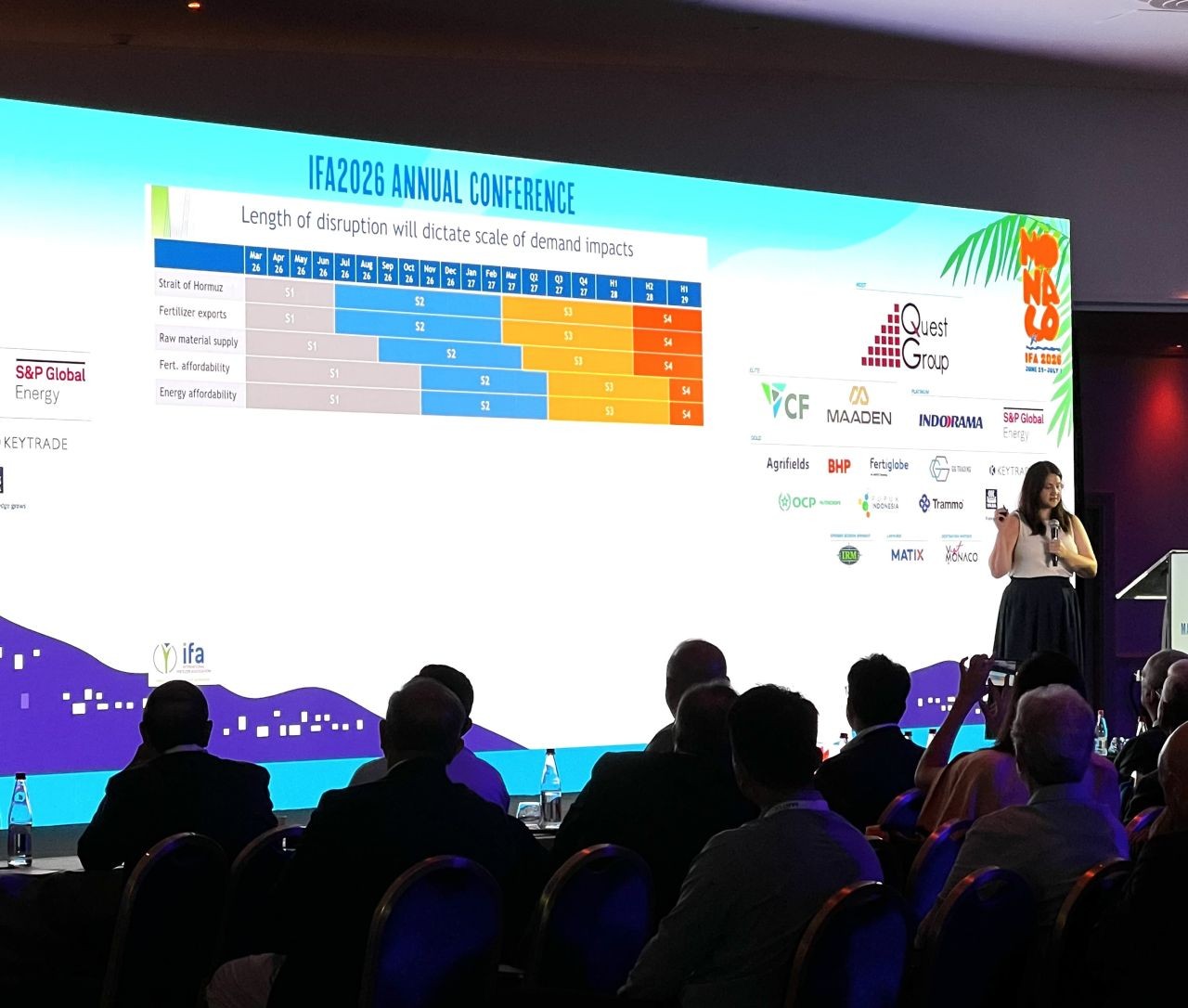
IFA’s Laura Cross presented a brief but highly informative market outlook. PHOTO: IFA
Laura Cross of IFA Market Intelligence gave a 20-minute whistle-stop tour of the Association’s latest five-year supply and demand outlook, as well as current market conditions. She focused mainly on the demand picture.
“Nitrogen consumption remains one of the absolute fundamentals for farmers. As we get towards the end of the next five years, we expect population growth and [agricultural] productivity gains to return to being some of the most important drivers — and that’s the same for phosphorus and potassium as well. When you look at the requirements in the coming five years and beyond, we do need to see continued growth in the application of those nutrients as well,” Laura said.
“In the short term, the disruption in the Strait of Hormuz is clearly not fully resolved, and we’ve seen that have multiple impacts, both for producers and for consumers. First of all, we continue to see raw material and freight cost disruptions. Sulphur vessels [for example] are really starting to pass through the Strait now. But sulphur prices are still at record highs — so even if availability has returned, the cost pressure is still there,” she added.
When it came to the current US-Iran peace accord, given that more than two million tonnes of fertilizers and fertilizer raw materials were stranded inside the Strait of Hormuz at one point, Laura advised delegates to mark the 16th August as a date to watch in their calendars.
“To move towards a deal that could [see] a managed resumption of flows, I think it’s important for us to remember that the two countries have 60 days to make that arrangement. So we need to look ahead to the middle of August — because that’s where we’re likely to see either a resumption in flows [through the Strait of Hormuz] at a much more normal rate or potentially going back to some of the disruption we saw before,” she said.