Fertilizer International 532 May-Jun 2026
CRU Phosphates+ Potash 2026


CONFERENCE REPORT

CRU Phosphates+ Potash 2026

400 delegates from 165 companies and 35 countries gathered at the Marriott Rive Gauche, Paris, France, 13-15 April, for CRU’s Phosphates+Potash Expoconference 2026. We report on selected keynote and commercial presentations.


A unique global gathering

Simon Inglethorpe, the Editor of Fertilizer International magazine, welcomed delegates to Paris:

“On behalf of CRU and our sponsors, I’d like to warmly welcome you all to Paris and the 2026 Phosphates+Potash Expoconference.

“As the only global gathering of the phosphates industry, this conference has always been unique. In Orlando last year, we also saw the event championing the potash industry for the very first time. Paris will build on that success with an event that lives up to its name, Phosphates and Potash, by bringing together these two sister segments.

“At their core, CRU events are about market intelligence and making connections – that’s because we believe our industry is much stronger when we work together and share knowledge, insights and expertise. Uniquely, Phosphates+Potash combines a commercial agenda with a technical agenda in one single event. This enables the conference to cover the entirety of these two industries from both an operational and a market perspective.

“I don’t need to tell anyone that we have a very tumultuous market backdrop right now – characterised by conflict, geopolitical upheaval, volatile fertilizer prices and supply stoppages. The good news is that our commercial programme has this fast-moving global market comprehensively covered and will keep you well informed with the very latest insights.

“Our technical programme, meanwhile, offers a deep dive into current innovations – with the focus very much on new technologies that can improve margins, elevate efficiency, ensure environmental compliance, and increase output.”

Fertilizers facing the biggest disruption

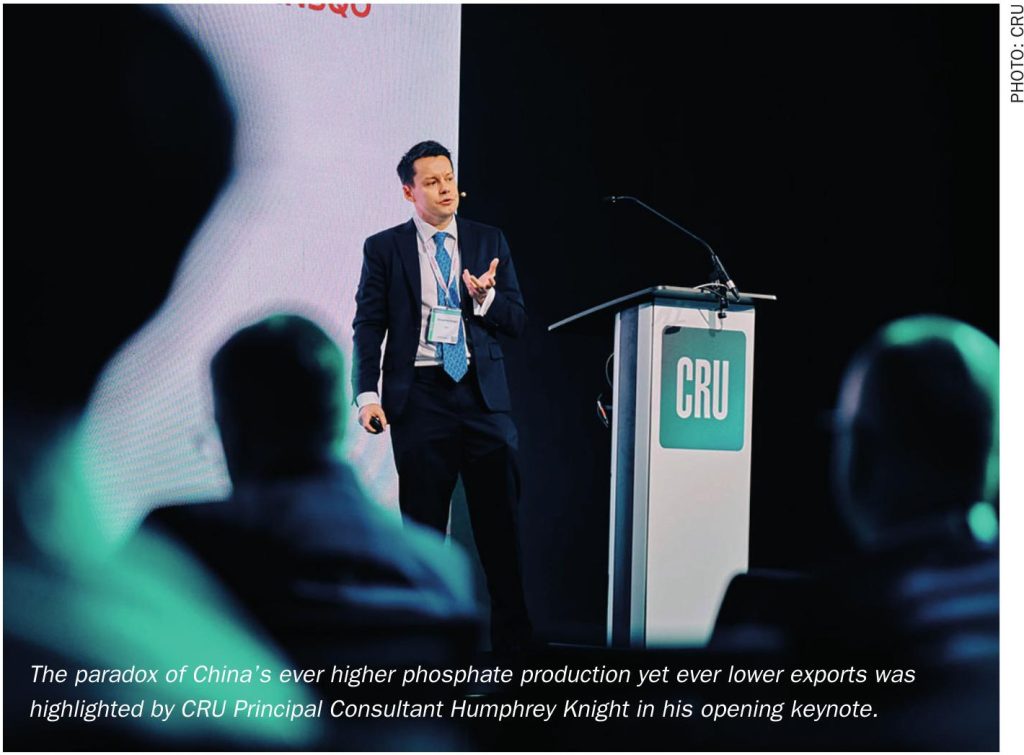
In the opening keynote, CRU Principal Consultant Humphrey Knight highlighted the fallout from the current Middle East conflict.

“Arguably among all bulk commodity sectors, fertilizers have seen the biggest direct disruption from the closure of the Strait of Hormuz, most notably sulphur and urea. Around half of all global sulphur exports originate or pass through Gulf nation states; for urea, it’s around one third. Phosphate fertilizers have faced direct disruption, as has ammonia, with about a fifth of exports currently stranded by what is occurring in the region today,” he said.

Knight did make one caveat, though.

“This is just focusing on the traded portions of those markets” he said. “For example, with the urea market, about one third of global urea produced is traded and about one third of that is currently facing direct impact – so, at a global level, the impact is not as severe as it might seem.”

Nonetheless, traded fertilizers are key when it comes to pricing, as Knight explained:

“Why this matters so much, when it affects the traded portion, is because that is where prices are set globally. And we have seen a complete uptick in fertilizer prices over the last couple of months. There have been some very significant price moves, particularly on the nitrogen side, while on phosphates and potash it is a little more muted.”

Affordability was emerging as a particular market concern currently, relative to the previous Russia-Ukraine crisis of 2022.

“One difference that arguably makes this as severe as 2022 relates to crop prices. What’s occurred over the past six weeks has barely made any movements in the crop price market at all. Consequently, even with these more muted upticks in fertilizer prices, what we’ve seen is that fertilizer affordability, on average, is about as bad as it was at the worst moments in 2022,” Knight said.


Phosphate prices are on an upward trajectory, at least in the short term, according to Knight.

“We’re expecting to see prices continue to rise over the next 5-6 months or so. While the Middle East is going to have a big effect on the magnitude, it doesn’t fundamentally change the direction. Chinese export restrictions have been the big controlling factor on prices over the past few years – we think that’s going to continue,” he said.

This year, China is not expected to release any DAP and MAP exports until August. CRU is also expecting 2026 export volumes to fall to below three million tonnes for the first time since the late 2000s, adding to market tightness. The paradox in China is, while its exports have become increasingly restricted, the country’s DAP and MAP production is at record levels.

“The last couple of years, we’ve seen more than 30 million tonnes of DAP and MAP being produced within the country [annually]. Now, it’s hard to gauge how this is being consumed – we do think there’s been a lot of stockpiling going on,” said Knight.

Furthermore, these volumes are probably being produced at a loss, suggested Knight.

“Sulphur prices in China today – which China can’t really control because it’s a net importer – are now significantly above the capped price of DAP, an extraordinarily rare situation. This means that Chinese phosphate margins, generally the lowest in the world anyway, have now turned firmly negative – so most producers, not all of them, are now loss-making,” he said.

Returning to phosphate fertilizer pricing levels, these are exceptionally high at present and at levels rarely seen in the 21st century to date.

“Even before the Middle East conflict had broken out, prices were already rising. Today, if you’re looking to get hold of some DAP or MAP, you’re going to be given an offer of something in the low $800s to $900 per tonne,” said Knight, before warning of further rises to come. “It’s worth noting that we are expecting a number of DAP and MAP prices to breach $1,000 a tonne over the course of the next few months – so do keep an eye on that.”

Fertilizers, grains and shipping – one shock after another

The opening day’s industry keynote panel was chaired by Willis Thomas, CRU’s Head of Fertilizers. On stage with him were Ilya Motorygin, Managing Partner at GG Trading DMCC. Monika Tothova, Senior Economist at the FAO, and Jari Kiuru, SVP Raw Materials at Finnish Minerals Group.

Ilya Motorygin set out the trader’s view of the Strait of Hormuz supply shock. On fertilizer affordability – echoing Humphrey Knight’s comments – he argued that the current episode feels worse than the 2022 Russia–Ukraine crisis. Then, crop prices rose broadly in line with fertilizers, he said, giving growers more revenue to absorb higher costs. Now, with fertilizer prices moving faster than most crop benchmarks, the affordability squeeze is more severe, he suggested.

Motorygin also highlighted a sharp rise in freight rates.

“We trade from the Baltic to Brazil. This time a year ago, we were able to find handysize vessels at [freight rates] of $25-30 a tonne. Today, we’re talking about $50 to $55 – so it’s doubled, literally doubled,” he said.

For Brazilian buyers, therefore, rocketing freight rates add a large delivered cost before the DAP price is even considered. With Saudi tonnes constrained, the overall effect of the Strait of Hormuz closure is tighter and more expensive supply, advised Motorygin. Ilya offers an in-depth traders view of current market conditions in an accompanying interview with Fertilizer International. .

The impact of the Middle East conflict on wheat prices has been muted so far, according to Monica Tothova, while maize and vegetable oils have shown some price response.

“For wheat, looking at futures prices for the current marketing year 2025/26, you have not seen much movement yet in reaction to anticipated shortage. You have seen movement for maize, [and] obviously for vegetable oils, because of the biofuels linkages,” Tothova said.

The lack of price movement for wheat was largely because this year’s global crop was already planted with spring fertilizer supplies also secured, Tothova suggested.

“Most of the wheat in the world is actually planted as a winter wheat – so that is already in the ground. The main [wheat] producers, most of them, have [also] already bought the fertilizers for the spring applications. The importer might be holding onto it because they might get a better price. But, physically, the supplies for spring applications should be in-country already,” she said.

Tothova added: “The world hasn’t fully grasped the implications of the disruption in the Strait of Hormuz yet.” She expects more visible impacts to emerge as the Northern Hemisphere spring progresses and farmers adjust their planting decisions.

In the US, for example, the growing area may shift from maize to soybeans to reduce fertilizer requirements.

“What are farmers going to plant: are they going to go more into the soybeans, are they going to go into maize? The indications are that a chunk of them are going to adjust the mix to the extent they can,” she commented.

Tothova also flagged up grain transport and shipping as a major concern. “Already, even without fertilizers applications, the concern we are following right now is the increase in shipping costs – and the fact that you might not have even enough fuel to get the grain from point A to point B,” she said.

Tothova also highlighted major differences in the ability of farmers to cope with fertilizer supply shocks. Large commercial farms and cooperatives in the US, EU and Brazil, for example, can forward buy, carry stocks and use hedging tools. Smallholders in lower income regions, in contrast, typically buy fertilizer only when cash or subsidy allows. They cannot build strategic stocks or manage price risk, even though they need fertilizers as a key lever to raise their yields and incomes.

Tothova warned that a shift to self sufficiency in food commodities would be a costly and environmentally damaging move that could “get pretty dangerous, pretty fast”. Past attempts to achieve cereal self sufficiency in water scarce regions, for example, have led to serious aquifer depletion.

For both food and fertilizers, she argued, predictable and reliable international trade remains essential.

“The best thing is to maintain open trade. The same applies for agricultural commodities and, as Ilya mentioned, for fertilizers. Without a predictable trading environment, which we have not enjoyed in the last few years, with one natural or man-made shock after another, we cannot achieve a state of equilibrium,” said Tothova.

In Europe, Jari Kiuru suggested that classifying phosphorus as a critical but not a strategic mineral was creating problems for phosphate project development and resource security within the EU.

“Phosphate is not strategic, it’s only critical, and that’s why we cannot access instruments which would help with project financing, green financing, permitting and so on. At the moment, this systemic error makes it especially difficult to develop phosphate projects in Europe – it’s also the reason why we are developing multi-product mines,” he said.

Combining phosphate mining with the extraction of rare earths – which are classed as strategic minerals – within a single project was therefore advantageous, Kiuru suggested: “One of the reasons we include rare earths in production is that that allows us to apply strategic status.”

He concluded by suggesting that – in response to the Middle East conflict – the EU needed major policy support for domestic fertilizer production that matched the ambitious RePowerEU support package put in place after 2022 to limit EU dependence on Russian oil and gas.

“Let’s hope that they come up with a ‘ReFertilizeEU’ [package] to help,” Kiuru said. “It’s not the sole solution, but it would give more instruments to take the [company’s Sokli phosphate] project forward.”


CONFERENCE HIGHLIGHT: EUROPE’S ELEMENTAL PHOSPHORUS GAP

Elemental phosphorus – also known as white phosphorus and P4 – underpins a wide range of applications and has become one of the more exposed materials in the global chemical industry.

Robert Van Spingelen, President of the European Sustainable Phosphorus Platform (ESPP), and Willem Schipper of Willem Schipper Consulting used their joint session in Paris to focus on P4 – and set out the case for why it should receive greater attention from industry, investors and policymakers. While P4 accounts for only 2% of total global phosphorus use by volume, the industries it serves span several strategically important sectors.

Elemental phosphorus is produced by heating phosphate rock with coke and silica in an electric arc furnace at extremely high temperatures and condensing the phosphorus vapour driven off into liquid P4. This is a reactive, hazardous and energy-intensive process.

P4 is a chemical building block that, critically, has no real substitutes across a range of applications. Its derivatives include: glyphosate; flame retardants used in electronics and aerospace components; pharmaceutical compounds; and thermal phosphoric acid used in food-grade applications.

P4 also underpins the production of lithium hexafluorophosphate (LiPF6) — the electrolyte salt used in lithium-ion batteries. This makes the P4 supply chain directly relevant to the energy transition.

The EU has had no domestic P4 production since 2012, when the last European producer, Thermphos in the Netherlands, closed. The bloc is now entirely reliant on P4 imports, principally from Vietnam and Kazakhstan, with P4 derivatives also flowing from China.

Schipper’s market analysis revealed major challenges to P4 supply currently. The price of P4 from Vietnam – Europe’s primary source – has increased by 50% this year due to supply disruptions. Europe’s supply route for P4 from Kazakhstan, running through Ukraine, Russia and Belarus, is also severely disrupted by conflict.

The P4 price has been highly volatile this decade, having been stable at around $2,700–$3,200/t until 2020, before rising to $3,700–$4,000/t in 2022, with Vietnamese P4 exceeding $6,000/t at that point. While prices have fallen back since 2023, current Vietnamese supply disruptions could push prices back up to $5,000/t, suggested Schipper.

In terms of new P4 supply, a 48,000 t/a capacity plant in Malaysia is currently being commissioned, after a two-year delay, with on-specification product expected in the third quarter of the year. New plants are also under consideration in the MENA region, although high power costs remain a significant hurdle.

P4 was classified as a critical raw material under the 2024 EU Critical Raw Materials Act. ESPP is now calling for its elevation to ‘strategic’ status – a designation that would unlock EU support mechanisms and accelerate domestic production initiatives. Van Spingelen drew a parallel between Europe’s P4 dependency and the critical mineral exposure faced by Japan, India and South Korea – countries he cited as comparable reference cases.

The ESPP is promoting emerging technologies that could reduce European P4 import dependency by establishing in-region production from secondary sources. The most advanced is Spodofos, a technology developed by ThermusP with investment from SNB, LANXESS, Aquafin, GMB BioEnergie and STOWA. This process produces P4 from the incineration of sewage sludge ash, using scrap aluminium in an exothermic process that reduces energy costs. A pilot plant is operating in the Netherlands.

The EU R&D-funded Flashphos pilot project, located at ARP in Leoben, Austria, recovers P4 from secondary phosphate streams. ESPP is also tracking other emerging routes – including the RECOPHOS and FerroPhos P4 processes.

What does all this mean for the wider industry? Schipper’s assessment was that supply chain risks for downstream P4 customers remain elevated, new capacity is slow and expensive to build, and planned capacity in the MENA region faces persistent cost challenges. ■

Technical programme and other highlights

Presentations from the event’s technical programme were highlighted in a series of articles in our March/April magazine:

Meeting sustainable growth in fertilizer demand with CASALE technology. Gabriele Marcon, CASALE (Fertilizer International 531, p48)

The strategic transformation of phosphogypsum from a waste to a resource. Tibaut Theys, Prayon (Fertilizer International 531, p52)

Merchant-grade acid (MGA) preparation and logistics. Jan Tytgat, De Smet Agro (Fertilizer International 531, p56)

Innovative reagents for processing phosphate ores worldwide. Benoit Grymonprez and Guoxin Wang, Arkema (Fertilizer International 531, p58)

Unlocking phosphate beneficiation potential: a ‘Mine-to-Mill’ transformation. Keenan Collins, Jayden Ladebruk and Edward DeRose, Hatch (Fertilizer International 531, p62)

Next generation evaporation units in phosphoric acid plants. Aziz Chbeir, Yara, and Azza Kioua, GEA (Fertilizer International 531, p68).

Our March/April issue also featured eight abstracts of technical presentations (Fertilizer International 531, p41) and an interview with regular conference exhibitor Bradley Pulverizer/Lancaster Products (Fertilizer International 531, p70). An article based on the presentation ‘Promoting increased potassium use efficiency (KUE)’ by Karl Wyant, Nutrien’s Director of Agronomy, is also featured in the current May/June issue. 


PARIS DIARY

Simon Inglethorpe, Editor, Fertilizer International, shares some takeaways and personal highlights from the three-day event.

Unsurprisingly, the Middle East conflict and consequent commodity supply interruptions via the Strait of Hormuz were the subject of – or the subtext to – many conference conversations. The decision this year to boost the event’s market outlook content with insightful contributions from CRU’s Humphrey Knight, Willis Thomas, Maria Gamboa, Sam Adham, Viviana Alverado, Mariana Fortuna and Alexander Chreky was a good one: it satisfied a genuine hunger from delegates for first class analysis and market intelligence that CRU is uniquely well placed to provide.

The new supply constrained reality of the last six weeks has also created new priorities. Foremost, I would say, are the need for greater resource and energy efficiency, waste reduction and reuse, plus in-country /in-region supply security.

Again, the conference had this covered with presentations from: Nutrien’s Karl Wyant on getting more of your potassium into the crop; Tibaut Theys of Prayon on phosphogypsum reuse; Hunter Swisher and Kyle Isaacson of Phospholutions on both phosphate production efficiency and nutrient use efficiency; Philipp Theuring of EasyMining on their imminent EU breakthrough moment for commercial-scale nutrient recovery. Filippo Davolio of Casale also had a laser focus on fertilizer production efficiency as a way of driving sustainable agricultural growth in his presentation.

These are just a few examples. I’m sure you can name more. As I said in the welcoming address, the whole focus of the technical agenda for CRU Phosphates+Potash is very much on new technologies that can improve margins, elevate efficiency and increase output.

I’ve been attending CRU Phosphates+Potash for more than a decade now. The event has always showcased landmark innovations and Paris was no exception. I’m therefore especially pleased that companies such as GEA, Ballestra and K-UTEC used the event to launch or highlight their latest technologies and share these breakthroughs with delegates. Thank you Azza Aziz, Stefano Vignado, Markus Pfander and all our other industry innovators.

The overall upshot? The fertilizer industry is faced with the challenge of delivering a lot more from a lot less in coming weeks and months. Our partners and customers in food and agriculture are looking to us for urgent answers and workable fixes. I’d like to think the fresh conversation, new insights and knowledge shared in Paris this week will help with problem solving and start to shape how we deliver on this urgent task.

Finally, a massive thank you to our dedicated and hardworking CRU Communities team (pictured) for making Paris 2026 a successful event. We look forward to seeing you all in Rome in March 2027! ■


Acknowledgement and market information

Additional reporting by Natalie Noor-Drugan, Senior Editor, CRU Communities. Please note that market information and commentaries reported here date from the time of the event in mid-April 2026. These should therefore be interpreted with caution.

Latest in Community

People

Three leading regional fertilizer producers have come together to create the Southeast Asia Fertilizer Association (SEAFA). The new association formally announced its formation at an industry conference in Bali on 1 April 2026. The founding members are Pupuk Indonesia (Persero) of Indonesia, Petronas Chemicals Group Berhad of Malaysia, and Brunei Fertilizer Industries (BFI) of Brunei Darussalam. Under the founding agreement, Brunei Darussalam will host the association’s secretariat. Pupuk Indonesia has been appointed to provide SEAFA’s first chairman, President Director of Pupuk Indonesia Rahmad Pribadi, with Petronas Chemicals Group providing a co-chair. The chairmanship will rotate annually between the association’s members.

People

Three leading regional fertilizer producers have come together to create the Southeast Asia Fertilizer Association (SEAFA). The new association formally announced its formation at an industry conference in Bali on 1 April 2026. The founding members are Pupuk Indonesia (Persero) of Indonesia, Petronas Chemicals Group Berhad of Malaysia, and Brunei Fertilizer Industries (BFI) of Brunei Darussalam. Under the founding agreement, Brunei Darussalam will host the association’s secretariat. Pupuk Indonesia has been appointed to provide SEAFA’s first chairman, President Director of Pupuk Indonesia Rahmad Pribadi, with Petronas Chemicals Group providing a co-chair. The chairmanship will rotate annually between the association’s members.