Nitrogen+Syngas 398 Nov-Dec 2025

19 November 2025
Blue ammonia projects
Blue ammonia projects
Blue ammonia – ammonia produced from fossil hydrogen with carbon capture and storage (CCS) – offers a cheaper alternative than green ammonia for low carbon supply in the short term, and is more suited to retrofits.
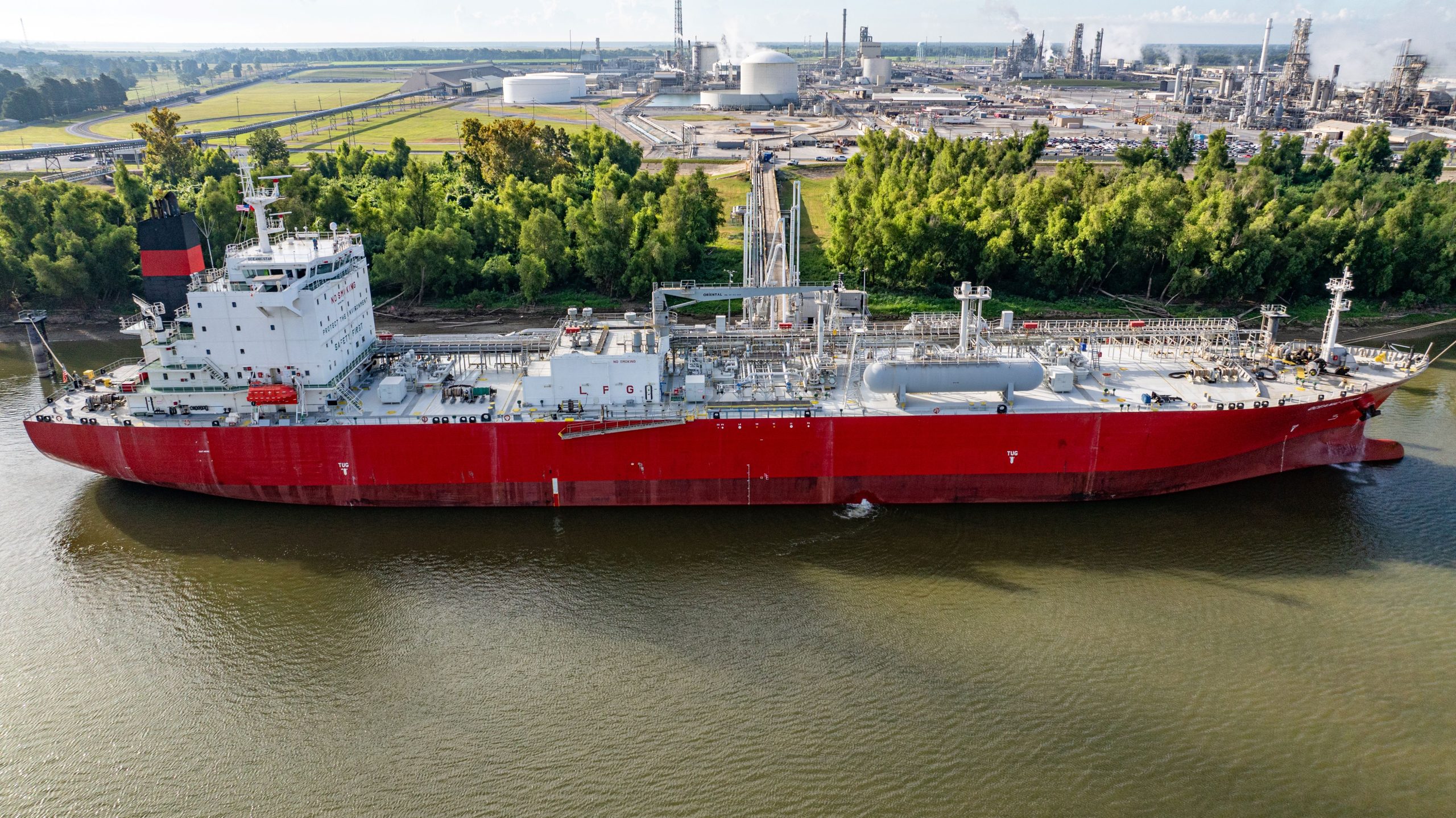
Blue ammonia has moved from demonstration projects into large commercial builds over the past few years. The technology has been attractive to existing producers because it leverages existing steam reforming and ammonia synthesis infrastructure, while allowing them to address fertilizer sector decarbonisation. On the demand side, it serves as a potential low-carbon fuel export to Asian coal-fired power stations or future maritime fuel uses. However, project delivery depends on long-term offtake agreements, the complicating factor of CO2 transport and permanent storage, and government funding and associated certification regimes.
Policy driving markets
Low carbon incentives such as the US 45Q tax credit and industrial decarbonisation goals in Japan, Korea and the EU have created tangible demand signals for low carbon ammonia. Importers in Japan and Korea are sponsoring offtake and equity partnerships to secure supply. Major Japanese utilities and trading houses have stepped forward as anchor customers (and in some cases equity partners), improving project bankability. That buyer demand is a decisive factor for convincing lenders and export credit agencies to support projects financially. Japan and South Korea have mandates for low carbon ammonia co-firing in coal-fired power stations, and blue ammonia offers a concrete pathway for Asian power sectors to cut CO2 emissions quickly while leveraging existing logistics and suppliers. Its ultimate scale will depend on CCS credibility, terminal and handling investment, certification rigour, and how fast green alternatives fall in cost.
Europe’s carbon border adjustment mechanism (CBAM) is also a potential demand pull for low carbon ammonia imports as the additional cost burden of grey ammonia increases over the next few years. In the near term, low-emission ammonia is expected to compete with grey ammonia, pending a ramp-up in the end-use market demand, and CRU does not expect price differentiation between blue and green ammonia to emerge before 2032. As free carbon allowances are phased out towards 2034, there is likely to be increasing differentiation in the carbon value between green ammonia and blue ammonia. Price premiums across blue ammonia grades are expected to remain limited before 2030 or until demand from end-use markets strengthens.
Some of this demand will come from the maritime sector, where the IMO’s net-zero framework has been approved in draft form and is highly likely to be formally adopted in the MEPC/ES.2 scheduled in October 2025. Approval of the framework is expected to accelerate the adoption of low-emission ammonia in marine fuels. As LNG faces Tier penalties from 2030 and potential Tier 2 carbon offset costs from 2033 due to its GHG intensity, ammonia is positioned to gain a competitive edge, supporting stronger demand growth. Ships calling at EU ports are now subject to the EU ETS, with the first surrender deadline in September 2025 for 40% of 2024 emissions. FuelEU Maritime also began this year, with compliance reports due in early 2026 and a Document of Compliance required by mid-year. CRU expects these EU measures to evolve once a global IMO framework is adopted, supporting greater alignment and a level playing field.
There is however some uncertainty as regards US tax credits, which have driven a lot of the investment in blue ammonia to date (see Table 1). In a proposal introduced earlier this year, House Republicans called for ending the 45V clean hydrogen tax credit ahead of its original 2033 deadline, requiring hydrogen facilities to begin construction before 31st December 2025 to qualify for up to 10 years of support worth up to $3/kg. This posed a potentially devastating blow to green ammonia developments, but may still allow blue ammonia projects to be economically viable.
There remain some areas of policy uncertainty; the classification of blue ammonia remains ambiguous, as no globally standardised threshold currently exists. Ultimately, however, the price of low-emissions ammonia will vary according to the level of carbon tax avoided.
Producer response
Existing fertilizer producers have tended to see blue routes to ammonia production as the more rapid path to lowering product carbon intensity, allowing retrofits to existing facilities (such as CF Industries at Donaldsonville or LSB Industries at El Dorado). But there is also now some evidence of carbon capture and storage hub development: there are now large CO2 transport and storage projects being developed in the Arab Gulf region, the North Sea and the US Gulf Coast, which could enable aggregation of point source CO2 from multiple ammonia and hydrogen producers into a shared sequestration infrastructure.
Table 1 shows blue ammonia projects currently under development. CF Industries has been a leading player, retrofitting and expanding activity at its US Gulf assets with CCS linkage and is a central player in some other multipartner blue projects such as the CF–JERA–Mitsui Blue Point project in Louisiana. Existing producers already have an established sales and distribution infrastructure to tap into, which gives them a head start in blue ammonia developments.
The combination of cheap shale gas and relatively easy access to mature/ declining oil and gas wells in the US Gulf Coast, coupled with the tax credits mentioned above have made the US Gulf Coast region a hotspot for blue ammonia developments, as the Table shows. Woodside (after acquiring an OCI asset) is close to delivering the Beaumont ammonia plant in Texas, with CCS linkage targeted to make the product low carbon from the mid-2020s. Some of the other projects are more speculative, but the US is set to be producing several million t/a of blue ammonia by 2030.
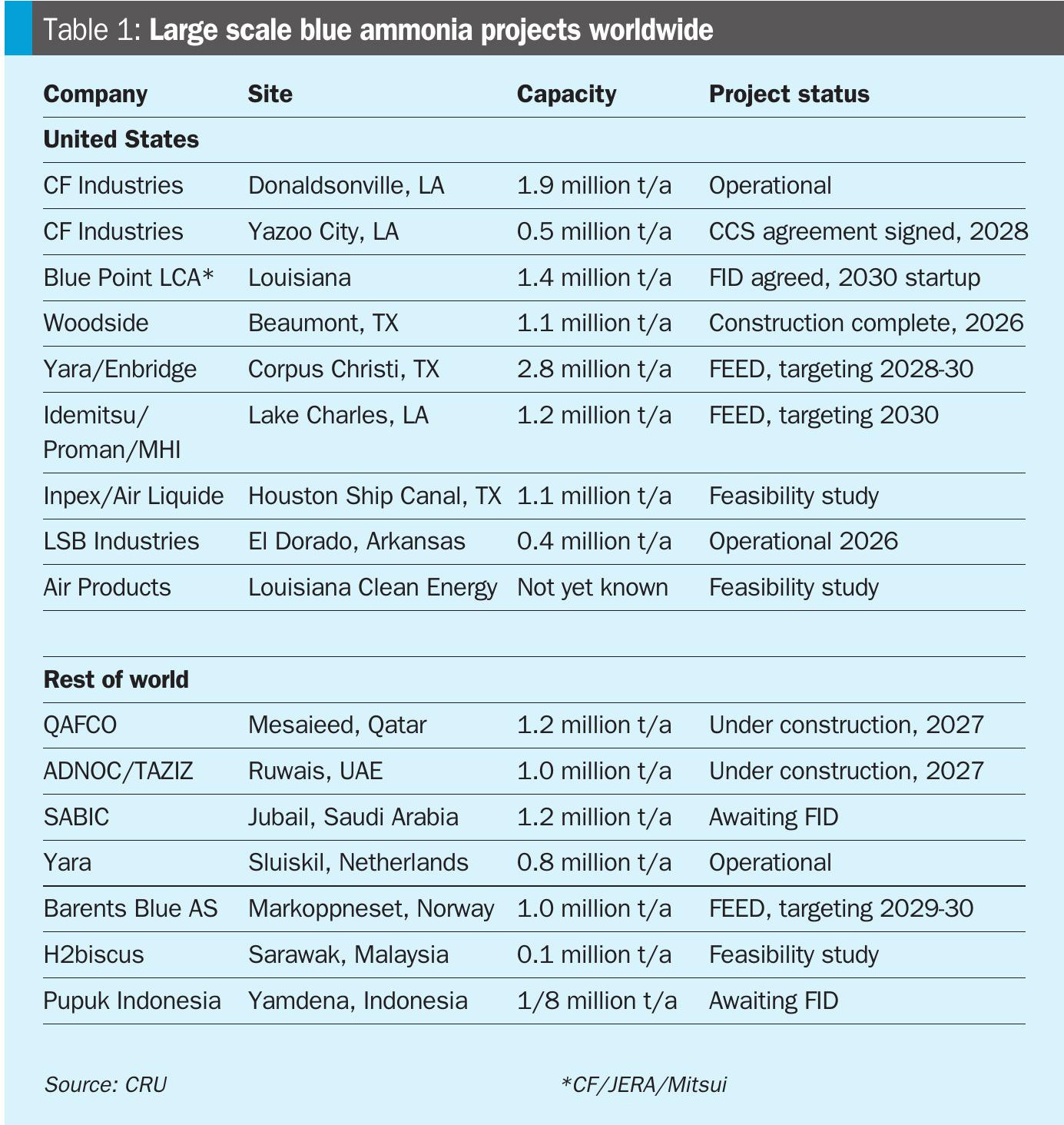
Outside the US, there is another development hotspot in the Arab Gulf, where again there is existing oil and gas infrastructure to tie the carbon capture and storage into. ADNOC and its TA’ZIZ partners are building a 1 million t/a low carbon ammonia plant in Ruwais with a planned CCS pathway and strong state backing, and QatarEnergy/ QAFCO is building a world-scale Ammonia7 train (~1.2 million t/a) at Mesaieed and integrating CCS plans.
In Europe the North Sea may play a similar role. Yara is advancing cross-border transport and storage in Europe by transporting CO2 by tanker from Sluiskil in the Netherlands to the Northern Lights project in Norway.
Key obstacles
Carbon capture and storage remains a relatively new technology. Permitting of long CO2 pipelines and securing injection permits in the US or seabed licensing in Europe can be complex and can materially delay timelines. Local opposition to CO2 infrastructure also remains a political factor in some US Gulf communities.
Certification also remains an open question. Buyers and regulators are tightening low carbon criteria. Projects that rely on CO2 utilisation or temporary enhanced oil recovery rather than verified permanent storage may face challenges for export markets demanding low carbon intensity.
Finally, lower carbon ammonia must find sustained demand beyond early offtakers.
However, a base case based on the projects already under construction and those likely to secure approval means that up to 8 million t/a of blue ammonia could be being produced by 2030. If CCS permitting, or EPC or offtake slips push projects past 2030, and a couple of projects do not reach a final investment decision, this could fall to around 6 million t/a based on already committed projects. On the other hand, if some of the proposed Saudi greenfield projects (not included in the table) make significant progress, and all FEED projects hit a final investment decision with no major delays, total achievable blue/low carbon capacity could reach 10–11+ million t/a by 2030.