• Skip to main content

    Sulphur 417 Mar-Apr 2025
    Sulphur supply agreed for battery manufacturing


    UNITED STATES

    Sulphur supply agreed for battery manufacturing

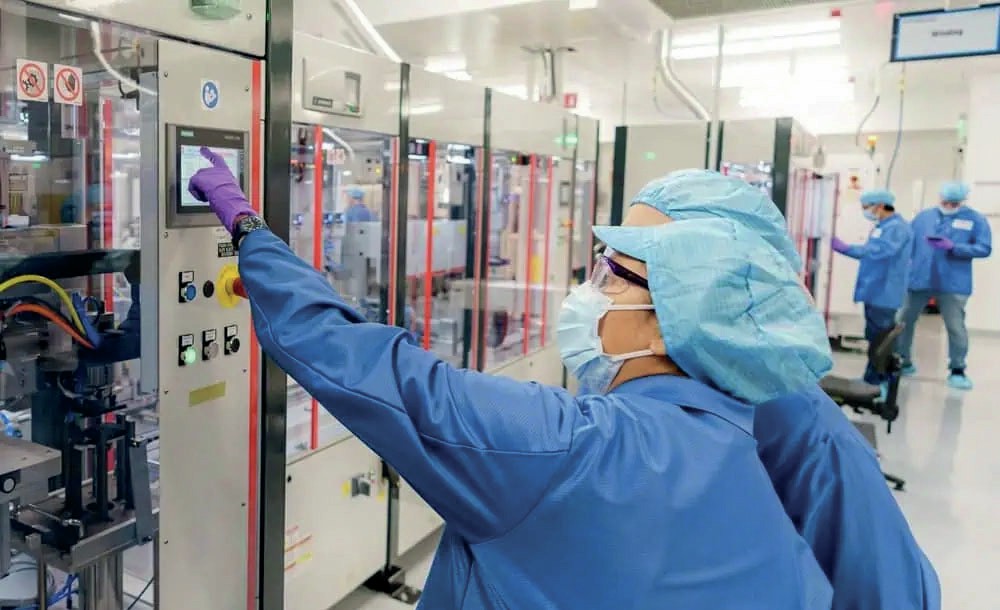
    Lyten’s battery plant in California
    PHOTO: LYTEN

    Lithium sulphur battery manufacturer Lyten has signed agreements with California Sulphur Company, at the Port of Los Angeles, and a Port of Stockton company to supply US domestically sourced, industrial-grade sulphur to Lyten’s manufacturing facilities in San Jose, CA, San Leandro, CA, and its recently announced Reno, NV, “gigafactory”.

    Dan Cook, Lyten Co-Founder and CEO stated, “The US needs an alternative to lithium-ion batteries. Batteries are critical to the functioning of our energy grid, powering satellites, supporting our military, ensuring competitiveness of US companies, and powering new forms of transportation. Today, the supply of nearly every lithium-ion battery is controlled by a single country, creating an enormous vulnerability for the US. Lyten’s Lithium-Sulphur batteries use local materials, are fully manufactured in the US, and are cost competitive because of low-cost sulphur.”

    The use of low-cost sulphur creates a battery cathode that is 40% lighter weight than lithium-ion, which requires nickel, manganese and cobalt (NMC), and 70% lighter weight than Lithium Iron Phosphate (LFP), which currently lead the market.

    Celina Mikolajczak, Lyten Chief Battery Technology Officer, said: “In every industry, weight is critically important. In satellites and drones, we can remove kilograms of weight that directly translates into more payload. In vehicles, we can remove hundreds of kilograms of weight that improves cost, safety, and range while reducing the impact on transportation infrastructure. In battery energy storage systems, we can literally remove tons of weight, dramatically simplifying installation and reducing infrastructure cost. In our observation, electrifying everything requires the lighter battery weights we are achieving with lithium-sulphur.”

    Lyten signed a $650 million loan in December 2024 with the Export Import Bank of the US (EXIM) to fund the scale up and delivery of its Li-S batteries energy storage systems (BESS). Additionally, in 2024, Lyten announced its integration into Chrysler’s Halcyon Concept EV, plans to integrate lithium-sulphur into AEVEX Aerospace’s unmanned aerial vehicles (UAVs), and the selection of its batteries for demonstration on-orbit aboard the International Space Station (ISS), scheduled for launch later in 2025.

    Latest in Commodity

    Nickel Industries starts up ENC acid plant

    Nickel Industries announced started up the sulphuric acid plant at its new Excelsior Nickel Cobalt (ENC) HPAL project in the final week of June. The ENC Project is a massive, multi-billion dollar high-pressure acid leach (HPAL) facility located in the Indonesia Morowali Industrial Park (IMIP) in Central Sulawesi, Indonesia. It is operated by Australia’s Nickel Industries to supply battery-grade materials for the electric vehicle (EV) market. At capacity, it is expected to yield roughly 72,000 t/a of contained nickel equivalent as mixed hydroxide precipitate (MHP), nickel sulphate, and nickel cathode.

    Russia bans rail transport of Kazakh sulphur

    Russia has ordered a “temporary cessation” of rail transport of all sulphur originating from Kazakhstan that is destined for Russian seaports and railway checkpoints, representing a significant policy shift, according to an official order from the Federal Agency for Railway Transport (Roszheldor). The directive, which took effect from May 26th, orders a halt to the loading and movement of Kazakh sulphur “until further notice.” While the measure is officially described as temporary, the order provides no specific timeline for when the transit might resume. The action cites instructions from Russia’s First Deputy Prime Minister, D.V. Manturov, as its basis.