Nitrogen+Syngas 372 Jul-Aug 2021

Price trends


Price trends

Market Insight courtesy of Argus Media

NITROGEN

Recent ammonia market developments include a rise in the Tampa ammonia contract price to $585/t c.fr, continuing outages in the Middle East – mainly Saudi Arabia – and Ukraine exports potentially being under threat. A $50/t jump in the Tampa contract price for July shipments removed any doubt over whether there would be a slowdown in the latest price rally over the next few weeks. Cargoes continue to be lined up from the west to ship to supply customers short of product in east Asia. Buyers remained out of the market towards the end of June, weighing up potential options if the market remains tight into August.

There is still as yet no official word from Saudi Arabia over how long exports will be impacted from Ras al Khair following the fire which damaged the Ma’aden ammonia plant there, affecting 1.1 million t/a of export capacity. Traders are preparing for the region to be below capacity until August. Buyers of Saudi ammonia are facing the prospect of buying more spot ammonia, which is supporting delivered offers above last done business.

US Gulf cargoes are expected to become available next month as the regions moves further into its off-season and maintenance starts on the NuStar pipeline, but delayed turnarounds from the start of the year due to the poor weather conditions may restrict availability. In general, August offers an opportunity for some respite to the market, and lower pricing if Saudi production starts to ramp up.

Much of the urea market has been on hold toward the latter stages of June, waiting to see prices from the 24th June Indian tender. If the prices rumoured to have been offered are confirmed, the wait will have been well worth it for suppliers. Initial indications are that offer prices in the RCF tender were all above $500/t c.fr, with east coast prices rumoured close to $510/t c.fr. This would reflect netback prices above $470/t f.o.b. in China and the Middle East, marking a new step up in price.

Ethiopia is also tendering to buy over 200,000 tonnes of urea for July, squeezing available supply and most likely facing higher prices than India.

Markets in the western hemisphere have been inactive, but buyers face a new round of price increases, not only because of higher f.o.b. prices but also because freight has jumped again from the Middle East and FSU/Mediterranean origins. Recent market drivers include Indian buying and urea availability for the RCF tender, flat recent prices in Brazil, and Chinese government pressure to curtail exports due to concerns about higher domestic urea prices in China. If this does occur it will reduce availability still further. Overall market supply looks to be very tight for July and it seems that further price increases may be on the cards, especially East of Suez.

Table 1: Price indications

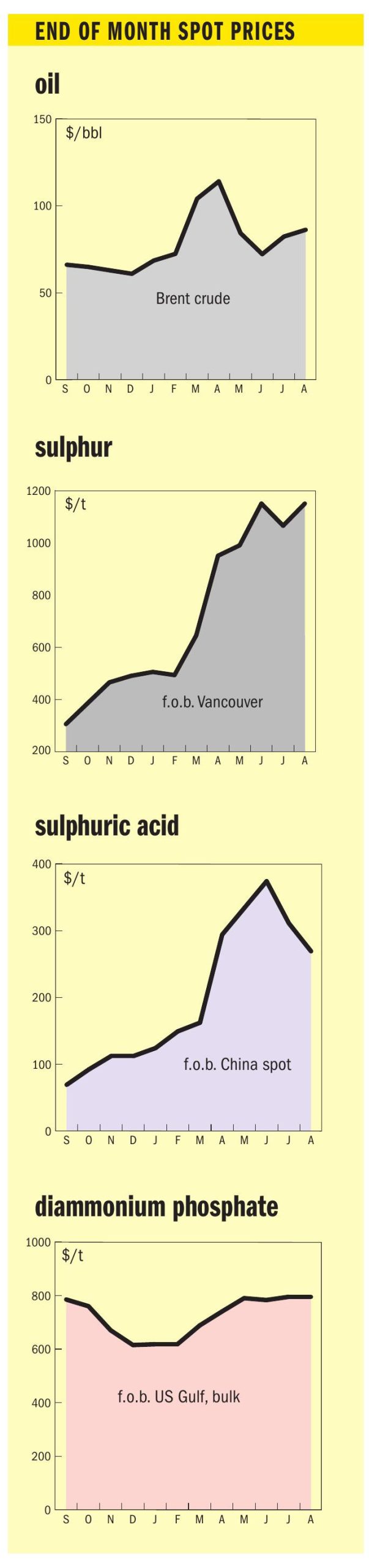
END OF MONTH SPOT PRICES

natural gas

ammonia

urea

diammonium phosphate

Latest in Outlook & Reviews

CRU Phosphates+Potash conference focuses on sulphur

CRU’s Phosphates+Potash Expoconference was held in Paris in mid-April, with the Iran crisis uppermost in everyone’s mind. Margins are under pressure, sulphur has become a strategic constraint, and the phosphates investment pipeline is thin. CRU Principal Consultant Humphrey Knight examined the fallout from the closure of the Strait of Hormuz, noting that fertilizers have been hit harder than most bulk commodities. A large share of exportable sulphur and traded urea normally originates in, or passes through, Gulf producers. The effective closure of the strait has squeezed the traded part of these markets, where international prices are set, and pushed benchmarks up sharply. The global phosphate market is structurally tight, and the combination of Chinese export policy and Middle East logistics has pushed the traded segment into a much more fragile state.

Supply crisis worsens

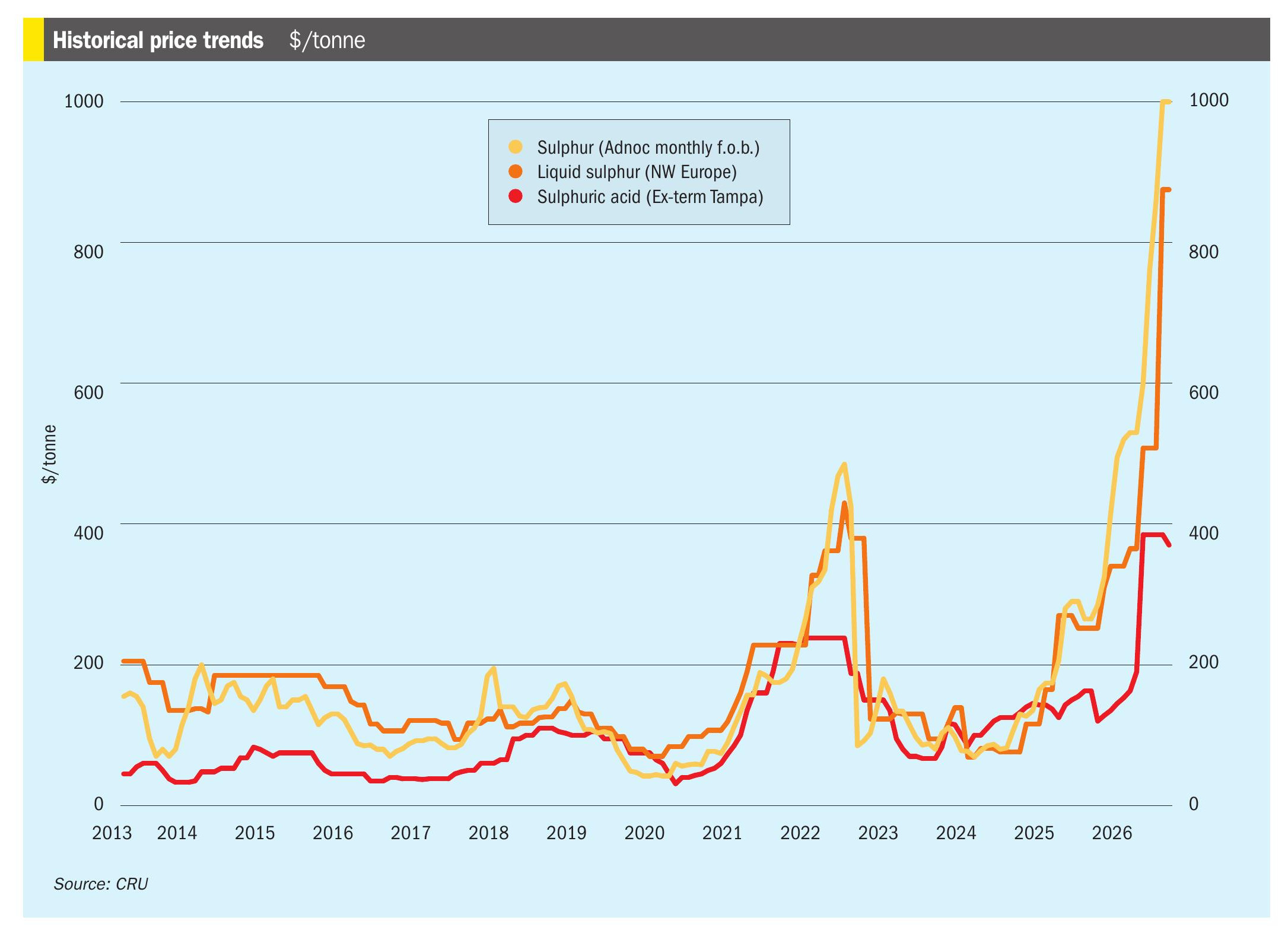
It is two months on from our previous issue, and almost none of the news has been good from sulphur and downstream markets. Only three sulphur cargoes are confirmed to have transited the Strait of Hormuz since the US and Israeli strikes on Iran began, all loaded at Ruwais, with destinations in India, Tanzania and Morocco, carrying a total of 160,000 tonnes. It is believed that a couple of Iranian vessels with a total of 75,000 tonnes may also have left covertly. But in spite of some Middle Eastern sulphur making its way to Saudi Red Sea ports or Duqm on Oman’s Indian Ocean coast, around 700,000 tonnes is still trapped on ships stranded in the Gulf, and coupled with production cuts in the region, it is estimated that over 1.2 million tonnes has so far been removed from the market.