Middle East sulphur
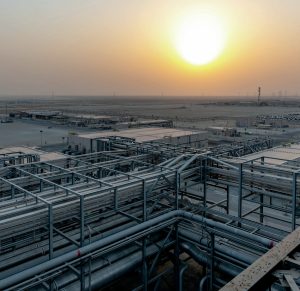
The Middle East remains the world’s largest regional exporter of sulphur, with additional capacity continuing to come from both refineries and particularly sour gas processing.


The Middle East remains the world’s largest regional exporter of sulphur, with additional capacity continuing to come from both refineries and particularly sour gas processing.

Kazakh state gas company QazaqGaz says that work is progressing well and on schedule on the 1 billion m3 expansion project at the Kashagan Gas Processing Plant. A recent site report says that seven absorption columns have been installed at the sulphur treatment unit (each weighing between 50-170 tonnes); three sections of the smokestack have been installed at the sulphur recovery block, along with storage tanks and pumps for the heat carrier, instrumentation air, and nitrogen supply units; and a total of 2,177 t of process equipment has been installed. Welding works for tank assembly are ongoing, and over 12,000 meters of underground piping have been laid, and more than 38,000 cubic meters of concrete have been poured.

Astron Energy, a subsidiary of Glencore, says that it will spend $328 million to upgrade its South African crude oil refinery in order to comply with the country’s upcoming cleaner fuel regulations. The investment aims to bring the facility in line with South Africa’s Clean Fuels II standards, which mandate lower sulphur content in both petrol and diesel. The 100,000 bbl/d refinery near Cape Town is one of only two remaining operational refineries in the country. Astron says that construction work is already under way for a gasoline hydrotreating plant that will reduce sulphur levels to Euro 5 (<10ppm sulphur) specifications. The regulations have been delayed to July 2027 due to concerns over the cost of upgrading existing refining infrastructure. n
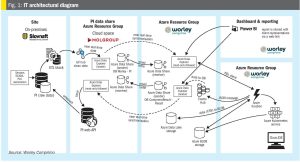
Together with Slovnaft, Worley Comprimo has developed a near real-time monitoring dashboard using data sharing via the Cloud. Using a two-year data set containing minute average data, trends and insights were used to optimise performance. This paper describes the main learnings and improvements with respect to energy optimisation, which supports sustainability targets for Slovnaft.

The Middle East’s premier event for the sulphur global industry, MEScon 2025, returns to the Conrad Abu Dhabi, Etihad Towers from 19 to 22 May 2025.
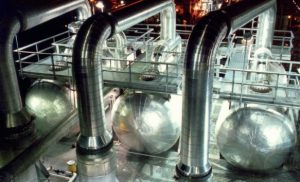
Wood presents the pros and cons of leaving a refinery SRU on hot standby versus long-term idle taking into consideration reliability, safety, and operations responsibilities during extended downtime.

Fluor discusses the main causes, detection techniques, management methods and prevention procedures of SO2 breakthrough in the quench water system of a TGTU, with some unique design features for Fluor’s Desuperheater Contact Condenser.
Axens Catalyst Arabia Ltd to manufacture Tail Gas Treatment Catalyst on newly expanded site
Kuwait’s state owned Kuwait Oil Company (KOC) has issued a tender for companies to bid on construction of the second phase of its gas sweetening facility at booster station BS 171 in West Kuwait. Thirty-two companies have been pre-qualified to bid for the $390 million engineering procurement and construction (EPC) contract for the project. Phase II will involve the construction of two processing trains, each with a capacity to produce 60 million scf/d of sales gas from sour gas with an H2S content of 4%. Sulphur recovery from the project will come from two separate 100 t/d trains with a total capacity of 65,000 t/a of molten sulphur.
Spetco’s contract with the Kuwait Oil Company (KOC) to install depletion compression systems and sulphur recovery units (SRUs) is said to be awaiting final approval. The $460 million project will upgrade two key facilities in North Kuwait, and Spetco says that it expects project execution will start quickly after final approval. The project involves installing new units at the Early Production Facility 50 (EPF-50) and Jurassic Production Facility 3 (JPF-3) using uses a build-own-operate-transfer (BOOT) contract model. The contract was originally tendered in 2023, but scope changes meant that the deadline has been extended several times.