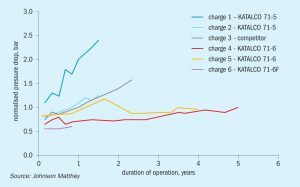
A catalyst for the most demanding HTS applications
Johnson Matthey's latest KATALCO™ 71-7F high temperature shift catalyst with its robust shape provides lower lifetime pressure drop.


Johnson Matthey's latest KATALCO™ 71-7F high temperature shift catalyst with its robust shape provides lower lifetime pressure drop.

Ammonia has been recognised as an advantageous hydrogen and energy carrier. This article focuses on the use of ammonia as fuel in steam reformers and ammonia crackers in order to reduce or completely eliminate direct CO2 emissions. Ammonia combustion knowledge is especially important for ammonia crackers with respect to the recycling of unconverted ammonia. Air Liquide is constructing an industrial scale pilot plant in Antwerp, planned to be operational in 2024, that will be used to demonstrate ammonia cracking and combustion in a process furnace with a multiple burner configuration.
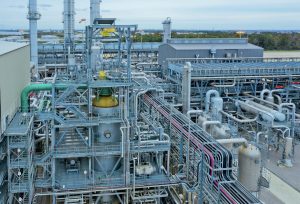
New blue production schemes are available to meet the need to significantly reduce the overall carbon intensity of high-volume hydrogen and ammonia production for a large-scale emerging market. KBR, Air Liquide, Mitsubishi Heavy Industries, Casale and Johnson Matthey report on their latest technologies.
The CO2 emissions in a hydrocarbon fed hydrogen plant occur largely during the energy intensive syngas production step. Hydrogen production is therefore a major factor in the CO2 emission balance of an ammonia plant. BASF’s OASE® technologies for CO2 capture are capable of achieving cost-effective 99.99% carbon capture at scale. In this article Elena Petriaeva and Bernhard Geis of BASF investigate different grey and blue hydrogen production technologies.
SunGas Renewables Inc. has formed a new subsidiary, Beaver Lake Renewable Energy, LLC (BLRE), to construct a new green methanol production facility in central Louisiana. The project will have a capacity of 400,000 t/a of green methanol, using gasified biomass, specifically wood fibre from local, sustainably-managed forests as feedstock. The methanol will have a negative carbon intensity through sequestration of the nearly 1.0 million t/a of carbon dioxide produced by the project, which will be executed by Denbury Carbon Solutions. The methanol will then be used as a clean marine fuel by A.P. Moller–Maersk, which is building a fleet of methanol-powered container vessels.

Hydrocarbon-based production of ammonia carries an unavoidable carbon footprint. But one of the best methods for mitigating that footprint is already here: ultra-low carbon-intensity ammonia production, also known as “blue” ammonia. With blue ammonia production, a typical ammonia plant can sequester or repurpose game-changing volumes of carbon dioxide that would otherwise end up in the atmosphere. To help foster an optimal understanding of the benefits, Ameet Kakoti and Per Juul Dahl of Topsoe A/S provide an overview of the technologies that can help any ammonia operation achieve and maintain sustainable operations – sooner rather than later.

New methods for low-carbon ammonia production are emerging, while project activity is also rising rapidly.
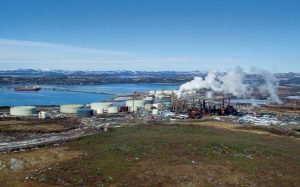
Liquid fuels will be with us for decades to come, but refiners will be pushed to decarbonise their activities, via greater use of biofuels, and green/blue hydrogen use.
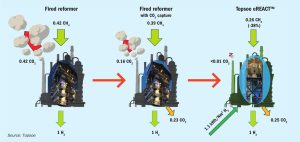
The world’s most common syngas production method remains steam methane reforming, a process which has a substantial CO2 footprint as the necessary reaction heat is supplied by combustion of hydrocarbons. Topsoe’s eREACT™ technology allows for the first-of-its-kind electrification of the traditional SMR process. The reaction heat for eREACT™ is instead generated directly by (renewable) electricity, thereby eliminating the flue gas altogether. Having gone through scale-up from bench scale to industrially relevant pilot scale the technology is now ready for industrial application.
Casale has developed a range of methanol-ammonia coproduction processes to match different requirements according to product capacity.