IMTOF 2023
The International Methanol Technology Operators Forum (IMTOF) met at the Leonardo Royal St Paul’s hotel in London from June 11th-14th.
Although the nitric acid industry has an extensive history dating back centuries, nitric acid production continues to be a dynamic process with bespoke system solutions necessary per plant rather than a one size fits all. Kate Cardonne of Johnson Matthey discusses strategies to balance the cost and performance in nitric acid production.
Market Insight courtesy of Argus Media
Supply in southeast Asia looks tight for the coming weeks, but further declines in Chinese domestic prices could alter the supply/demand balance in the region in August.
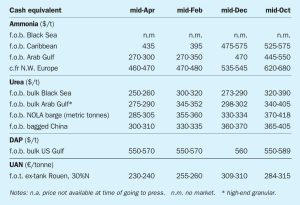
Market Insight courtesy of Argus Media. Urea: There was a general price upswing for both urea and ammonium nitrate in mid-June, while ammonium sulphate and urea ammonium nitrate (UAN) prices remained weak. Urea prices were pushed up in most regions as traders sought to secure cargoes across the globe – resulting in granular urea deals from the Baltic ($260-280/t f.o.b.), Egypt ($312-335/t f.o.b.), Middle East ($253-280/t f.o.b.) and China ($308-310/t f.o.b.).
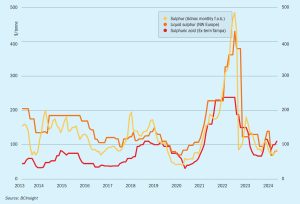
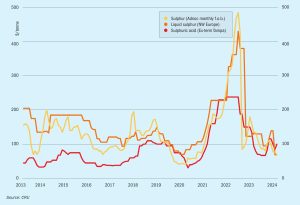
Meena Chauhan, Head of Sulphur and Sulphuric Acid Research, Argus Media, assesses price trends and the market outlook for sulphur.
Indonesian imports have increased in 2023 so far on a year earlier. As new nickel high pressure acid leach projects ramp up, demand for sulphur is expected to increase further. Swing buyers have been importing significant volumes of sulphuric acid, affecting short term sulphur demand in the second quarter. It remains to be seen if this will continue, we expect sulphur demand to ramp up further in the second half of the year, bringing import expectations for the year to around 2 million t.
Market Insight courtesy of Argus Media
Further downward corrections are possible but the rate of demand is stabilising, suggesting the market floor is in sight, though some have suggested that May could bring another sharp reduction in the Tampa contract price towards the mid$300s c.fr. Demand remains sluggish in both eastern and western hemispheres.
Last year, in the wake of Russia’s invasion of Ukraine and the associated disruption to fertilizer and grain exports from both countries, there were dire predictions of the impact upon global food supply. That the worst of these predictions have not so far come to pass is in no small part due to the deal brokered by the United Nations and Turkey in July 2022 to allow exports of grain and fertilizers from Black Sea ports. According to the UN, since last July, some 29.5 million tonnes of grain and foodstuffs have been exported from Ukraine via the Black Sea, including nearly 600,000 tonnes in World Food Programme vessels for aid operations in Afghanistan Ethiopia, Kenya, Somalia and Yemen. Before the war, Ukrainian grain fed the equivalent of up to 400 million people worldwide, and the deal ensured that Ukrainian grain exports ‘only’ fell by 5 million t/a over the past year.