
IFA open letter highlights global fertilizer supply risks from Middle East conflict
The current block to shipping through the Strait of Hormuz places global fertilizer supply chains at risk, warns the International Fertilizer Association (IFA).


The current block to shipping through the Strait of Hormuz places global fertilizer supply chains at risk, warns the International Fertilizer Association (IFA).

Nutrien says that it underwent “a controlled shut down” of its Trinidad Nitrogen operations at the Point Lisas’ facility from October 23rd, 2025. The company said that the shutdown was in response to port access restrictions imposed by Trinidad and Tobago’s National Energy Corporation (NEC) and “a lack of reliable and economic natural gas supply that has reduced the free cash flow contribution of the Trinidad Nitrogen operations over an extended period of time”. Nutrien says that it will continue to engage with stakeholders and assess options with respect to its operations in Trinidad. Ammonia and urea sales volumes from Nutrien’s Trinidad operations were approximately 85,000 tonnes per month and 55,000 tonnes per month, respectively. Nutrien expects to be within its 2025 annual nitrogen sales volume guidance range of 10.7 to 11.2 million tonnes due to the continued strong performance of its North American Nitrogen operations.
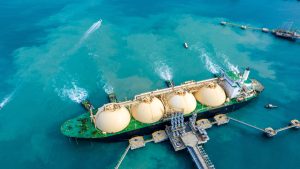
Gas consumption is rebounding in Europe as prices stabilise at lower levels, while the LNG market continues to see large capacity additions.

A consortium consisting of TotalEnergies, Osaka Gas, Toho Gas, and ITOCHU have signed a joint development and operating agreement, granting the Japanese companies a combined 33.3% stake in the Live Oak project – a large-scale facility to produce renewable synthetic natural gas, also referred to as e-NG or e-methane, initiated by TES and TotalEnergies and currently under development in Nebraska. Following the agreement, TES and TotalEnergies will each maintain a 33.35 % stake in the project.
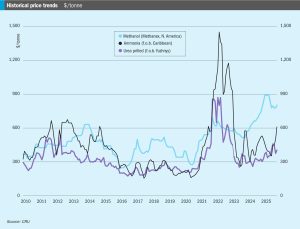
By the end of October the ammonia market was facing an acute shortage of spot tonnage, reflected in a $60/t jump in the Tampa price for November. The benchmark Tampa price increased for the sixth straight month to its highest since February 2023 as the global ammonia supply crunch deepened. The surge at Tampa was said to be driven by good demand in the US for direct application combined with a lack of supply. Contributing factors included Nutrien shutting down its nitrogen production in Trinidad, potentially removing around 85,000 tonnes/month from the market. So far, there is no suggestion that other producers in Trinidad will follow suit, and they may even benefit from a boost natural-gas supply given the Nutrien outage, although it is unclear whether the spare gas will be directed to ammonia as opposed to other demand sources.
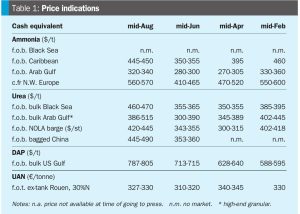
Ammonia prices in both hemispheres had levelled out by the end of August, with the exception of a few marginal upticks in some regions on the basis of the latest supply-demand dynamics. All eyes are now on September’s Tampa settlement, which should spell out the extent of the upside pressure set to emerge over the coming weeks.
Egypt is looking towards hugely increased LNG imports to try and reduce domestic shortages. A second floating regasification and storage unit arrived in May and two more are expected to be in place soon. Reuters reports that the country has reached agreements with energy firms and trading houses to buy 150 to 160 cargoes of […]
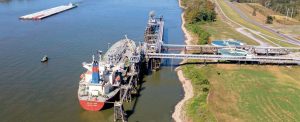
Methanol demand is rising again after a few years of relative stagnation, but with the Chinese MTO boom largely over, it looks to be energy uses which will drive most future demand.
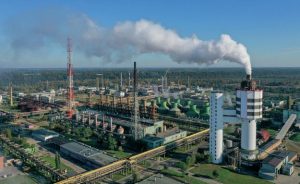
Achema says that it plans to “temporarily” suspend ammonia production at its site at Jonava from May 15th, due to the volatility of natural gas prices and competition from cheaper foreign imports. It currently plans to resume production in 3Q 2025. The facility has been operating at reduced capacity since 2021, and Lithuanian lawmakers have discussed converting the site to explosive grade ammonium nitrate production as part of a European rearmament programme.
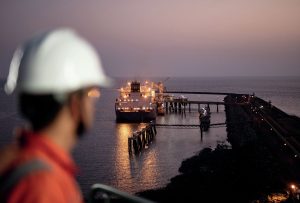
Global gas demand has returned to growth after the supply shock of 2022-23, but geopolitical tensions and short supply in LNG markets.