
Price Trends
Market Insight courtesy of Argus Media


Market Insight courtesy of Argus Media
Fertilizers are always political to some extent, sitting as they do at the intersection of key commodities such as oil and gas on the one hand and food on the other. Markets for major nitrogen derivatives have often been distorted by political decisions to achieve self-sufficiency in fertilizer production, such as in, e.g. China or India. But over the past couple of months ammonia has found itself particularly in the political spotlight, in the context of the ongoing conflict in Ukraine, which continues to shape and indeed re-shape global commodity markets.

Topsoe has agreed to supply an initial 500 MW of industrial-scale, solid oxide electrolyser cells (SOEC) to First Ammonia, a US company aiming to produce green ammonia for transportation fuel, power storage and generation, as well as fertilizer, at sites in northern Germany and the southwestern United States. The companies envisage that over the lifetime of the agreement some 5 GW of SOEC electrolysers will be supplied, potentially replacing almost 5 bcm of natural gas and eliminating the emission of 13 million t/a of CO 2 emissions. The facility to manufacture the electrolyser cells will be built in Herning, Denmark, and has recently received a final investment decisions from Topsoe’s board.
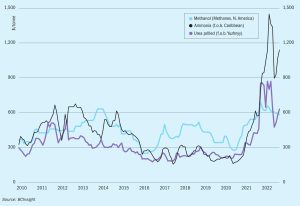
The ammonia market appears to be oversupplied as of the end of October 2022, with a ready availability of spot cargoes. Coupled with increased availability from European producers due to an easing of gas prices, this seemed to indicate bearish market sentiment for the immediate future.
Casale has developed a range of methanol-ammonia coproduction processes to match different requirements according to product capacity.

The curtailment of ammonia production in Europe and reduction in export supply from Russia has led to an unprecedented year for the merchant ammonia market.
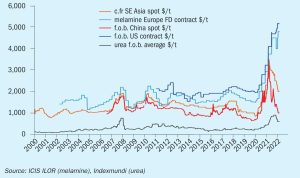
The latest improvements to melamine process technology now make it even easier to integrate a melamine plant with an ammonia and urea fertilizer complex. Guido Canti of Eurotecnica and Marc Wieschalla of thyssenkrupp Uhde discuss the benefits of plant integration.
Topsoe has made a number of changes to its board. Kim Saaby Hedegaard has been appointed as the company’s new Executive Vice President, Power-to-X. Hedegaard has served as interim Head of Power-to-X since May 2022. Before that, he held the position as Chief Operations Officer (COO). He joined Topsoe in 1999 and has since held various leadership positions within engineering, technology, and sales. Since 2017, he was responsible for Catalyst Production and Technology globally. He holds a MSc in chemical engineering from the Technical University of Denmark. He is replaced as COO by Andreas Bruun Jørgensen.

Industry focus on technologies to reduce the carbon intensity of ammonia and methanol production has been intensifying. In this article thyssenkrupp Uhde, Proton Ventures, Toyo Engineering Corporation, Stamicarbon, BD Energy Systems and KBR report on some of their latest technology developments towards decarbonisation.
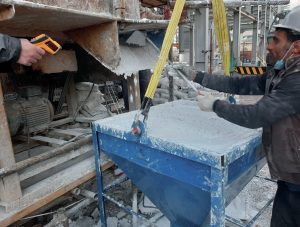
Refractories are heat resistant materials used in high temperature processes to protect industrial equipment such as utility boilers, heaters, and ammonia primary and secondary reformers against heat and chemical attack. In this article Hasan Akbari of Kermanshah petrochemical Industrial company (KPIC) reports on experiences of different stages of refractory casting in the secondary reformer of an ammonia plant, located in Kermanshah province of Iran (KPIC – Phase II). The pouring operation was carried out in three stages and each section was cast nonstop for a period of three days in total.