
Fuel uses for syngas derivatives
Low carbon production is attracting considerable attention to using syngas derivatives as fuels, but there are considerable logistical and commercial barriers to overcome.

Low carbon production is attracting considerable attention to using syngas derivatives as fuels, but there are considerable logistical and commercial barriers to overcome.
SunGas Renewables Inc. has formed a new subsidiary, Beaver Lake Renewable Energy, LLC (BLRE), to construct a new green methanol production facility in central Louisiana. The project will have a capacity of 400,000 t/a of green methanol, using gasified biomass, specifically wood fibre from local, sustainably-managed forests as feedstock. The methanol will have a negative carbon intensity through sequestration of the nearly 1.0 million t/a of carbon dioxide produced by the project, which will be executed by Denbury Carbon Solutions. The methanol will then be used as a clean marine fuel by A.P. Moller–Maersk, which is building a fleet of methanol-powered container vessels.

Market Insight courtesy of Argus Media

CF Fertilisers UK Limited, a subsidiary of CF Industries, says that it plans to permanently close the ammonia plant at its Billingham fertilizer complex in order to secure the long-term sustainability of its business in the UK. The Company intends to continue to produce ammonium nitrate (AN) fertiliser and nitric acid at the Billingham site using imported ammonia, as it has for the last 10 months following its decision to temporarily idle the plant in August 2022.
The CO2 emissions in a hydrocarbon fed hydrogen plant occur largely during the energy intensive syngas production step. Hydrogen production is therefore a major factor in the CO2 emission balance of an ammonia plant. BASF’s OASE® technologies for CO2 capture are capable of achieving cost-effective 99.99% carbon capture at scale. In this article Elena Petriaeva and Bernhard Geis of BASF investigate different grey and blue hydrogen production technologies.

Sustainable aviation fuel (SAF) is increasingly seen as a vital tool in the aviation sector’s transition to net zero. These drop-in fuels, which can be derived from bio and renewable-derived syngas, are used to dilute the fossil-derived components of fuel and are fully compatible with existing fuel infrastructure. This positions SAF as a convenient and rapid route towards decarbonisation. However, questions remain around its ultimate viability at scale and whether it really can be the ‘silver bullet’ aviation leaders are looking for. We spoke to Paul Ticehurst from Johnson Matthey (JM) to shed some light on SAF and the future role of syngas in aviation.

The US Inflation Reduction Act has been a major step in terms of incentivising green syngas production, and has encouraged other governments to look at their own regulatory regimes.
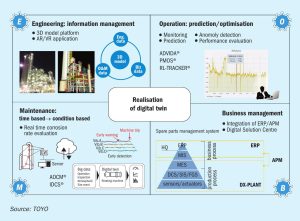
TOYO’s digital twin concept combines its unique digital twin at both the project execution stage and the commissioning stage, and when used in conjunction with its proprietary process simulator it can predict the whole plant lifecycle.

The closure of CF Industries’ ammonia plant at Billingham, Teesside (see Industry News, page 8) marks the end of a long era for UK fertilizer manufacture. The facility was the last operating ammonia plant in the country, following CF’s decision to permanently close its site at Ince in Cheshire in June last year. Going forward, Billingham will now rely on imported ammonia as a feedstock to run the nitric acid and 625,000 t/a ammonium nitrate plants on the site.
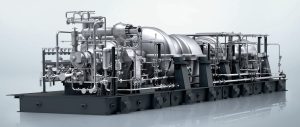
Plant digitalisation can contribute to increase the profitability of chemical plants by optimising performance of operation as well as maintenance. Available digital products range from visualisation of plant data for increased transparency to closed-loop AI controllers based on digital twins.