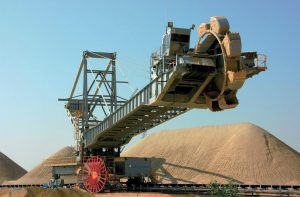
Developments in phosphate markets
Tight supply limits availability as China maintains export restrictions.


Tight supply limits availability as China maintains export restrictions.

The Chinese government has issued a development plan for the country’s copper smelting industry covering the years 202527 which is looking to reduce the level of overcapacity in the sector. New copper smelters must now control sufficient copper mine supply via ownership or equity stakes to cover their production requirements, something few smelters do at present. Chinese smelter output has reached record levels, with treatment charges falling to historically low levels as producers compete for copper concentrate – China imports around 85% of its copper concentrate. Meanwhile more smelter capacity is planned, with around 1 million t/a of new capacity scheduled for 2025. The country aims to boost domestic copper mine resources by 5% to 10% in three years to secure raw material supply, according to the government plan. China will also encourage copper smelters to sign long-term purchase agreements with global miners, boost imports of copper blister and anode, and encourage scrap imports.
The past few weeks have seen sulphur prices spiking after a steady rise since 3Q 2024. At time of writing, delivered prices to a variety of locations were around $280/t c.fr, their highest level since mid-2022 when the price of commodities of all kinds jumped in the wake of the Russian invasion of Ukraine and subsequent sanctions. Steady buying from Indonesia and China, the two largest importers of sulphur, appears to have supported the market, in China’s case mainly for phosphate production as well as a variety of industrial processes, and in Indonesia’s case to feed the high pressure acid leach (HPAL) plants that are producing nickel for the battery and stainless steel industries. Although Chinese buying has dropped off slightly since Lunar New Year, and demand has also slackened in India, Indonesia’s appetite continues unabated, having tripled its nickel production since the start of the decade to become the world’s largest producer, representing 60% of global supply in 2024.

Rapidly increasing lithium production is projected to require several million t/a of sulphuric acid in the next few years, with China, the USA and Australia the main consumers.

Russia is considering limiting potash exports from the second quarter of 2025.
The European Commission is proposing to place tariffs on EU fertilizer imports from Russia and Belarus.

Nitrogen+Syngas went to press just a few days before Donald Trump’s swearing-in as the next president of the United States. While it is sometimes difficult to sort the truth from the hyperbole in his public pronouncements, nevertheless, if taken at face value, they would seem to indicate that we may be in for a turbulent four years in commodity markets in particular. While he is an avowed military non-interventionist, on the economic policy side he has emerged as a firm believer in the power of tariffs to alter markets in the favour of the US, and has promised 20% tariffs on all goods entering the US, potentially rising to 25% for Canada and Mexico, and 60% for his particular bugbear, China, sparking a scramble for wholesalers to stock up in the last few weeks of the Biden presidency. Trump previously raised tariffs on Chinese goods entering the US to 20% during his first term, and the Biden administration made no attempt to reverse this, and even added some additional ones, for example 20% on Russian and Moroccan phosphate imports.

The start of a new year is a traditional time to take stock of the previous 12 months and look ahead to the next. In this regard, CRU’s most recent annual client survey, conducted at the end of December last year, makes interesting reading as to your own concerns for 2025 and beyond. There were numerous responses across commodity and financial sectors, and broadly based worldwide, if slightly skewed towards Europe and North America, but across all of these the key worry for the coming year clearly emerged as trade tariffs and protectionism. This is perhaps unsurprising, given incoming US president Donald Trump’s avowed intent to impose blanket 20% tariffs on all goods entering the US, and up to 60% on China. While most clients did not think tariffs would rise as much as some of Trump’s rhetoric might suggest, most expect rises of 5-10% across the board, and Asian businesses are most concerned. CRU’s most recent position paper on US tariffs highlights some of the internal political and legal challenges in implementing these, but does acknowledge that some rises will be inevitable, and may well produce the kind of reciprocal measures last seen in the previous Trump administration’s trade war with China and the EU in 2018.

We look ahead at fertilizer industry prospects for the next 12 months, including the key economic and agricultural drivers likely to shape the market during 2025.

Venkat Pattabathula, a member of the AIChE Ammonia Safety Committee, reports on the American Institute of Chemical Engineers’ (AIChE) Safety in Ammonia Plants and Related Facilities Symposium held in San Diego on 8-12 September 2024.