Price trends
Market Insight courtesy of Argus Media
A move towards smaller scale feedstocks such as renewable energy and waste and biomass gasification is leading to increased focus on improving the efficiency of small-scale, modular plants.
A detailed rain and wastewater concept is an important part of a urea plant to meet current stringent environmental standards. Wastewater can originate from the process reaction or from outside the process equipment. In order to optimise the wastewater system of a urea plant, both the amount and type of contamination need to be known. With this knowledge, non-contaminated rainwater as well as process drains can be kept separate as much as possible to minimise the amount of wastewater to be treated, saving costs and energy. Wastewater treatment concepts from thyssenkrupp Industrial Solutions and Toyo Engineering Corporation are described.
Scanfeld™ is the world’s first remote sensing solution for fully automated early-warning gas leak detection for chemical plants. Using FTIR spectroscopy, Scanfeld™ identifies hundreds of different gases in real time from kilometres away. With just a few Scanfeld™ sensor units, large production sites, tank farms, or gas loading areas can be monitored reliably. Gas leaks are quickly detected, and the formation of dangerous gas clouds is monitored, measured, and visualised. René Braun of Grandperspective discusses how the system works and how it is being applied in industry.
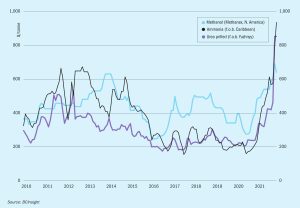
Global nitrogen and methanol markets are currently in the grip of a crisis in feedstock prices. Mostly this is about Europe’s dependence on imported natural gas, but – particularly on the methanol side – it has also been exacerbated by high coal prices in China, where heavy rains have led to flooding in Shanxi province, the source of one third of China’s coal. These have followed similar floods in Henan in July, and come at a time when China is facing power rationing due to a lack of electricity supply. The world economy’s long-awaited bounce back from the covid pandemic has also led to a general global surge in energy demand, and consequently higher oil and gas prices.
In China, requirements for methanol to produce olefins, mainly propylene and ethylene, from coal, has driven much of the growth in global methanol demand over the past decade. However, a new wave of ethylene cracker investment may put a stop to new MTO plant building.
Every urea plant continuously fights again corrosion. The intermediate product ammonium carbamate is extremely corrosive under synthesis conditions. The applied materials of construction require oxygen to form a protective passive layer of chromium oxides. The ammonium carbamate solution will continuously dissolve the passive layer, therefore it is vital to continuously supply oxygen, typically in the form of air, to maintain the passive layer. During blocking-in conditions of the synthesis section it is not possible to add air and the oxygen present will be consumed as a result of the passive corrosion reactions, while at the same time the passive layer dissolves in the ammonium-carbamate solution. At a certain point, the oxygen content in the solution becomes too low to assure a passive layer. At that moment active corrosion will start with much higher corrosion rates than passive corrosion. The picture on the left side shows the passive layer (blue, brown, grey surface) and the picture on the right side shows active corrosion (a shiny silver surface). It is important to realise that once active corrosion starts it cannot be stopped, adding more oxygen at this stage, for example, will not work. Active corrosion will continue, leading to the risk that the protective layer will be severely damaged. The only way to solve this situation is to drain the synthesis section and re-passivate the surfaces.
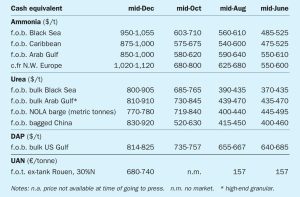
Soaring natural gas prices in Europe, up to five times higher than normal, have led to numerous economic shutdowns of ammonia capacity across the continent. This has coincided with shutdowns in the US due to hurricane season, reducing availability considerably and driving up prices in the western hemisphere.
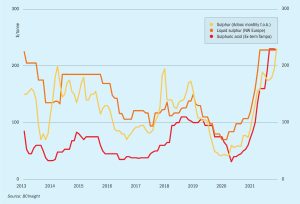
Meena Chauhan, Head of Sulphur and Sulphuric Acid Research, Argus Media, assesses price trends and the market outlook for sulphur.
A seasonal decline in weather conditions in the eastern Atlantic will hinder operations at Jorf Lasfar in Morocco through the end of 2021 and into 2022. In South Africa, port congestion problems were challenging at Richard’s Bay with vessels subjected to 15 day wait times, increasing demurrage costs.