
Ammonia markets face continuing disruption
The curtailment of ammonia production in Europe and reduction in export supply from Russia has led to an unprecedented year for the merchant ammonia market.

The curtailment of ammonia production in Europe and reduction in export supply from Russia has led to an unprecedented year for the merchant ammonia market.
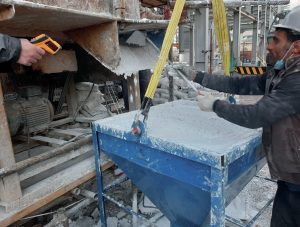
Refractories are heat resistant materials used in high temperature processes to protect industrial equipment such as utility boilers, heaters, and ammonia primary and secondary reformers against heat and chemical attack. In this article Hasan Akbari of Kermanshah petrochemical Industrial company (KPIC) reports on experiences of different stages of refractory casting in the secondary reformer of an ammonia plant, located in Kermanshah province of Iran (KPIC – Phase II). The pouring operation was carried out in three stages and each section was cast nonstop for a period of three days in total.

Venkat Pattabathula, a member of the AIChE Ammonia Safety Committee, reports on the American Institute of Chemical Engineers’ Safety in Ammonia Plants and Related Facilities Symposium, held at the Hyatt Regency in Chicago, USA, on 11-15 September 2022.
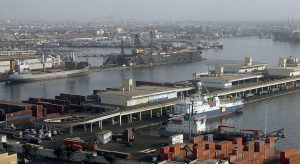
Seshu Dharmavaram of Air Products and Venkat Pattabathula of SVP Chemical Plant Services describe the Dakar ammonia accident, which occurred in Senegal on March 24th, 1992. It is claimed to be the worst industrial ammonia accident ever, leaving 129 dead and 1,150 injured.

Leaks in the high-pressure synthesis section of a urea plant may lead to catastrophic consequences. UreaKnowHow.com started to collect incidents in an incident database and in 2017 AmmoniaKnowHow.com and UreaKnowHow.com introduced FIORDA, the Fertilizer Industry Operational Risk Database, a global open source risk register for ammonia and urea plants.

Market Insight courtesy of Argus Media

As we near the end of the third quarter of 2022, the attention of the nitrogen industry is focused on the coming northern hemisphere winter, and the prospects for higher natural gas prices as temperatures fall and power and heating demands rise. Vladimir Putin has been stoking these worries to try and force a climbdown from European countries over the sanctions that followed his invasion of Ukraine, with the flow of gas through the Nordstream 1 pipeline across the Baltic Sea gradually dwindling over the summer and finally stopping altogether at the end of August due to “technical issues” – an explanation somewhat undermined by the subsequent statement from spokesman Dmitry Peskov that gas would flow again once sanctions were eased. This is a familiar enough tactic; Russia has used gas stoppages to pressure Ukraine and Europe several times over the past two decades.
Leaks in the high-pressure synthesis section of a urea plant can have catastrophic consequences. UreaKnowHow.com started to collect incidents in an incident database and in 2017 AmmoniaKnowHow.com and UreaKnowHow.com introduced FIORDA, the Fertilizer Industry Operational Risk Database, a global open source risk register for ammonia and urea plants.

Most nitric acid is used for production of fertilizer nitrates and ammonium nitrate explosives, but it is also used in polyamides, polyurethanes and aniline dyes as well as a number of industrial processes including ore treatment. High ammonia prices have pushed nitric acid prices to record levels this year, but growth predictions remain robust.
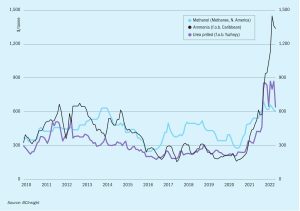
Overall the market finds itself in a period of illiquidity, and is exposed to further uncertainty in 4Q because of the European energy crisis. Spiralling natural gas costs in Europe, with Dutch TTF gas prices trading around e200/MWh, are forcing European fertilizer producers to close ammonia capacity and buy in from overseas.