Phosphate and potash mining update
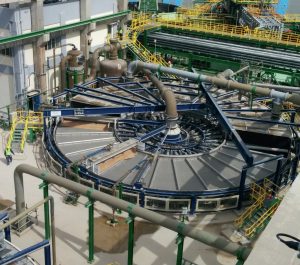
We look at state-of-the-art technology used in phosphate and potash mining, including equipment and systems for excavation, tailings thickening, transport, tunnelling and processing.
Newly-developed froth flotation schemes, equipment and reagents are improving selectivity and the grade and recovering of phosphate concentrates
The increased severity of operating conditions in modern steam methane reformers requires catalysts with high catalyst activity and good mechanical stability to avoid premature replacements or unplanned shutdowns. F. Morales Cano, M. Stenseng and M. Feddersen of Haldor Topsoe describe a new catalyst formulation with a very homogenous and stable carrier material delivering the high activity and high mechanical strength required for long time operation.
Heat exchanger tubes in heaters in a urea plant such as the high pressure stripper and medium pressure and low pressure recirculation heaters typically suffer from process-side fouling. This discussion looks at best ways to clean these heaters.
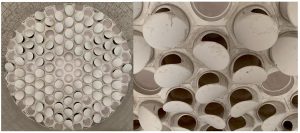
The main reasons for the installation of high efficiency trays (HET) in a urea reactor are: 1) to improve the redistribution of unreacted carbon dioxide inside the liquid phase rich in free ammonia, 2) to reduce the back mixing phenomena due to the density increase of carbamate and urea solution from the bottom to the top of the reactor and 3) to reduce channelling which has a negative effect on the solution residence time.
Vertical one pass (VOP) heat exchangers are commonly applied in urea plants. As the residence time in these heat exchangers is small, unwanted side reactions like biuret formation and hydrolysis of urea are limited. However, some phenomena can limit or reduce the performance of these heat exchangers e.g. bad distribution of the the inlet liquid/gas mixture over the tubes.
Most urea plants operate a two-stage evaporator section. Both stages operate under vacuum pressure conditions and both pressures and temperatures are critical to achieve the right urea product quality. It is not always easy to determine the exact cause of non-optimum values for certain process parameters like, for example, low vacuum pressure in the second stage evaporator. Many factors can influence this vacuum pressure as discussed below.
The CO2 compressor of the urea plant is an expensive piece of critical rotating equipment installed without any spare position. Its reliability is therefore of prime importance. Sometimes reverse rotation occurs which can damage the internals of the compressor. What are the causes and what are the remedies to avoid reverse rotation of the CO2 compressor? There is a lot of misunderstanding around this subject. Here we share the experiences of various end users.
There is a lot of misunderstanding about the purpose and functioning of the seal systems (stuffing box) of the high pressure (HP) ammonia and HP carbamate reciprocating pumps. Some believe that lubrication is the main purpose, while others feel it is all about sealing. Both views are partly true. This article features experiences from various end users.