
Phosphates project listing 2025
Fertilizer International presents a global round-up of phosphate rock, phosphoric acid and finished phosphates projects.


Fertilizer International presents a global round-up of phosphate rock, phosphoric acid and finished phosphates projects.

Days 2 and 3 of the CRU’s 38th Nitrogen+Syngas 2025 Expoconference turned to the technical sessions, organised in three parallel streams covering: green ammonia technology, nitric acid and ammonium nitrate, plant operations and reliability, urea technology, digitalisation, carbon capture, emissions reduction and sustainable fertilizer production, and fertilizer finishing.

In Part 4 of this series on stripper efficiency issues, we continue to look at the causes of lower stripper efficiency with a discussion on the high delta-P range of liquid dividers.

The production of urea, a critical component in the fertilizer industry, involves highly corrosive environments, particularly in the high-pressure sections of the process. This necessitates the use of advanced materials that can withstand such aggressive conditions to ensure long life and efficiency of urea production plants. Alleima, Stamicarbon, Saipem and TOYO report on their advanced material and equipment solutions for the urea industry.
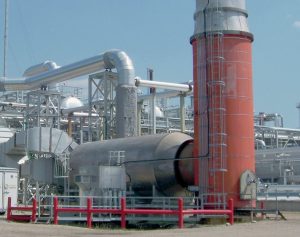
The 2030 greenhouse gas emission reduction goals in the European Union are driving oil and gas producers to reduce CO2 emissions wherever possible. This extends to even the incinerator attached to a sulphur recovery unit (SRU). In this article Sulphur Experts review the role of the incinerator, how the three most common European TGUs each affect the demand on the incinerator itself, and the potential reduction in CO2 emissions for a generic facility of each type.
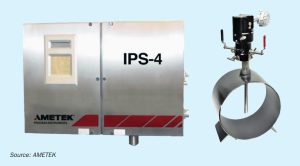
The development and implementation of modern process instruments and control systems in sulphur recovery units has increased significantly over the last decade. In this article, the impact of BTEX on sulphur plant operations and how the BTEX concentrations can be measured are discussed.
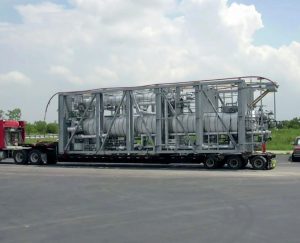
Marcus Weber of Fluor discusses degassing units for large scale sulphur recovery units, evaluating the pros and cons of various available commercial technologies with the emphasis on mega size sulphur recovery units and focussing on how technology can lower degassing capex via economy of scale for new facilities or existing facilities undergoing expansion.

CRU’s 38th Nitrogen+Syngas Expoconference will be held on 10-12 February 2025 in Barcelona. The most respected technical event for the global nitrogen and syngas community offers an ideal platform for industry professionals to connect, do business and learn about the latest innovations in operations, technology, process and equipment. The annual meeting attracts a global audience of producers, licensors and materials and equipment providers representing an unparalleled opportunity for business networking and peer-to-peer knowledge sharing.
In Part 3 of this series on stripper efficiency issues, we continue the discussion on some some of the many causes of lower stripper efficiency. Here we discuss liquid divider fouling and bad installation of liquid dividers.
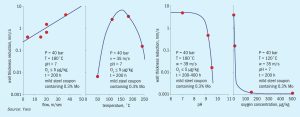
In recent years, extensive and severe internal attack has been observed of carbon steel equipment and lines in aqua ammonia service at several Yara manufacturing sites across the globe. In all cases, the damage has a distinct flow-accelerated corrosion (FAC) signature which challenges the current understanding of FAC. All features typically observed for this kind of damage mechanism, that seem to be specific to the NH3 recovery section of ammonia plant, are reported. Upgrading the material of construction for this unit, will solve this failure mode, but a leak would potentially generate health and safety problem for the release of ammonia.