Europe

26 August 2026
K+S starts pouring foundations at Wintershall
Written by Natalie Noor-Drugan
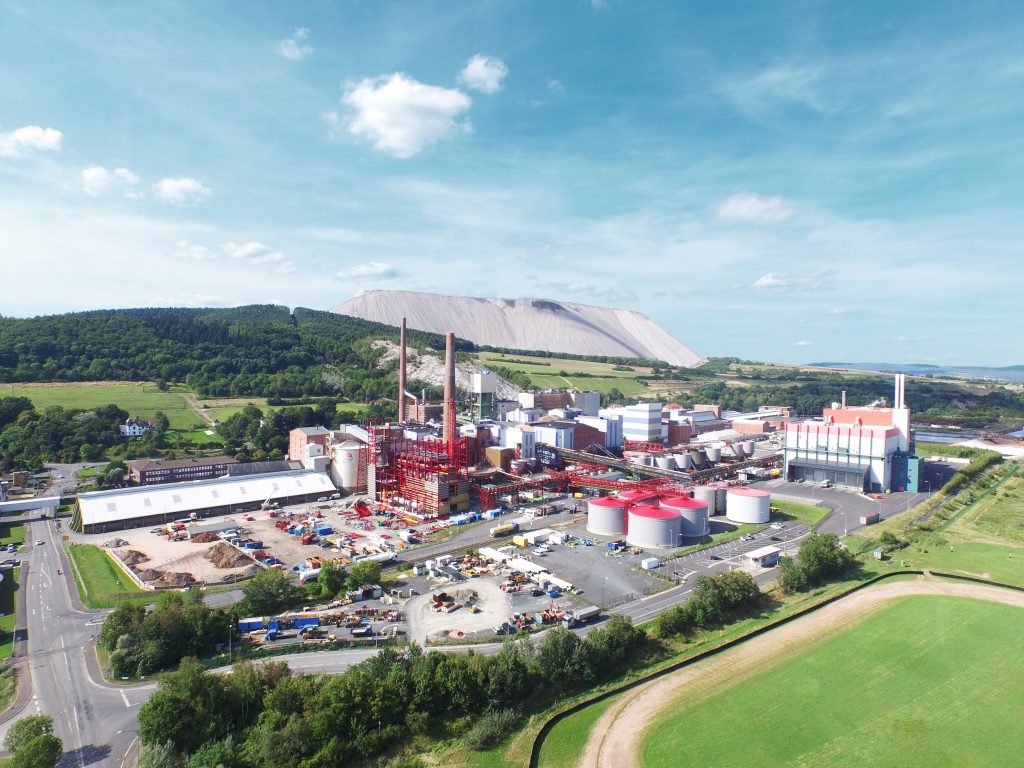
Contractors have begun sinking the 160 bored concrete piles that will hold up the new above-ground processing hall at K+S’s Wintershall potash plant in Heringen, central Germany, marking the first visible surface construction on the €600 million ($696 million) Werra 2060 transformation project. K+S confirmed the milestone on 12 August, telling investors alongside its second-quarter results that “above-ground implementation of the major ‘Werra 2060’ project has also recently begun”.
The Werra operation — K+S’s largest German site, straddling the Hesse–Thuringia border — is made up of three factories with their own mines: Wintershall and Hattorf, both in and around the Hessian town of Heringen and sharing the Hattorf-Wintershall mine below; and Unterbreizbach, on the Thuringian side. Together they employ about 4,500 people and produce roughly half of all potassium- and magnesium-based fertilizers sold in the EU.
Each pile at Wintershall is 1.2 metres in diameter and drilled 12 to 15 metres deep into Bunter sandstone next to the site’s existing 65-metre-high processing hall. Some 84 piles are already in place. The primary steel frame of the new building will use 4,000 tonnes of steel. “Since we do not have load-bearing ground here, the corresponding bored piles have to be installed,” André Spiegel, project manager for Werra 2060, told a K+S-led site tour for regional press in early July. The visible surface work has lagged changes below. “Underground, we are already considerably further ahead,” Wintershall plant manager Gerd Kübler told the same tour, referring to preparations for a new dry-backfilling method in the Hattorf-Wintershall mine.
The new hall at Wintershall will house K+S’s further-developed electrostatic separation (ESTA) technology, which sorts salt minerals in a dry state and eliminates the wet processing step used today. About 65% of the crude salt is currently dissolved in water to recover its potash and magnesium content, generating both the plant’s high energy demand and the saline wastewater discharged into the Werra river. Solid ESTA residues will instead be pumped back underground as stabilising backfill. K+S said the switch will halve production water disposal, shrink the Wintershall tailings pile by about 90% from 2028, and cut CO₂ emissions at Wintershall and Unterbreizbach by around 50%. Under the same project, the Unterbreizbach factory will be converted into a granulation site for fine potash produced at Wintershall, while its own mine is expected to run out of ore by 2040. From mid-2027, crude salt from Unterbreizbach will instead be moved to Hattorf and Wintershall for processing.
K+S admitted delays to the project in spring 2026, but chief executive Christian Meyer is holding to a 2028 completion target. “We want to carry out a radical transformation,” Meyer said on the same site tour.
Guidance raised as potash and salt drive Q2
K+S alongside the Werra update lifted its full-year 2026 EBITDA guidance to €680–760 million ($790–880 million), from €630–730 million previously. Second-quarter revenues rose to €978 million ($1.13 billion) from €871 million, and operating EBITDA jumped to €176 million ($204 million) from €110 million, ahead of €149 million market consensus. The group also confirmed its 2 June agreement to buy Qemetica’s salt business in Poland and Germany for €350 million ($406 million) plus up to €30 million ($34.8 million) in performance bonuses, with closing expected in Q1 2027.
“Strong demand for potash, combined with positive price trends, our improved production output, and the very good salt business, are driving revenues, earnings, and cash flow,” said Meyer. “That is why we are raising our forecasts for EBITDA and free cash flow for the full year, even though it is not yet clear how the uncertain developments in the conflict in the Middle East will continue to affect us.”