Sulphur 425 Jul-Aug 2026
Maintaining below-grade sulphur pits


MOLTEN SULPHUR HANDLING

Maintaining below-grade sulphur pits

Below-grade reinforced concrete sulphur pits are critical containment assets in sulphur handling operations, where temperature control, water ingress prevention, and structural integrity are essential to reliable performance. Thomas Kline of Structural Technologies outlines practical inspection, assessment, and repair strategies to help owner/operators maintain serviceability, extend asset life, and avoid costly process interruptions.

Below-grade reinforced concrete sulphur pits are typically incorporated into sulphur train processes that rely on gravity and elevation for the containment of molten sulphur. Whether the sulphur pit is part of a crude oil refining process or a sulphur rehandling/cake re-melt unit in a chemical plant, reinforced concrete sulphur pits function in much the same way.

These pits are designed to maintain molten sulphur within an elevated temperature range, typically through steam coils that preserve fluidity and minimise temperature fluctuations. Stable temperatures are essential to maintaining process flow within the sulphur train. The surrounding backfill soils also help maintain a consistent thermal profile, provided groundwater intrusion, condensate, and steam-coil malfunctions are controlled and maintained in accordance with OEM guidelines.

Importance of civil and structural maintenance

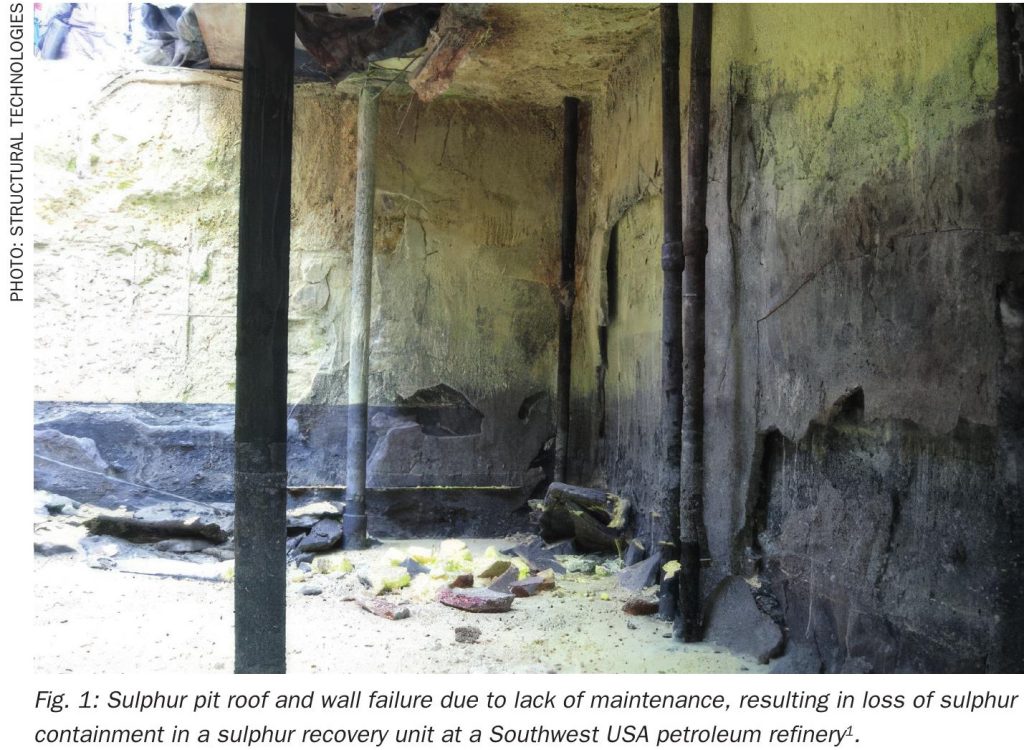
The civil and structural elements of a subsurface reinforced concrete sulphur pit are just as important to maintain as electromechanical equipment, since these assets are integral to the sulphur stream and process. Although they are not generally considered revenue-generating assets, failure of the civil or structural components that support or contain process operations can quickly shut down a process stream, resulting in significant lost revenue until repairs are completed and the system is returned to service (Fig. 1).

Safety planning before entry

Prior to working in or around any sulphur recovery unit (SRU) infrastructure, a safety execution plan (SEP) should be developed to identify task hazards as well as environmental and ergonomic concerns associated with the planned scope of work (SOW). The SEP should establish a series of steps and practices that align with industry best practices and Occupational Safety and Health Administration (OSHA) safety protocols to protect workers and support environmental stewardship.

The SEP should be integrated into daily toolbox meetings, along with manager and supervisor safety audits, to educate personnel and implement task-hazard analysis checkpoints tied to the SOW2.

Inspection and assessment methods

As noted in previous publications3, several evaluation techniques exist to assess the integrity of these important civil and structural assets using both non-destructive testing (NDT) and semi-destructive testing (SDT) methods. These techniques require validation of test results and access to internal regions once the sulphur pit has been taken offline. Dirty and clean inspections, performed after shutdown, can help determine the appropriate repair path and develop a strategic maintenance plan.

Dirty inspections

Dirty inspections (Fig. 2) occur after the sulphur pit is taken offline, cooled, and entered under fresh-air protocols or, depending on ventilation conditions, full-face air-purifying respirators. Inspectors should remain on ladders, harnessed and attached to extraction tripods with yo-yo lanyards, so that conditions can be viewed safely and entry readiness can be assessed quickly.

It is important to recognise that walking on what appears to be a hardened sulphur cake can be hazardous. Hot spots may remain below the crust, where molten sulphur has not fully cooled because hardened sulphur acts as an insulating layer. Over the years, incidents have occurred in which contractors and operations personnel have broken through these crust formations and suffered burns.

For this reason, metal rods are often used as probes during dirty inspections to assess sulphur cake stability and determine whether hot spots exist below apparently solid surfaces.

Clean inspections

Once the pit has been safely cleared, construction personnel are typically allowed to enter and begin removing hardened sulphur cake and carsul in accordance with industry best practices2. Clean inspections are performed after all portions of the sulphur pit have been cleaned and pressure washed with water to expose the concrete surfaces, allowing an accurate assessment of existing conditions.

Following a thorough inspection, maintenance strategies can be developed where significant distress or deterioration is identified. Typical approaches are summarised in the sulphur pit repair decision matrix in Table 1.

Planning repairs in advance

A clean inspection can reveal significant distress and allow a rapid response during a short outage, provided adequate preplanning has been completed in the pre-outage phase of the work plan. That said, durability and structural liners (Fig. 3) require substantial engineering effort and are not typically developed during an outage. They should be designed well before the outage event.

Performing a ground penetrating radar (GPR) survey, coupled with impact echo (IE) testing (Fig. 4) and truth-and-verification probes well ahead of the planned outage, will typically provide an accurate assessment of in-situ sulphur pit roof slab conditions. Those findings can often be extrapolated to the pit walls as well.

Decision-making and documentation

Having a planned response to anticipated conditions, supported by a fully developed repair decision matrix before a sulphur pit outage, allows owner/operators to make informed decisions when conditions are encountered. In many cases, these conditions remain hidden during normal service and only become apparent as discovery items during process outages.

Unfortunately, sulphur pit maintenance is sometimes overlooked because these critical civil and structural assets are buried and effectively out of sight and out of mind. Best practice, however, is to maintain accurate documentation, including original design information, as-built drawings, and maintenance records, in an accessible archive so that a repair plan can be developed quickly if operational issues arise.

Repairs and restoration work should also be archived, including Issued for Construction (IFC) drawings, Inspection and Testing Plans (ITPs), and repair material data sheets.

Water ingress and concrete deterioration

Owner/operators often report cold spots within sulphur pits after major environmental events such as heavy rainfall or hurricanes. These conditions can indicate breaches in molten sulphur containment that allow water to enter the interior regions of the pit.

Water is a serious concern in sulphur pits both from a process standpoint and from a civil and structural standpoint. When water combines with molten sulphur, it can form aggressive sulphurous acidic compounds4 that attack the hydrates in concrete and break down the bonds among the constituent materials, including sand, cement, and coarse aggregates. This can lead to severe concrete section loss.

Maintaining a watertight reinforced concrete sulphur pit is therefore essential for extending the service life of these critical assets. Fig. 5 shows a typical negative-side water mitigation technique, chinking, performed within the sulphur pit while offline.

Water mitigation techniques

Fig. 6 illustrates soil modification techniques that can be performed from within the sulphur pit while offline, as well as along the exterior perimeter while the pit remains online.

The use of severe sulphate-resistant materials in both original construction and repair of sulphur pits cannot be overstated. Materials that resist sulphate attack and elevated process temperatures are essential for durable, long-term service in sulphur handling facilities.

Post-repair behaviour

It should also be noted that minor water leakage conditions may redevelop after grouting if sulphur pits are left out of service for extended periods, such as weeks, rather than being recommissioned soon after repairs. In general, moisture ingress pathways tend to close when sulphur pits are returned to service temperatures.

This occurs because the reinforced concrete section expands thermally and is restrained by the surrounding compacted backfill soils4. In effect, thermodynamic growth movement meets an immovable object, and the cracks or joints close as a result of this growth-and-restraint behaviour. This is often confirmed when repaired sulphur pits are examined during later outage opportunities, where previously leaking cracks show little or no evidence of sulphate-attack erosion that would normally be present under active leakage conditions.

Conclusion

Below-grade reinforced concrete sulphur storage pits provide containment and bulk conveyance for molten sulphur products in the elemental sulphur process stream. With appropriate detailing, these civil assets can deliver long-term service in extremely harsh process environments and support dependable process throughput.

As with all man-made infrastructure, however, maintenance is essential. Programs should be in place so that repairs can be implemented quickly when needed. Sulphur pit civil maintenance programs should focus on repair and restoration much like those used for electro-mechanical systems and equipment. While civil assets may not directly generate revenue, their failure can certainly cost owner/operators significant revenue through lost production.

References

Latest in Technology

Axens signs agreement with Egyptian Refining Company

Axens says that it has strengthened its collaboration with Egyptian Refining Company (ERC) via a long-term agreement aimed at maximising asset value and supporting ERC’s evolving needs in product supply, digital transformation, and refinery performance optimisation. Under the agreement, Axens will use its integrated portfolio of technologies, equipment, catalysts, and services to support ERC’s operational, economic, and sustainability objectives.

Travertine processes Ariane phosphate samples

Arianne Phosphate has provided samples of its phosphate concentrate for processing at Travertine’s facility in Boulder, Colorado, US. Pilot scale testing was successfully performed, demonstrating proof of concept on the process and production of a high-quality purified phosphoric acid (PPA). The Travertine process captures and recycles over 95% of the sulphur used in the process of making PPA, providing a virtually closed loop system. The PPA produced using the process met specifications required for both LFP batteries as well as fertilizers. The companies have begun work to advance the PPA demonstration plant in Quebec’s Saguenay-Lac-Saint-Jean region, working with potential partners as well as end-users of the product.