Fertilizer International 533 Jul-Aug 2026
Sultech solves a decades-old fertilizer challenge


PIONEERING NORTH AMERICAN PRODUCERS

Sultech solves a decades-old fertilizer challenge

Sultech Global Innovation Corp’s patented micronisation technology is helping elemental sulphur perform throughout the crop-year – while creating a new connection between energy production and modern agriculture. As sulphur nutrition becomes an increasingly important component of modern crop production, technologies capable of delivering both performance and efficiency will likely play a growing role.

Introduction

When Murray MacKinnon recovered a largely forgotten body of sulphur research from the former Alberta Research Council, he wasn’t looking to reinvent sulphur fertilizer. He was trying to solve a problem that had frustrated agronomists, manufacturers, and growers for decades: how to make elemental sulphur perform reliably within a commercial growing season.

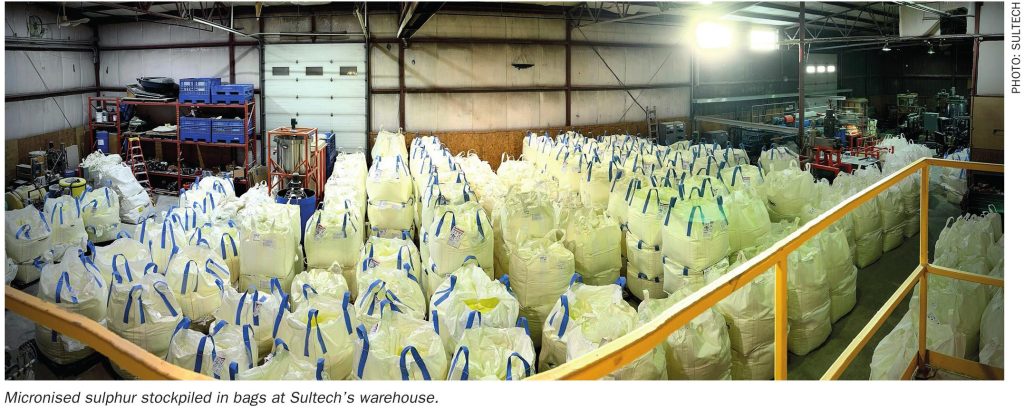
Today, Sultech Global Innovation Corp, based in Alberta, Canada, has commercialised a patented micronisation technology that is changing how the industry thinks about elemental sulphur. By reducing sulphur particles to less than 30 microns and stabilising them for field application, Sultech has created a product platform capable of delivering plant-available sulphur within the crop-year, while retaining the sourcing, cost, and sustainability advantages of elemental sulphur.

“We thought we were just going to make a better elemental sulphur,” says MacKinnon, founder and CEO of Sultech. “But once we got into field trials, we realised we had something that could match – and in some cases outperform – synthetic sulphate fertilizers.”

That realisation came at a time when sulphur was quietly becoming one of agriculture’s most significant nutrient challenges.

Why sulphur matters again

For much of the twentieth century, sulphur deficiencies were relatively uncommon in many agricultural regions. Industrial activity and fossil fuel combustion released significant quantities of sulphur dioxide into the atmosphere. While these emissions created environmental concerns, they also provided an unintended source of sulphur nutrition for agricultural soils through atmospheric deposition.

That dynamic has changed dramatically. According to the European Monitoring and Evaluation Programme (EMEP), sulphur dioxide emissions from land-based sources across Europe declined by more than 80% between 1980 and 2008 as international air quality agreements took effect. Similar reductions occurred throughout North America. The US Environmental Protection Agency reports that ambient sulphur dioxide concentrations declined by approximately 91% between 1980 and 2016.

Cleaner air has been a major environmental success story. But for agriculture, it’s created a new challenge. The ‘free’ sulphur that once arrived through rainfall and atmospheric deposition has largely disappeared, while crop demand has continued to rise.

Modern crop genetics, meanwhile, have dramatically increased yield potential. Farmers are producing more grain, oilseed, and forage per acre than ever before. Those higher yields do, however, remove more nutrients from the soil, including sulphur. The result is a widening gap between sulphur supply and crop demand.

Deficiency symptoms once associated with historically sulphur-poor soils are now being documented across major cropping regions worldwide. In crops such as canola and oilseed rape, sulphur deficiency can significantly reduce yield potential and oil quality. In cereals, sulphur plays a critical role in protein formation and nitrogen utilisation. In pulses and forage crops, it contributes directly to amino acid synthesis and overall plant health.

As MacKinnon explains: “Sulphur used to fall from the sky. Now it doesn’t. At the same time, we’re growing more food on the same acres and removing more nutrients from the soil. We’re seeing sulphur deficiencies around the world, and they’re beginning to limit yield potential.”

While the agronomic problem is well understood, the fertilizer industry’s response has been constrained by a more fundamental issue: sulphur availability.

The performance gap

The challenge facing sulphur fertilizers has never been one of supply. Globally, elemental sulphur is abundant. Large quantities are recovered every year as a by-product of natural gas processing and petroleum refining. The problem is that the oxidation of elemental sulphur in soils versus crop demand for sulphur operate on different timelines.

Traditional elemental sulphur particles, typically ranging from 80-200 microns, require microbial oxidation before plants can use them. Depending on environmental conditions, meaningful conversion to plant-available sulphate may take months or even years. That delay makes elemental sulphur difficult to rely on for immediate crop nutrition.

Synthetic sulphate fertilizers solve the timing problem by providing immediately available sulphur. However, they create a different challenge. Because sulphate is highly soluble, it can move readily through the soil profile, increasing the risk of nutrient loss through leaching and reducing fertilizer efficiency under certain conditions.

“Sulphur used to fall from the sky. Now it doesn’t. At the same time, we’re growing more food on the same acres and removing more nutrients from the soil. We’re seeing sulphur deficiencies around the world, and they’re beginning to limit yield potential.”

For decades, manufacturers attempted to bridge the gap. Polymer coatings, bentonite-sulphur products, sulphur-enhanced compounds, and other formulations all sought to combine the availability of sulphate with the economic and supply advantages of elemental sulphur. Yet the industry continued to face the same fundamental constraint: particle size.

Solving the particle size problem

The relationship between particle size and oxidation rate has been well documented in soil science for decades. As sulphur particles become smaller, their surface area increases dramatically, creating more opportunity for microbial activity. Researchers demonstrated years ago that elemental sulphur particles below approximately 40-50 microns could oxidise significantly faster than conventional products.

The science was clear. The manufacturing challenge was not. Producing stable elemental sulphur particles below 30 microns at commercial scale – without excessive costs, safety concerns, or product instability – had never been achieved successfully.

This was the challenge Sultech inherited. The company built upon earlier research conducted by the Alberta Research Council but had to redesign and commercialise the process from the ground up.

“We weren’t handed a finished technology,” says MacKinnon. “We were handed an idea that needed to be rebuilt, proven, and engineered for the real world.”

Sultech’s patented micronisation process injects molten sulphur at high velocity into a controlled water-polymer environment. The process fractures the sulphur into ultrafine particles and immediately stabilises them to prevent re-agglomeration.

The resulting material maintains particle sizes typically below 30 microns while remaining safe, stable, and commercially scalable. The agronomic outcome is significant. By dramatically increasing surface area, Sultech’s patented process accelerates microbial oxidation and allows elemental sulphur to function within the crop year rather than over multiple growing seasons.

In effect, the company has changed elemental sulphur from a long-term soil amendment into a precision crop nutrition tool.

“Sultech’s business model creates a direct connection between two industries that rarely intersect. Energy production creates the feedstock. Agriculture creates the demand. Micronisation creates the value. This circular economy model has attracted increasing attention from industry partners and governments alike.”

From Alberta innovation to global opportunity

What makes Sultech’s story particularly interesting is where it began. The company emerged from Alberta, one of North America’s largest energy-producing regions. It’s a location that provides, in addition to technical expertise, access to one of the world’s most reliable sources of recovered elemental sulphur.

Alberta’s natural gas industry produces significant volumes of sulphur as part of routine processing operations. For decades, much of that sulphur entered global commodity markets with relatively limited opportunities for value enhancement.

Sultech saw something different.

“We’re taking a by-product from energy production and turning it directly into a crop nutrient,” says MacKinnon. “That’s the bridge between energy and agriculture that makes Sultech unique.”

The company’s business model creates a direct connection between two industries that rarely intersect. Energy production creates the feedstock. Agriculture creates the demand. Micronisation creates the value. This circular economy model has attracted increasing attention from industry partners and governments alike.

In 2026, Sultech and Canlin Energy announced plans for a new Alberta manufacturing facility designed to produce 50,000 tonnes of micronised sulphur products annually. The project received $5 million in support from Emissions Reduction Alberta, recognising both its economic and environmental potential. The planned expansion in capacity is significant as it signals the transition from successful commercialisation to meaningful market scale.

Building a global platform

The implications extend well beyond Canada. Sulphur deficiency is global, not a regional challenge. It is increasingly recognised across Europe, Australia, Asia, and North America. As a result, Sultech’s technology has begun attracting international attention. The company has established partnerships in Australia, for example, with these focusing on co-developing and distributing new micronised sulphur products tailored to regional market requirements.

It has also entered discussions with major global sulphur producers, including initiatives involving the Abu Dhabi National Oil Company (ADNOC), one of the world’s largest sulphur suppliers. These relationships reflect a broader market recognition that micronised sulphur represents a new category of nutrient delivery.

What this means for the fertilizer industry

Importantly, Sultech’s technology shows that elemental sulphur can occupy a fundamentally different position within the fertilizer market. Historically, elemental sulphur has been positioned primarily as a long-term soil-building product.

Faster acting micronised sulphur changes that equation. It now creates an opportunity for distributors, retailers, and agronomists to recommend elemental sulphur for responsive nutrition programmes, liquid applications, dry blends, and integrated nutrient management strategies.

At the same time, the industry faces several long-term trends that support continued adoption. Atmospheric sulphur deposition is unlikely to increase. Crop nutrient removal rates continue to rise. Pressure to improve nutrient-use efficiency continues to intensify. And growers are increasingly focused on both economic and environmental performance.

Against that backdrop, precision sulphur nutrition is likely to become more important – not less. For Sultech, the next chapter is about scale. While, for the fertilizer industry, it will require a rethink about long-held assumptions.

The performance gap between elemental sulphur and synthetic sulphate has traditionally been viewed as a fixed limitation. Whereas Sultech’s experience suggests it was, in part, a manufacturing challenge waiting to be solved.

“It’s a simple idea,” says MacKinnon. “Take something low value and make it high performance, safely and efficiently. That’s what we’ve done, and we believe the opportunity ahead is significant.”

As sulphur nutrition becomes an increasingly important component of modern crop production, technologies capable of delivering both performance and efficiency will likely play a growing role.

For Sultech, the goal is straightforward: make sulphur work the way agriculture always needed it to.

Acknowledgment

Reporting by Chris Forrest, Veracausa.

Latest in Innovation