Fertilizer International 533 Jul-Aug 2026
8 July 2026
Phosphogypsum for clinker production: delivering a circular economy solution
EMBRACING THE CIRCULAR ECONOMY

Phosphogypsum for clinker production: delivering a circular economy solution
A new advanced treatment process from thyssenkrupp Uhde provides a viable way to convert phosphogypsum into a valuable feedstock for clinker production. This integrated concept has great potential as sustainable and scalable circular economy solution – being able to link together the fertilizer and cement industries, while addressing the environmental and economic challenges associated with phosphogypsum disposal.

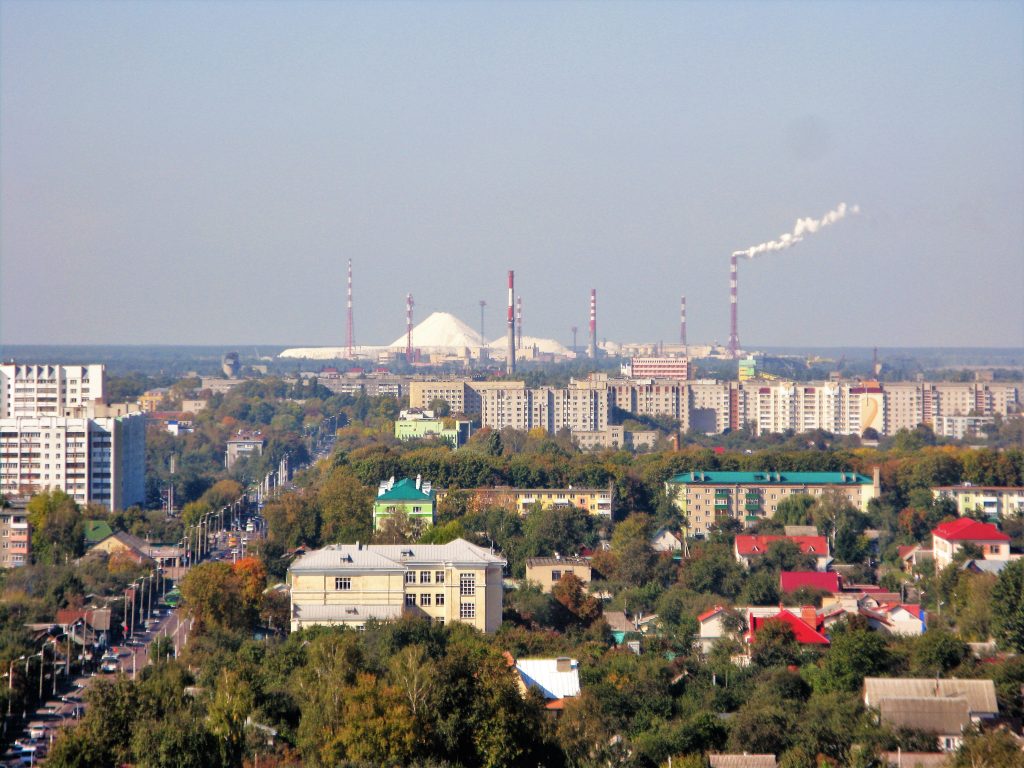
Phosphogypsum ‘mountains’ near Gomel, Belarus. PHOTO: GOMELBOY VIA WIKIMEDIA COMMONS
Introduction
Phosphogypsum (PG) is a byproduct of phosphoric acid production and represents one of the largest industrial waste streams in the world. Historically, companies have stockpiled PG, or even dumped it into the sea, because the impurities present – residual acids, fluorides, phosphates, heavy metals and naturally occurring radionuclides, particularly radium – have acted as a barrier to its utilisation.
Previously, thyssenkrupp Uhde (tk Uhde) highlighted the critical challenges in managing and using PG in Fertilizer International in 2021 (Fertilizer International 501, p48). Progress in transforming PG into a valuable secondary raw material has, however, accelerated in recent years due to a variety of factors, as the International Fertilizer Association (IFA) reported last year1 (Fertilizer International 527, p4). The drivers for greater PG use include increasing regulatory pressure, new strategies for improving resource efficiency and meeting decarbonisation targets. Recent developments in process engineering have also led to renewed interest in the valorisation of PG.
Within this context, the focus at tk Uhde has been on developing a circular economy concept that can link the fertilizer and cement industries together – by transforming PG into valuable products like clinker feedstock and sulphuric acid.
This article presents an advanced treatment approach for PG developed by tk Uhde. The process converts PG into a purified calcium sulphate feedstock suitable for clinker production and generates sulphur dioxide ready for conversion into sulphuric acid. This integrated approach combines together impurity removal, radium reduction and material conditioning in a single process.
Experiments by tk Uhde researchers Peter Stockhoff and Stefan Helmle have shown that the valorisation of PG is a viable circular economy strategy. This generates an excellent mineralogical composition by recovering valuable components like P2O5 and significantly reducing radionuclide content.
Phosphogypsum use – global status and challenges
The industrial usage of PG is a patchwork globally, being highly dependent on national regulations and acceptance criteria, especially those governing radiological safety. While some countries allow limited use in construction materials or soil conditioning, large-scale industrial applications remain rare.
To further complicate matters, every PG source varies – in terms of chemistry, mineralogy and radioactivity – and its potential as a commercial feedstock therefore needs to be individually assessed for different end uses. Figure 1 illustrates the relationship between PG composition, the regulatory environment and potential market uses.

The tk Uhde phosphogypsum treatment process
The tk Uhde treatment concept transforms PG of variable quality into a standardised ‘clean’ calcium sulphate (gypsum) suitable for downstream use as clinker in cement (Figure 2). It is designed as a zero liquid discharge process and consists of two main stages.
The first chemical purification stage removes specific components like phosphorus and fluorides which have a negative impact on clinker/cement production and quality. This initial stage:
• Converts PG into the anhydrite form of calcium sulphate (CaSO4)
• This process is controlled by parameters such as temperature, acid concentration, solid-to-liquid ratio and reaction time
• Recovers valuable P2O5 in the ‘effluent’ stream for return to the phosphoric acid plant to increase its efficiency
• Efficiently removes P2O5, fluorides and other impurities.
The second radium reduction and cleaning stage is critical/essential for regulatory compliance and enabling the broader reuse of the phosphogypsum. This second stage:
• Converts anhydrite to dihydrate gypsum (CaSO4.2H2O)
• Enables the final cleaning of phosphogypsum by reducing heavy metals, for example
• Requires process conditions dedicated to controlling the partitioning and removal of radium.

• Sulphuric acid concentration
• Seed crystal size and quantity
• Process temperature
• Presence of rare earth elements (REEs)
• Use of specific reaction promoters.
Process optimization and reactor design
The second treatment stage requires particular care due to the unique reaction behaviour of different types of PG. The size of the reactor (and reaction time) required for radium removal is influenced by a range of process parameters, as shown in Figure 3.

To optimise this treatment stage, tk Uhde developed a laboratory test matrix to assess multiple parameters at the same time. Using this approach, the various parameters can be adjusted to optimise reaction performance, as shown in Figure 4. Key insights from the optimisation of the reaction include:
• Smaller seed crystal sizes and larger quantities of seed crystals, while increasing reaction rates, can negatively affect radium removal.
• Sulphuric acid concentration must be carefully controlled due to its influence on reaction time.
• The highest radium removal efficiency is achieved by collectively optimising temperature, solids concentration and mixing conditions in the reactor.

Overall, results show that no single factor predominates and that, instead, the interaction between a wide range of parameters determines the final performance of the reactor process. The optimisation of these multiple parameters is therefore essential for maximising radium reduction.
Achieving the desired physical and chemical characteristics for clinker processing is also important. The purified PG obtained after the second treatment stage has a uniform crystal morphology (Figure 5), compared to untreated material, with this enhancing both handling properties and reactivity during clinker formation. Overall, the improvements in both purity and particle characteristics are favourable for kiln processing in cement production.

The tk Uhde process achieved the following significant improvements in PG quality (Table 1):
• It removes P2O5 and fluorides below the final specification for clinker and cement.
• It recovers more than 95% of phosphorus for optional reuse in fertilizer production.
• It provides an opportunity to recover rare earth elements (REEs).
• It significantly reduces radium from approximately 1,000 Bq/kg to less than 230 Bq/kg (an 80% reduction).
• The yield of radium-depleted PG product exceeds 80%.
These results demonstrate that treated PG can meet regulatory thresholds for industrial reuse while enabling resource recovery.

Conclusions
The accumulation of phosphogypsum (PG) in ever larger volumes presents both an environmental challenge and a resource opportunity. tk Uhde’s advanced treatment process provides a viable way to convert PG into a valuable feedstock for clinker production. It ensures the effective removal of impurities, significant reduction in radionuclides, and favourable material properties for kiln processing.
Additionally, the ability to integrate this process into existing infrastructure is a key potential advantage. Overall, PG treatment offers a range of benefits:
• It optimises phosphoric acid plant efficiency by recycling phosphate.
• It turns PG into a marketable product that’s in high demand in large amounts.
• It offers management costs savings for land, PG stacks and landfill.
• It avoids the need for landfill approvals and permits and helps companies comply with their environmental commitments.
• It eliminates raw material related CO2 emissions in cement production by cutting the consumption of calcium carbonate as a raw material.
• It decreases reliance on imported raw materials and protects against fluctuating market prices – for sulphuric acid, for example.

References