Fertilizer International 532 May-Jun 2026
27 May 2026
A year of positives for Anglo American
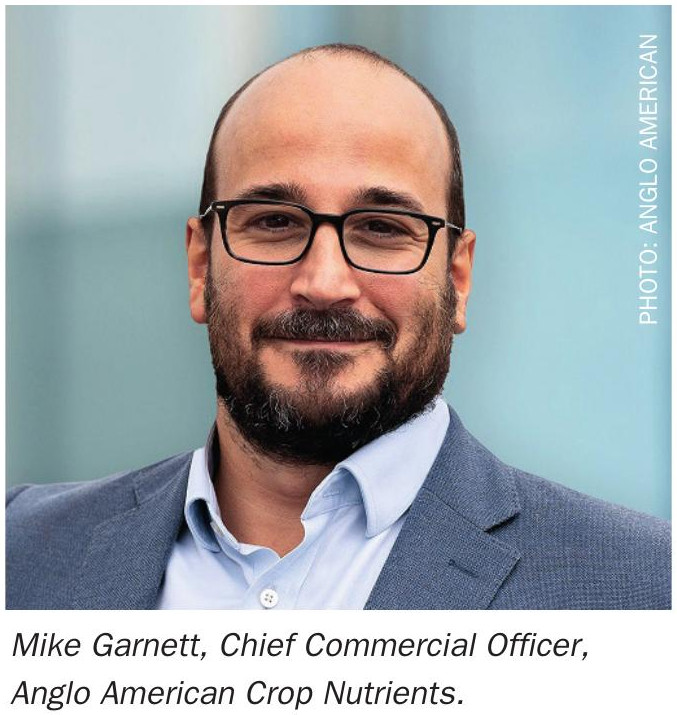
We speak to Mike Garnett, Chief Commercial Officer, Anglo American Crop Nutrients, ahead of the International Fertilizer Association’s Annual Conference in Monaco at the end of June.
Introduction
The last 12 months have been a positive period for Anglo American’s Crop Nutrients business. In May last year, the company published The Future of Fertiliser report. Commissioned by Anglo American and compiled by Deloitte, 74 independent agricultural experts from around the world were interviewed to better understand how the industry needs to change in future decades, if it is to keep feeding the world successfully by 2050.
The report concluded that the fertilizer industry must collaborate across the whole food value chain to produce scalable, sustainable crop nutrient products – needed to provide future food security – while also reducing agriculture’s impact on soils and the wider environment (Fertilizer International 528, p34).
In February this year, a comprehensive study of polyhalite’s crop benefits was also published in Agronomy Journal. Based on a decade’s worth of global trials, this confirmed that Anglo American’s POLY4 product typically improves crop yields by 3-5%, compared to conventional fertilizer practice, across a wide range of crops, soils and growing environments.
“The study… found to the highest possible scientific standard that polyhalite’s ability to improve yield across a range of diverse soils, crops and geographies demonstrated its value as an effective and sustainable future farming solution,” Anglo American said.
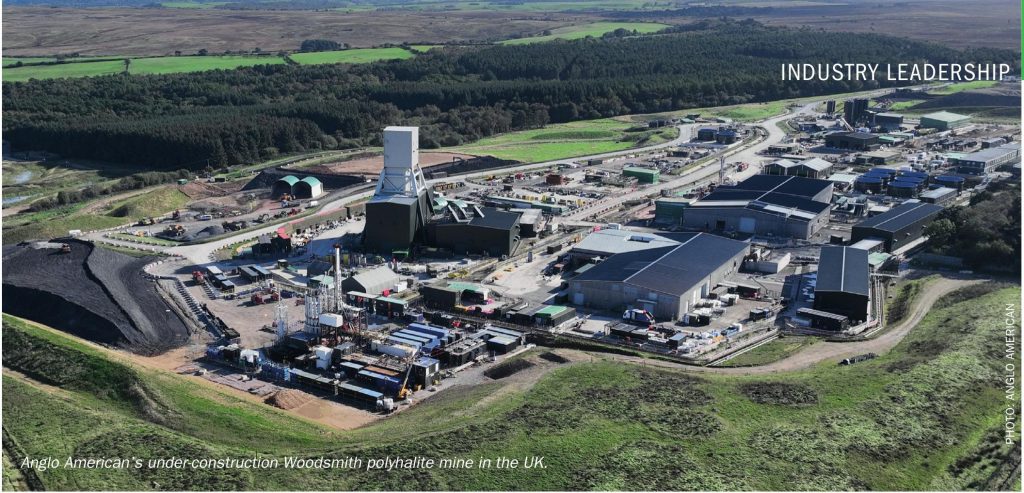
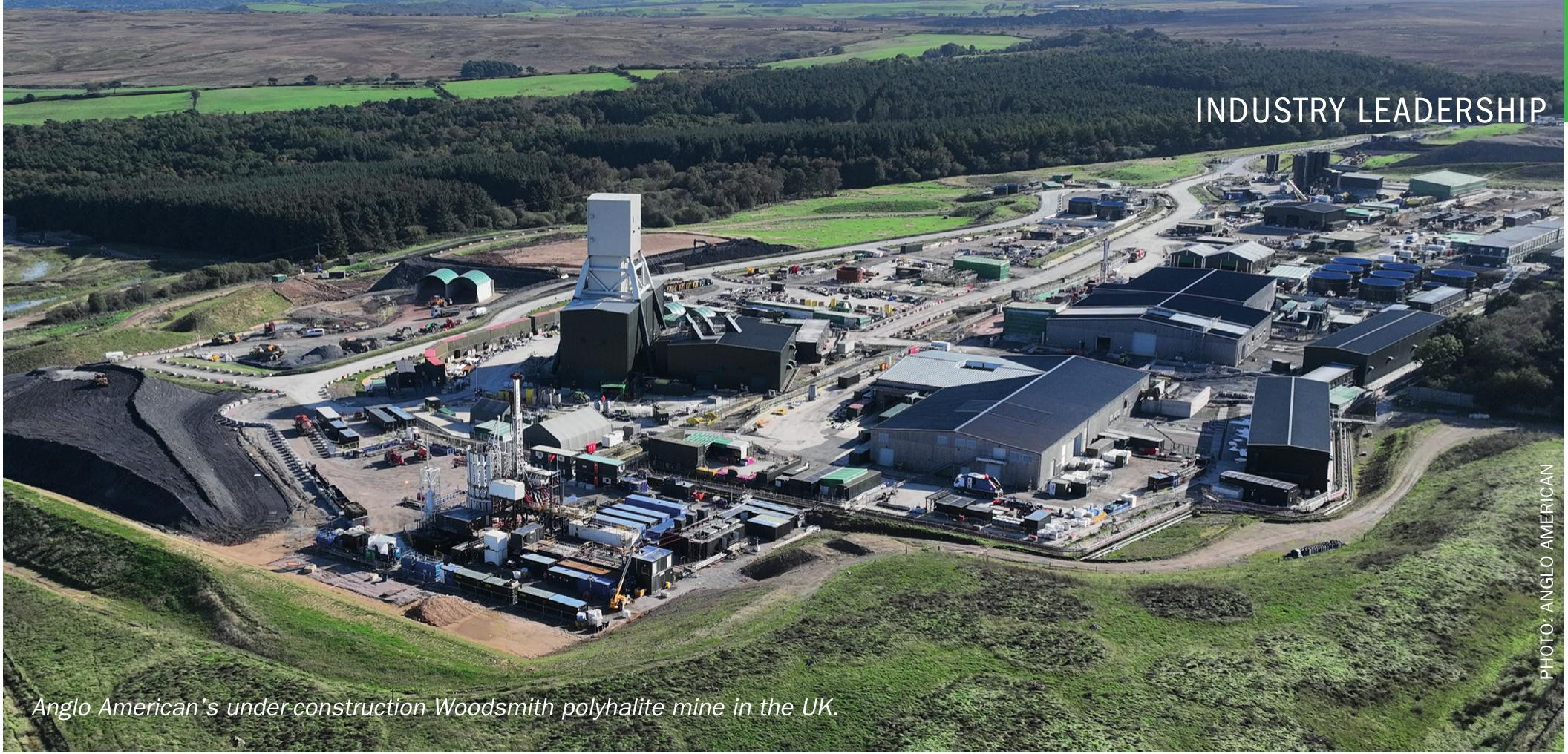
Then, later in February, Anglo American announced an investment agreement with Mitsubishi Corporation (Fertilizer International 531, p7). Although the details are confidential, the agreement includes an initial equity investment by Mitsubishi in Anglo’s Woodsmith polyhalite mine in the UK. This will support the continued development of the mine until a final investment decision (FID) is made by Anglo American’s board. This is now expected from 2028 onwards.
Anglo American has made its final approval of the Woodsmith mine project subject to three conditions:
1. The completion of a feasibility study to demonstrate its “robust economic potential”.
2. A clear “pathway to syndication” by securing of one or more investment partners.
3. “Sufficient deleveraging” of Anglo American’s balance sheet, i.e., debt reduction.
Mitsubishi will decide whether to contribute further financing to the project when the FID is made, potentially acquiring an equity stake of 25% at this time. Until then, Anglo American will press on with critical construction activities at Woodsmith, with an annual investment of approximately $300 million.
The new agreement builds on a longstanding partnership between Anglo American and Mitsubishi Corporation, most recently at the Quellaveco copper mine in Peru, which is 40% owned by Mitsubishi.
Fertilizer International sat down with Mike Garnett, Chief Commercial Officer, Anglo American Crop Nutrients, to discuss what has been a year of positives for the company’s UK-based Woodsmith polyhalite project.
Major boost from Mitsubishi
Mike, congratulations on Anglo American’s recently-announced landmark investment agreement and partnership with Mitsubishi Corporation. What does Mitsubishi bring to the table – and what will its involvement mean for the Woodsmith project in practice?
“We’re really excited about the Mitsubishi partnership. We have been working with the team at Mitsubishi for almost three years to get to this point. They’ve made a significant investment in the project.
“It’s a validation from a very credible partner who shares our values and vision of the potential of the Woodsmith mine and our product. Mitsubishi have spent a lot of time thinking about and understanding the role that polyhalite has to play in the future of fertilizer.
“Does it move us closer to a final investment decision (FID) and making Woodsmith a reality? Absolutely it does. Having a credible partner who understands our product will make a big difference when we come to raising money at FID to move the project to operations.
“Mitsubishi committing as a shareholder to the project, making a positive investment decision, is a huge endorsement and lends credibility to the project. So, we’re thrilled to have them on board.
“We’ll now have Mitsubishi team members as we move through to the FID. They’re particularly interested in our market development work. We’re now making sales into most of our key regions and growing that programme – and Mitsubishi are very interested in how they can support us with that effort. They’ve very extensive connections in agriculture and commodities. That together with their experience in trading and logistics will all come in handy as we develop the market for polyhalite.”
A focus on project-critical activities
With more than 1,000 people still at work on the Woodsmith mine project, could you provide an update on construction progress?
“We now have a budget approved of $300 million of capital this year – and guidance for the same amount in 2027 – which we’re really galvanised by. It’s a public statement of intent to progress critical activities.
“This investment allows us to continue with the service shaft sinking and is absolutely critical to delivering the highest quality feasibility study we can. That includes market development work, which is obviously hugely valuable to build confidence in the demand for polyhalite and our business plans. As you know, the second condition to getting Anglo American board approval for the project at FID is to pass all of the gate tests at the feasibility stage and have a clear economic case.
“The main construction activity progressing is service shaft sinking. Shaft sinking really drives the schedule and therefore the overall cost of the project. So, the more progress we can make sinking the service shaft, the insights gained will lend themselves to the time and cost of the other shafts – as we’ll need to complete the production shaft and the ventilation shaft to finish the project.
“We’re currently in the Sherwood Sandstone aquifer. This was always going to be the most challenging section. But every metre of progress provides confidence in our sinking rates and the overall time and cost of completion. So, it’s a really valuable thing to have the capital to continue with the service shaft and have the team working on that. That will give us a lot more confidence in the overall project cost and schedule.
“The tunnel for the mineral transport system (MTS) is the big success story of this project. The tunnel boring machine (TBM) Stella Rose has broken world records for the longest single drive TBM tunnel by reaching 30 kilometres out of 37. So that’s great.
“We’ve also sunk and completed intermediate shafts to access the MTS tunnel, one at Woodsmith and two along the length of the tunnel. But, in terms of construction work, the real focus is to progress the shaft sinking.
“The local economic and social impact of the project also remains massive – that’s something we report on every year. We continue to support local businesses and employ a thousand people on the project, with 76% of these from the local area within an hour’s commute. Woodsmith, once in production, will also make the UK a significant crop nutrient exporter at a time when food security is front of mind.”
“Mitsubishi committing as a shareholder to the project is a huge endorsement and lends credibility to the project. So, we’re thrilled to have them on board.
Polyhalite’s proven benefits
Agronomy Journal has just published a comprehensive study of polyhalite’s agronomic benefits – what were the key headline findings for you?
“We’ve managed to amass an enormous amount of trial data over 10 years and are super excited about the results and having that good news out there. Going back to the very start of the project, there was no market for polyhalite as a fertilizer – so we began the agronomic work to support the financing.
“The Agronomy Journal study allows us to talk about what a great product we have and its performance, based on validated statistical results published in a credible journal.
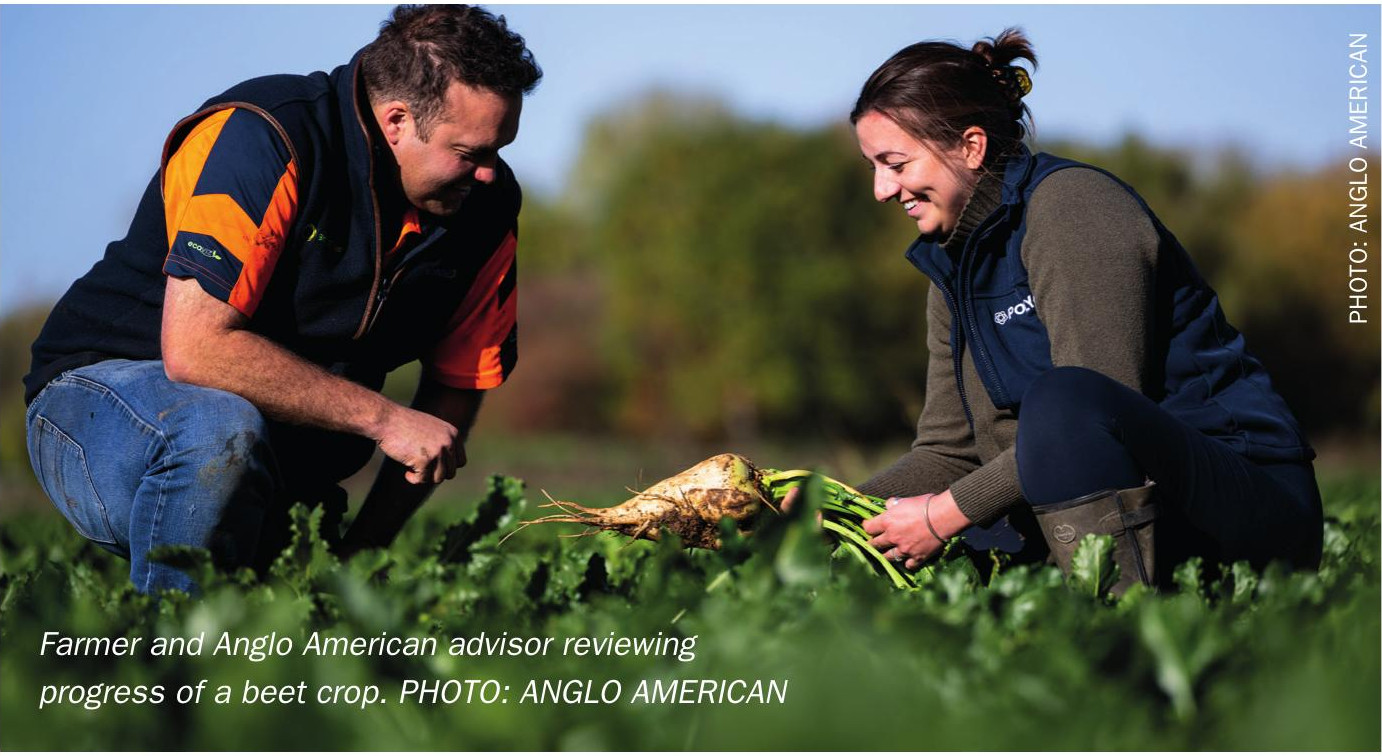
“Across the world, we’re seeing a genuine 3-5% yield improvement with polyhalite compared to standard practice in around a 1,000 use cases. Within that, there’s also some very high yielding results for crops, such as sugarcane, vegetables and potatoes.
“We haven’t cherry picked trials to show the best results: it’s a proper global programme looking at polyhalite’s overall performance across a very wide range of crops and countries. Being able to talk about that by referring to an independent third-party review is hugely valuable to us.
“We have a great team of technical experts, agronomists and soil scientists working on polyhalite R&D. We’re very proud of having an agronomic programme of this size and scale, as it’s quite unique and has given us a lot of insights to support our sales. And we’re now in a period where we’re putting into practice all the knowledge that we’ve amassed, with pilot sales in key markets such as the US, EU, India and China.”
Collaborate to innovate
Last summer, Anglo American and its partner Deloitte published the landmark Future of Fertiliser report. How has this gaze into the future – and the many insights from the leading voices in agriculture – informed the company’s thinking about crop nutrition in the 21st century and the future role of polyhalite in feeding the world?
“This was a great exercise because we canvassed 74 different opinions on the critical factors that will drive the future of fertilizers, not in five years or 10 years but in 2050. There were some really clear macro themes: the pressure on food security from decreasing arable land and changing diets, and getting the most from our fertilizers in a sustainable way.
“What was very clear to me is how well-placed our polyhalite product POLY4 is to meet those challenges. There really aren’t other scalable solutions that deliver the nutrients that everybody knows are needed in a very efficient way.
“It’s the privilege of our resource that every granule of POLY4 is naturally packed with nutrients that plants need. Our challenge is to show how POLY4 best fits into farming practices and to convince the market to change and adopt POLY4.
“It’s a global solution. At full production, we will have 13 million tonnes a year and we’ll have it for decades. That’s what we can offer and it’s our job to show the market how POLY4 can be substituted for existing ingredients to offer better solutions. It will do that in a way that strengthens resilience in crops and helps care for soils.
“A highlight for me is that polyhalite fits into current farming practices; it’s not a difficult technology change for farmers. We can introduce it into the blends that farmers buy today and it’ll offer a better solution, a more sustainable solution. It’s a scalable answer to the problems that the industry faces, affordable and it addresses macro trends.
“That was also the picture very clearly painted by the panel we interviewed. Any solution to the challenges of the future of fertilizer needs to be done at scale, in a way that farmers around the world can adopt, and it has to be economic for farmers. It also has to be more sustainable – as we can’t apply nutrients in a way that deliver yields tomorrow, but destroys soils for future generations.
“Overall, the Future of Fertiliser report was a great exercise that has really helped us cement our long-term strategy for polyhalite and where it fits in. It’s pretty clear to me that polyhalite is a great solution that can make a difference on a global scale.”
“Across the world, we’re seeing a genuine 3-5% yield improvement with polyhalite as the broad performance compared to standard practice. Within that, there’s also some very high yielding results for high value crops, such as sugarcane, vegetables and potatoes.
The path to board-level approval
Could you explain Anglo American’s current approach to project investment and what’s needed to move to a final investment decision (FID) from 2028 onwards?
“The board approves the budget for Woodsmith each year and clearly they’re happy with the overall strategy. Woodsmith is the big growth project for Anglo American and one of the pillars of the new business, along with copper and iron ore.
“The board made the decision back in 2020 to invest in the project, but approval to complete the project is a separate process. The engineering definition and the cost certainty need to reach a certain level for the board to make a final investment decision. That’s simply part of good governance and capital allocation, as the economics of the project need to stack up against other uses of capital.
“The board has set out three very clear conditions for full approval and we’ve made great strides on all of them. Firstly, the Mitsubishi transaction increases confidence and is a huge endorsement of the pathway to syndication. Mitsubishi are a valuable partner and targeting a 25% investment in the project at FID – so on syndication we’re making great progress.
“Secondly, the feasibility study is there to provide the board with the level of definition they need to make that final investment decision as we go through an internal assurance process. Work is already well underway to optimise parts of the project for the future and deliver the best possible feasibility study.
“The other condition is the deleveraging of the balance sheet. Anglo’s looking to sell parts of the business to simplify its portfolio. While those divestments are not fully concluded, parts are either well underway or have been completed.
“All of that leads towards a projected FID date from 2028. The work we’re going to do between now and then will really help put forward the best possible investment case for the Woodsmith mine. All the things that we’re doing – the shaft sinking and the market development work – will contribute to a very robust feasibility study at FID.”
Summing up
“We’re really excited about getting the agronomic trial data out there and helping people to understand what POLY4 will offer, in terms of better yields, improved nutrient availability, resilience in crops, better soil health, and the fact that it easily fits into farming practices in bulk or compound blends or by direct application. We’re able to explain clearly to people what POLY4 will offer – and actually put that into practice now with the pilot sales in all our key regions. That’s an exciting development that really builds credibility around the product we offer.” ■