Sulphur 423 Mar-Apr 2026
23 March 2026
Dire Straits
“The impact on prices at time of writing has been significant but not yet critical …”
The effective closure of the Strait of Hormuz by Iran in the wake of US and Israeli attacks has sent shockwaves through all markets, but sulphur has been particularly badly affected. While the Straits carry 22% of global phosphate exports and 35% of urea, for sulphur around 45% of the 39 million tonnes transported internationally every year must traverse the narrow waterway, with major suppliers like Abu Dhabi and Saudi Arabia relying upon it for their export cargoes.
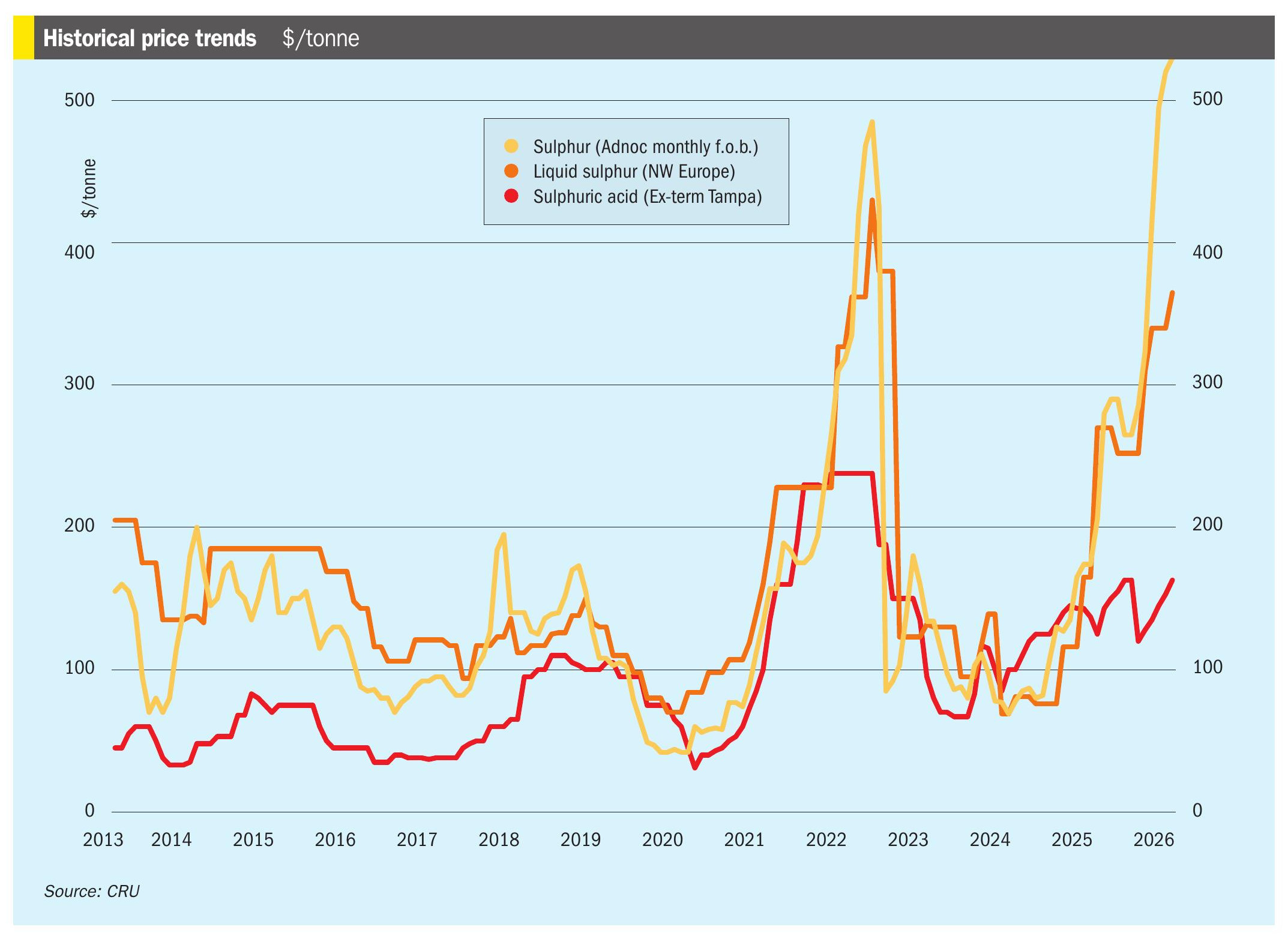
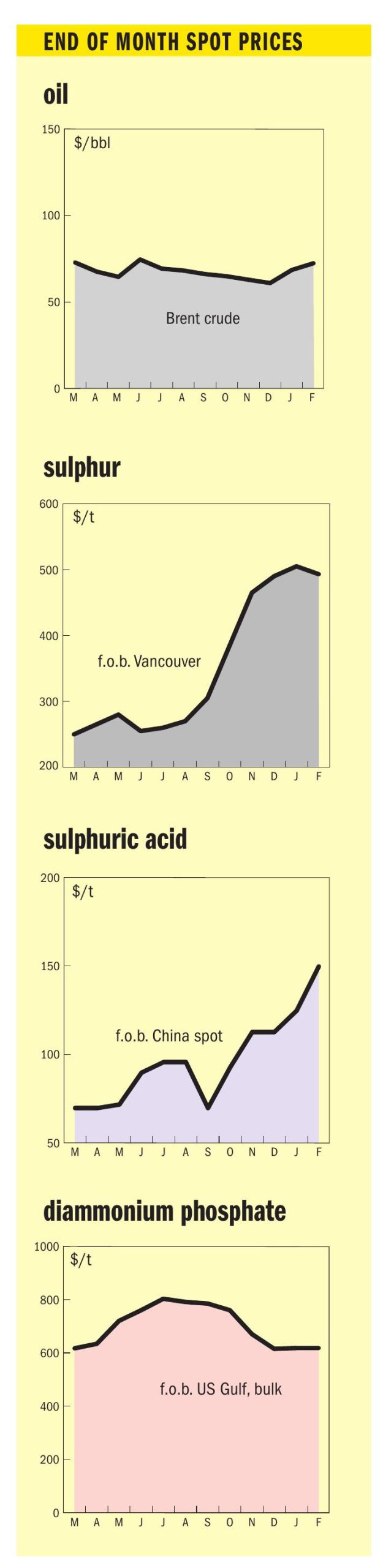
The sulphur market had already been tight prior to the attacks on February 28th, with a ban on exports from Russia extended to March 31st, and the lingering effects of a stoppage at Tengizchevroil (TCO) in January due to a fire at a power station helping to send prices to levels not seen since 2008. But the closure of Hormuz to shipping has led to a series of force majeure declarations and production cuts at major facilities in Bahrain, Kuwait, Qatar and Saudi Arabia. The impact on prices at time of writing has been significant but not yet critical. In Brazil, prices jumped $40-60/t to $560-590/t c.fr, while Mediterranean prices surged to $580-590/t c.fr. However, panic buying has not – yet – materialised, largely due to regional buffers. Major fertilizer plant turnarounds in India and Brazil have muted immediate spot demand, while OCP in Morocco, a key importer, is reportedly well-supplied for March, with nearly 900,000 tonnes of pre-conflict cargo arriving via the longer Cape of Good Hope route. Adding to this, the temporary shutdown of four nickel HPAL plants in Indonesia following a landslide is expected to reduce regional sulphur demand, further tempering sentiment in Southeast Asia.
For now, the market’s direction depends upon how long this situation continues. A swift resolution would likely release the significant volume of trapped cargo, putting downward pressure on prices. Conversely, a prolonged disruption would tighten the global balance considerably, likely leading to further price increases and potential demand destruction. President Trump has shown some signs that rising oil prices and the knock-on effect on gasoline pump prices at home may encourage him to declare victory and end the campaign. However, the selection of Mojtaba Khamenei as Iran’s new Ayatollah seems a clear signal by Iran that it is in no mood for concessions, and the Islamic Revolutionary Guard Corps (IRGC) has said that it will determine when the war ends, not the US.
The extreme uncertainty has stalled forward business. Quarterly contract negotiations for Q2, which should be underway, have not yet started as market participants await clarity. Overall, CRU is forecasting a sharp price rise due to the supply shock, with the potential for further significant increases if the conflict is a prolonged one.