Nitrogen+Syngas 400 Mar-Apr 2026
20 March 2026
Lower site emissions and energy costs
MONITORING AND OPTIMISATION TOOLS
Lower site emissions and energy costs
Toby Hallitt, Kunpeng Guo and Mayank Patel of Siemens Digital Industries Software explain how digital process twins and real-time optimisation can be used to achieve significant cost savings and reduce emissions at industrial sites.
Industrial sites face mounting pressure to reduce carbon emissions and energy costs while maintaining operational reliability.
The chemical and process industries are under unprecedented pressure to reduce carbon emissions and energy costs while maintaining operational efficiency. Global sustainability goals, tightening regulations, and rising and spot energy prices demand innovative solutions that go beyond incremental improvements. Industrial sites face mounting pressure to reduce carbon emissions and energy costs while maintaining operational reliability. With carbon pricing expected to rise significantly worldwide, companies that fail to act risk losing competitiveness and market share. Reducing emissions is not just an environmental imperative – it is a direct path to cost reduction and long-term sustainability.
Siemens believes achieving sustainability goals requires a three-phased approach:
- optimising energy usage to reduce current emissions;
- mitigating harmful emissions through technologies like carbon capture and storage (CCS);
- and developing low-carbon process alternatives.
While carbon capture and process alternatives are long-term strategies, energy efficiency remains the most immediate and cost-effective enabler of decarbonisation. For many organisations, the challenge is clear: how to achieve significant reductions in carbon footprint without major capital expenditure and while meeting plant demand?
The complexity of utility systems poses a barrier to optimisation
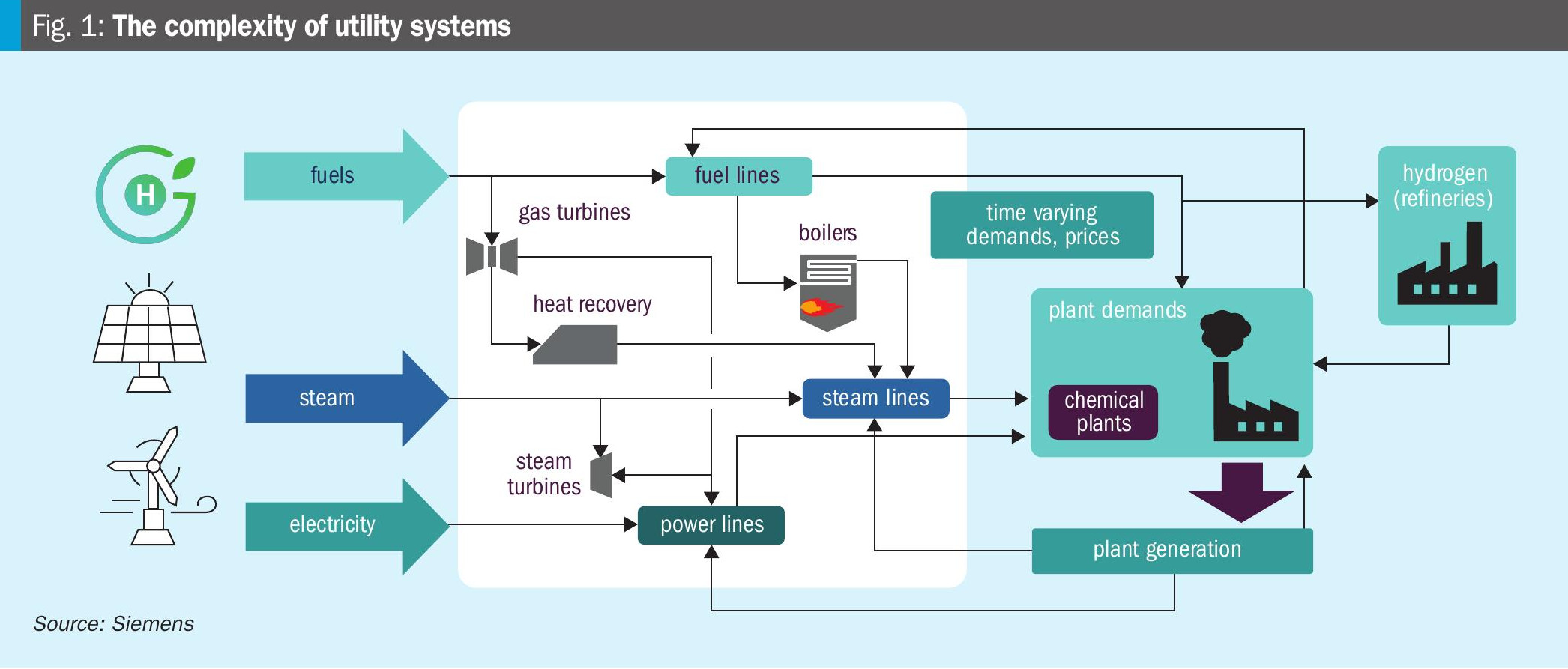
Utility systems – typically comprising of boilers, turbines, cogeneration units, complex steam, condensate, renewable resources, fuel gas and power networks – are at the heart of this challenge (Fig. 1). As the backbone of industrial chemical operations, they are major contributors to energy consumption and emissions. Consequently, managing them manually has become increasingly challenging, not only due to their inherent complexity, dynamic nature, and the multitude of variables at play, but also because of the recent integration of renewable resources (solar, wind, and green hydrogen) and fluctuating spot energy prices, demanding far more than just experience and intuition. The key question becomes: how can we produce and distribute utilities in a way that minimises both costs and emissions?
The digital twin as operational imperative
Digital replicas of operating assets that combine plant data with high-fidelity process models are bringing a new level of decision support to the operation of utilities systems. They provide many benefits to operators, from information on monitoring and ‘soft-sensing’ to advice on optimal set-points and energy trade strategy. At the heart of such shadowing systems is an always-current predictive process model of the assets which updates itself periodically based on real-plant performance.
In the context of utility systems, digital process twin technology is now being implemented in many applications in the chemical industry. The associated benefits include: equipment monitoring to determine the real state of equipment; real-time ‘soft-sensing’ to provide up-to-date performance information which is either difficult or impossible to measure; forecasting to determine future performance based on current equipment state and anticipated operation; operational optimisation to give advice to operators regarding set-points; and finally ‘what-if’ analysis to anticipate how to operate for future/alternative operating scenarios.
“Digital process twins are a powerful way of providing actionable energy-saving insights and informed choices on how to balance productivity and sustainability goals.” – Multinational energy company.
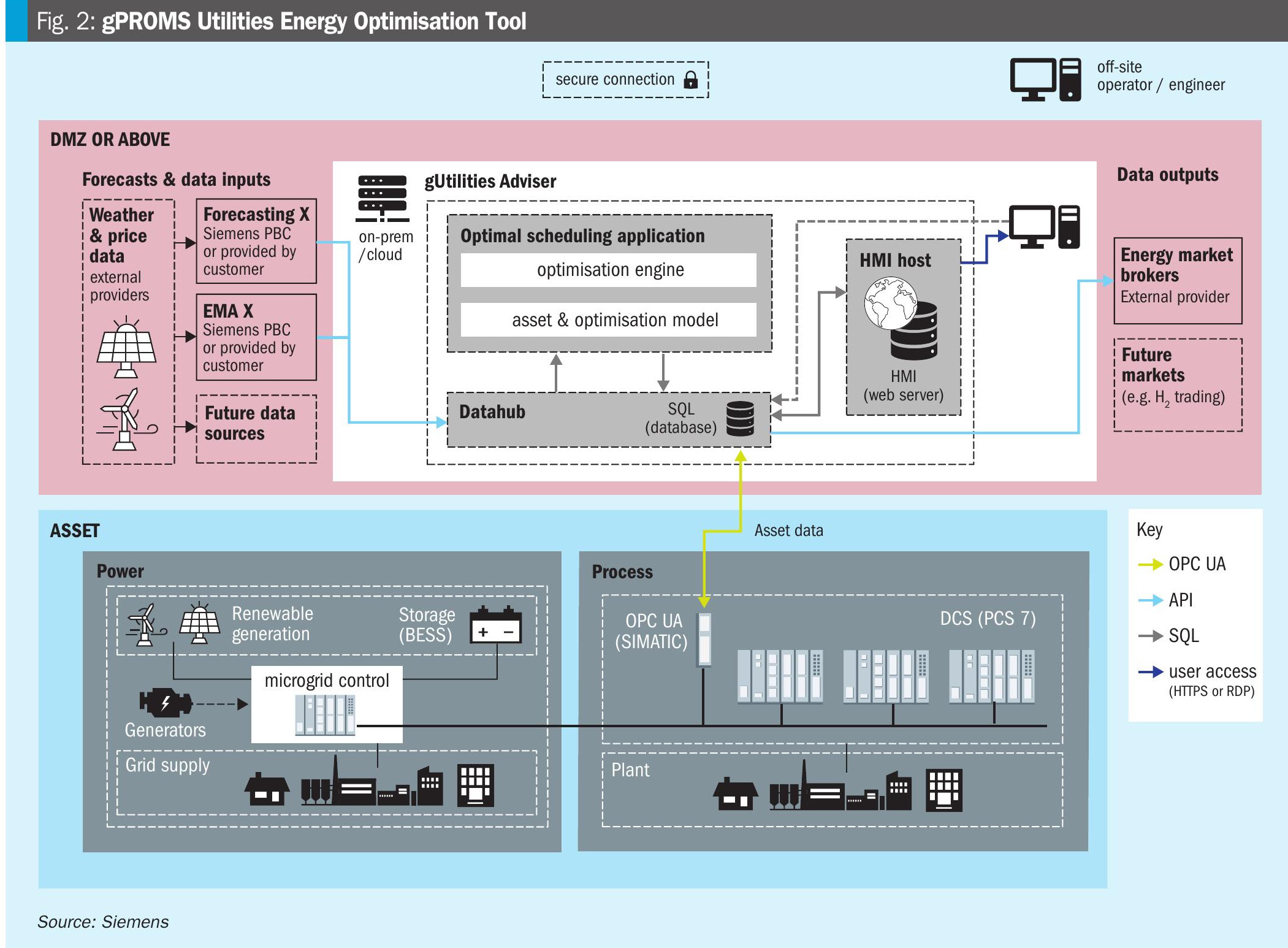
Siemens gPROMS Utilities digital application exemplifies this approach by applying advanced process modelling technology to deliver actionable insights and measurable benefits for utilities systems. The solution integrates seamlessly with plant IT/OT systems and cybersecurity policies. Installed either on a dedicated computer or within a private cloud environment, the system efficiently retrieves plant data before performing comprehensive data validation and reconciliation; a critical process designed to address faulty or missing measurements and ensure the accurate closure of both mass and energy balances. Subsequently, it runs advanced optimisation routines and presents the results clearly on user-friendly dashboards. Key features include:
• Real-time optimisation: Frequent updates based on live plant data and running 24 hours a day, 7 days a week to continuously provide the optimum operation conditions for operator’s guidance.
• Custom dashboards: Tailored views for management, finance, and operations teams.
• Parameter management: Easy one-click updates and maintenance for engineers without deep-diving the process modelling.
• What-if analysis: Quick evaluation of scenarios such as steam and power demand changes or energy price fluctuations.
One of the biggest challenges in deploying advanced optimisation tools is ensuring operator acceptance. A sudden shift from manual decision-making to fully automated recommendations can be overwhelming. Siemens addresses this through a multilevel optimisation strategy, which introduces changes gradually and builds trust over time.
For example, at the first level only the continuous steam flowrate is treated as a decision variable and the boiler, cogeneration and steam turbine unit statuses are fixed. This helps build the operator’s confidence in the solution, by keeping the number of variables to be adjusted, and thus the recommended actions, to a minimum and increasing savings step by step.
At the second level optimisation, more decision variables can be added, such as the load distribution and status of the cogeneration, boilers and steam turbine units, to further minimise the total operating costs. Furthermore, this multi-level optimisation also provides significant advantages for future closed-loop implementation.
Predictive optimisation for dynamic markets
European industries are increasingly adopting decarbonisation and responding to spot energy pricing primarily due to stringent regulations, ambitious climate targets, and the growing integration of renewable energy sources into liberalised markets. However, the renewable energy resources, like solar, wind and green hydrogen, will make the system more complicated to handle due to the availability of weather-dependent features. Also, to enable grid operators to proactively plan generation, maintain a crucial real-time supply-demand balance, and ensure overall system stability and market efficiency, the day-ahead submission of energy demand is a fundamental requirement in a spot energy market, largely because electricity cannot be easily stored.
Siemens gPROMS Utilities operates as a digital process twin, mirroring and optimising an industrial facility’s entire energy ecosystem. It does this by seamlessly integrating and interpreting forecast data and comprehensive day-ahead weather forecasts, which are essential for predicting both the availability of on-site renewable generation and the facility’s overall energy demand. It also incorporates dynamic, often volatile spot energy prices that shape market opportunities, as well as the facility’s detailed production schedule, which defines its underlying energy consumption profile. This powerful integration enables the system to perform complex, predictive optimisation, charting a precise course for the entire subsequent day, broken down into granular hourly or even 15-minute intervals. The ultimate purpose of this intricate analysis is twofold. First, to generate highly refined operational set-points that guide the facility in dynamically adjusting energy-intensive processes, optimising equipment performance, and intelligently managing energy storage solutions. Second, to formulate a strategic energy trade plan that dictates the most advantageous times and quantities for buying electricity from the grid or selling surplus power back into the market. Through this proactive, data-driven approach, Siemens gPROMS Utilities empowers facilities to not only significantly reduce their overall operating costs by capitalising on market fluctuations and maximising the utilisation of cheaper, often greener energy sources, but also to effectively avoid the substantial financial penalties typically associated with energy imbalances, inefficient consumption patterns, or deviations from grid commitments.
Reducing CO2 emissions: A real-world success story
In the way of example, a major European refinery faced some of the aforementioned challenges in optimising its utility system. The refinery involved in this project is a relatively complex crude oil refinery with a fluid catalytic cracker and a hydrocracker. Its utility system consists of a cogeneration plant with numerous boilers. The large number of steam headers and the mixing of several fuels gives rise to multiple decisions that affect performance.
Rising energy costs and carbon taxes made it imperative to reduce emissions and operating expenses without compromising production reliability. The objective was to minimise operating costs, including fuel, electricity, water, and CO2 taxes. gPROMS Utilities Energy Optimisation Tool was implemented to reduce energy consumption and CO2 emissions, leveraging real-time plant data to run optimisation models and provide actionable recommendations via user-friendly dashboards. The twin is linked to plant data systems, updating itself through machine-learning capabilities, validating actual performance and, where appropriate, identifying departures from normal operation.
A multi-level optimisation strategy, as outlined previously, was adopted to ensure operator confidence and smooth adoption of the technology, along with the deployment of user-friendly web-based dashboards in the control room, highlighting easy to follow instructions on beneficial operating changes which operators can view and act upon. These dashboards were developed through a collaboration between all stakeholders, and they provide a comprehensive summary of utility system performance, all presented on a consistent basis. Visualisation of the twin is seen to be critically important to give operators greater insight and confidence to operate the process safely at the optimum point with a view to reducing green-house gas emissions and reducing energy consumption.
The immediate savings following the project delivery were estimated to be approximately €800,000 with a payback time of less than six months. A further €3.6M in incremental savings was achieved in the next few months through continued use of the solution, resulting in significant base-line savings on the refinery site. With a proven track record of continuous operation spanning more than six years, the solution unequivocally demonstrates its remarkable robustness.
As a wider beneficial impact, operators transitioned from intuition-based decisions to data-driven optimisation and there has been improved understanding and knowledge of energy consumption across the refinery within different stakeholders, with the Utilities Twin acting as a focal point to make improvements in many different aspects of energy consumption. As such, the twin is delivering improvements, keeping the refinery utility system running optimally, and making a significant contribution to the refinery’s decarbonisation and energy reduction goals.
In conclusion, Siemens’ gPROMS Utilities solution delivers a unique combination of accuracy, adaptability, and ease of use. By leveraging digital process twins and real-time optimisation, industrial sites can achieve significant cost savings, reduce emissions, and secure a competitive edge.