Fertilizer International 530 Jan-Feb 2026
23 January 2026
Brazil’s UGF project – delivering the energy transition
PROJECT UPDATE
Brazil’s UGF project – delivering the energy transition
Brazil has the renewable energy capacity, agricultural scale and industrial expertise to lead the global transition to low-carbon ‘green’ fertilizers, according to Atlas Agro. The under-development Uberaba Green Fertilizer (UGF) project in Minas Gerais state is the first step in that direction, as Petter Ostbo, CEO and founder, Atlas Agro, explains.
Brazil is one of the world’s agricultural powerhouses. Yet the country imported around 95% of its nitrogen fertilizer needs in 2024, a structural dependency that exposes the country’s farmers to global volatility, logistics risks, currency shocks and geopolitical disruptions.
While Brazil’s agricultural output has continued to grow – by more than 15% over the last 5 years – domestic nitrogen production has stagnated. This growing mismatch in Brazil between agricultural expansion and stalled fertilizer production, if left unchecked, is a direct risk to global food security and threaten Brazil’s international competitiveness, in our view.
At the same time, Latin America is on the frontline of climate change. The Amazon, for example, is approaching an irreversible tipping point driven by climate change and deforestation, according to renowned Brazilian climate scientist Carlos Nobre, beyond which the rainforest ecosystem could collapse. Agricultural productivity in Brazil – and its long-term strategic autonomy – is therefore inexorably linked to environmental stability and climate action.
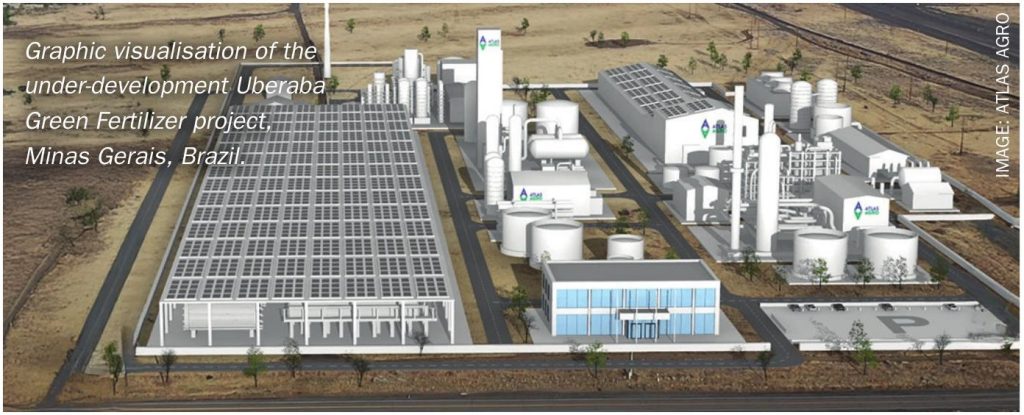
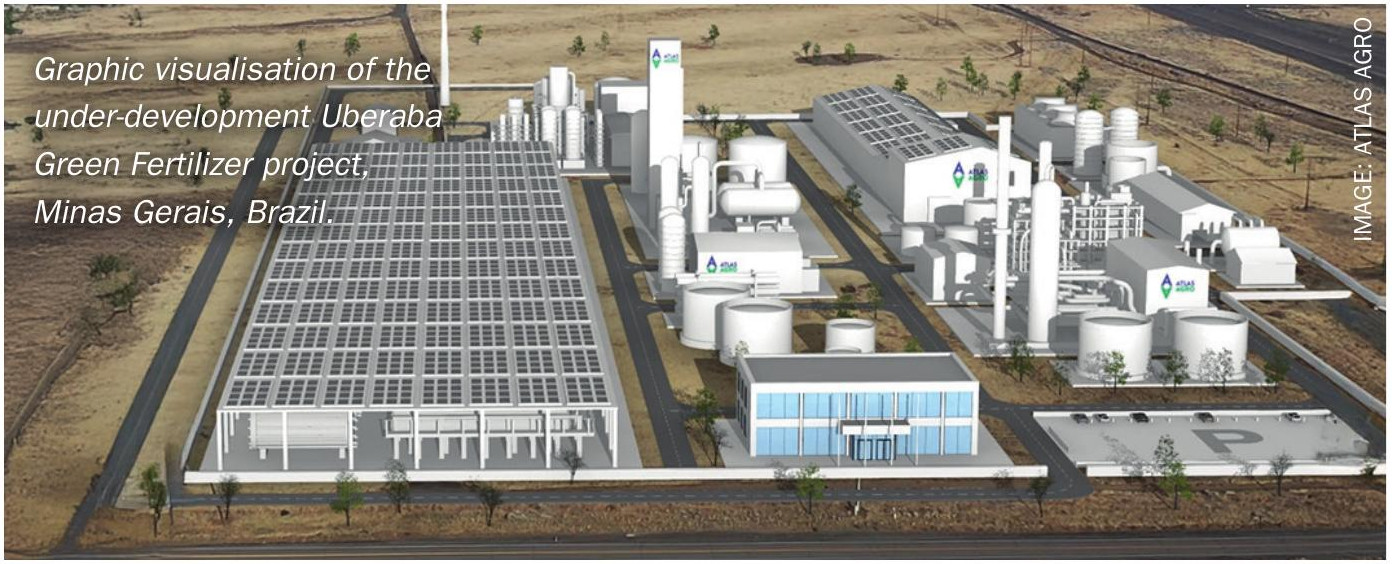
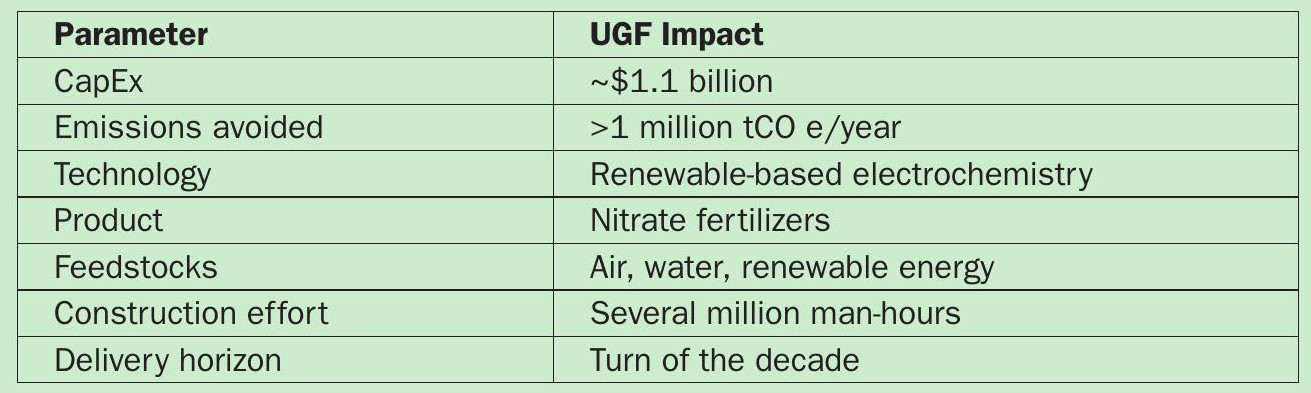
This is the context driving Atlas Agro’s Uberaba Green Fertilizer (UGF) project in Minas Gerais state. UGF is designed to be the first industrial-scale plant in Brazil to produce nitrate fertilizers using only renewable electricity, air and water as raw materials. There is no natural gas consumption, no coal consumption and therefore no carbon emissions.
Decentralised green industrialisation
The project’s business logic is simple: move fertilizer production closer to farmers and decouple it from fossil fuel feedstocks. By producing ‘green’ nitrate fertilizers in Brazil, the UGF project avoids the embedded carbon footprint of conventional (natural gas-based) urea and ammonium nitrate currently supplied to the domestic market.
The UGF project is a textbook example of ‘powershoring’ – essentially moving production to where green power is found. It relocates a hard-to-abate, energy-intensive industry based on fossil fuels to a region where there is abundant renewable power – and where energy is structurally cheaper, cleaner and more reliable.
In our view, Brazil is the best place to ‘powershore’ green fertilizer production since it has:
1. One of the lowest LCOE (levelised cost of renewable energy) globally.
2. An electricity grid that is already around 88% renewable, making it uniquely suitable for green hydrogen and green ammonia production.
3. A nitrate fertilizer market that is more than 95% import dependent.
Producing green nitrate fertilizers within Brazil and substituting these for domestically produced ammonium sulphate and urea also avoids the local pollution, soil acidification and agronomic inefficiencies associated with these two fertilizer products.
Atlas Agro believes that the planned UGF plant will be a cornerstone asset for Brazilian agriculture: it will create jobs, reduce emissions, add value to local economies and strengthen the resilience of Brazil’s agricultural supply chain.
At Atlas Agro, our goal is not to look back and replicate the fossil fuel model of the 20th century. Instead, our goal is to create a paradigm shift – one that redefines fertilizer production for a 21st century agricultural economy.
Engineering, sponsors and institutional backers
The UGF project is currently at the front-end engineering design (FEED) stage, after three years of pre-feasibility and feasibility studies. A final investment decision (FID) is expected in the first half of 2027 with construction then scheduled to start in the second half of that year.
The project represents a strategic investment of up to BRL 6 billion in the integrated production of green hydrogen, green ammonia and green fertilizers. UGF, as an industrial-scale project, will require several million worker hours to complete. Its scale is large enough to materially change Brazil’s fertilizer balance in favour of domestic production and, once complete, will remain operational for generations.
Atlas Agro has executed a Memorandum of Intent with the government of the state of Minas Gerais. This formally confirms the establishment of the UGF industrial complex in Uberaba. State support for the project includes the following targeted industrial incentives:
1. A special tax regime ensuring ICMS exemptions and deferrals for machinery, equipment and consumables (particularly energy, the single largest driver of operating cost).
2. A credit mechanism that reduces the effective tax burden on domestic and interstate fertilizer commercialisation.
3. Dedicated support from INVEST MINAS to attract and expand local suppliers, while also prioritising industrial as well as energy grid licensing.
These mechanisms strengthen the project’s economic viability and underscore the state government’s commitment to securing long-term structural investment in Minas Gerais and its industry.
UGF is also backed by a robust ‘ecosystem’ of industrial, financial, technical and public sector support. To develop the project, Atlas Agro has aligned itself with strategic partners across many sectors, including customers (fertilizer buyers/distributors) and technology providers. The project’s main sponsor, Macquarie Asset Management, notably provides the necessary institutional backing and long-term investment discipline.
Organisations tasked with bringing about the energy transition are also involved. Collaborations with the Industrial Transition Accelerator (ITA) and the Brazil Investment Platform for Energy Transition (BIP), in particular, have galvanised stakeholder engagement over the past year.
Both initiatives are designed to build bridges and improve coordination between industry, investors and policymakers in Brazil. They also provide a conduit for a constructive dialogue with the Ministry of Mines and Energy and other federal institutions. These government bodies are now working alongside Atlas Agro on the UGF project, in pursuit of common goals on Brazilian infrastructure, industrial policy and national competitiveness.
Offtake agreements and commercial progress
Farmers, cooperatives and distributors understand the agronomic advantage of nitrate fertilizers – including higher nutrient use efficiency, reduced nutrient losses, improved soil health, and superior crop yields and quality. Increasingly, important buyers are recognising that switching to low-carbon crop inputs is no longer optional, and is becoming central to their future competitiveness instead.
Atlas Agro is pleased to confirm the signing of its third firm offtake agreement, this time with Tereos, one of the leading players in Brazil’s sugar, ethanol, and bioenergy value chains. This agreement consolidates confidence in nitrate fertilizers, in our view, and marks an important milestone in the commercialisation of UGF.
“Through our partnership with Atlas Agro, we reinforce our commitment to contributing to a low-carbon Brazilian agriculture by bringing to the field a technology that redefines the emissions standard of the most critical input for agricultural productivity. Access to low-carbon fertilizers is a fundamental part of achieving our agricultural decarbonization targets and our SBTi commitment, accelerating our journey toward large-scale production with a lower carbon footprint,” says Felipe Mendes, Director of Sustainability, New Business, and Institutional Relations at Tereos.
Atlas Agro has signed two additional firm offtakes to date, although these remain confidential at the time of writing. This brings the total value of contracted volumes for the UGF project to around half a billion US dollars in confirmed, multi-year commitments.
Showing COP30 climate leadership
Atlas Agro, instead of waiting for trends to mature, is also helping shape them through its advocacy and business model.
The company was highly active at the UN’s COP30 climate conference in Brazil this year, both during the event itself and as part of agenda setting process beforehand. This included participation in high-level discussions on clean industrialisation, food systems, green commodity chains and the decarbonisation of agricultural inputs.
COP30 brought together policymakers, private sector leaders and international organisations, at a moment when climate action is moving beyond theory to execution.
Our presence at the conference was not symbolic either. It reflects the fact that fertilizer production is one of the world’s largest sources of industrial emissions, making up around 2% of global greenhouse gas (GHG) emissions, roughly equivalent to aviation and around 50% more than shipping.
The transition to green nitrogen fertilizers can reduce production emissions by up to 99%, compared to the standard ‘grey’ production process via conventional steam methane reforming (SMR). The UGF project alone is expected to avoid more than one million tonnes of carbon dioxide equivalent (CO2e) annually. These are real, measurable, large-scale carbon reductions – equivalent to removing nearly 230,000 passenger vehicles from the planet’s roads.
During COP30, Atlas Agro presented the UGF plant as a concrete example and proof that decarbonisation is an executable, bankable and scalable proposition. Our COP30 conversations, before and during the event, centred on three core observations:
1. Food security and climate stability are inseparable. Agricultural resilience cannot depend on fossil-based inputs.
2. Industrial transition requires local production. Green manufacturing must be anchored in the countries that consume their output.
3. The private sector must lead. Waiting for perfect policy alignment is a recipe for stagnation. Companies must build, invest and deliver.
The reaction from policymakers and financial institutions was clear and highly positive: green fertilizer plants are strategically aligned with national priorities for climate, agriculture, energy security and economic development.
WHAT MAKES UGF DIFFERENT?
UGF is not a symbolic low-carbon pilot project: it is a full-scale industrial plant designed to permanently replace fossil fuel-based fertilizer factories. Atlas Agro – instead of following a high-emission path and then attempting to retrofit decarbonisation later – will eliminate emissions from day one.
UGF – key performance characteristics
Brazil’s agricultural producers are efficient. The missing link has been industrial sovereignty in nitrogen fertilizer. UGF directly addresses this gap. ■
Agricultural advantages
Setting aside the climate dimension and decarbonisation, nitrate fertilizers offer agronomic benefits that traditional urea or ammonium sulphate cannot match. They eliminate ammonia volatilisation, improve nutrient availability and deliver higher yields and quality, for example. They also mitigate soil acidification and support long-term farm productivity.
In practice, that means better outcomes for farmers, improved resilience for farm cooperatives, and more sustainable and competitive agricultural exports for Brazil, a country that feeds more than a billion people globally.
In short, Atlas Agro believes UGF is where clean power becomes clean food.
Next horizon
Atlas Agro’s broader vision is to replicate the business imperatives driving the UGF project across other parts of Brazil and Latin America. As a company, we are not building a single plant. We are establishing a new paradigm for ‘local and green’ industrial development that can be scaled and adapted in different countries.
The strong alignment in objectives we are now witnessing, between customers, investors, technical partners and policymakers, is stronger than at any previous moment. The feasibility studies for UGF are complete, the engineering is advancing, while the market is not waiting for green fertilizers – it is actively asking for them.
Brazil has the renewable capacity, agricultural scale and industrial expertise to lead a fertilizer transition on a global level. The UGF project is the first step in that direction. The journey is long, but the opportunity is undeniable in our view.