• Skip to main content

    Nitrogen+Syngas 397 Sep-Oct 2025
    Start-up of world’s largest methanol plant


    CHINA

    Start-up of world’s largest methanol plant

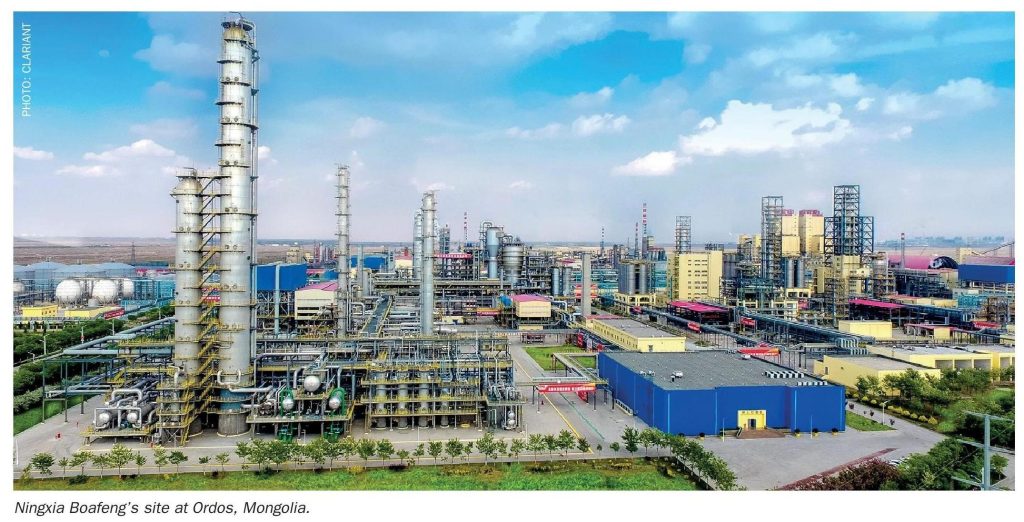
    Johnson Matthey (JM) says that the three methanol production trains of Inner Mongolia Baofeng Coal-based New Materials Co., Ltd., a wholly owned subsidiary of Ningxia Baofeng Energy Group, were successfully commissioned in November 2024, February 2025, and March 2025, respectively. Located in the Wushenqi Sulige Economic Development Zone of Ordos City, Inner Mongolia Autonomous Region, this plant employs Johnson Matthey’s advanced methanol synthesis technology and catalysts, making it the largest single methanol plant in the world. Inner Mongolia Baofeng also stands as one of the largest chemical enterprises globally that produces polyethylene and polypropylene by using coal as a substitute for oil.

    Ningxia Baofeng Energy Group is a key partner of Johnson Matthey in the fields of methanol process licensing and catalysts. The partnership between the two companies began in 2014 and has continued to deepen over the years. The successful start-up of this methanol plant marks another milestone in their long-standing collaboration. Johnson Matthey was awarded the contract for this project in 2020, which included process licensing for three methanol synthesis units, process design, technical review, commissioning support, and the supply of catalysts. To date, Johnson Matthey has licensed seven methanol synthesis units to Ningxia Baofeng Energy Group. This achievement underscores the company’s sustained technology leadership in this critical and fast-growing market, as well as its commitment to delivering the highest standards of quality and performance.

    This successful commissioning also represents JM’s 14th methanol plant in China with a capacity exceeding 1.8 million t/a, further highlighting the proven success of using Chinese-fabricated radial steam-raising converters and compressors in large-scale projects.

    Latest in Asia

    Nickel Industries starts up ENC acid plant

    Nickel Industries announced started up the sulphuric acid plant at its new Excelsior Nickel Cobalt (ENC) HPAL project in the final week of June. The ENC Project is a massive, multi-billion dollar high-pressure acid leach (HPAL) facility located in the Indonesia Morowali Industrial Park (IMIP) in Central Sulawesi, Indonesia. It is operated by Australia’s Nickel Industries to supply battery-grade materials for the electric vehicle (EV) market. At capacity, it is expected to yield roughly 72,000 t/a of contained nickel equivalent as mixed hydroxide precipitate (MHP), nickel sulphate, and nickel cathode.

    Russia bans rail transport of Kazakh sulphur

    Russia has ordered a “temporary cessation” of rail transport of all sulphur originating from Kazakhstan that is destined for Russian seaports and railway checkpoints, representing a significant policy shift, according to an official order from the Federal Agency for Railway Transport (Roszheldor). The directive, which took effect from May 26th, orders a halt to the loading and movement of Kazakh sulphur “until further notice.” While the measure is officially described as temporary, the order provides no specific timeline for when the transit might resume. The action cites instructions from Russia’s First Deputy Prime Minister, D.V. Manturov, as its basis.

    Restart for Hongda smelter

    Hongda's 100,000 t/a zinc smelter, in China's Sichuan Province, completed scheduled maintenance and equipment upgrading and officially resumed production on 21st June, the company said. The smelter had been shut down for planned maintenance since January, during which time a modernisation project for the electrolytic zinc smelting system was also carried out. Following the nearly six-month revamp, the resumption of production is expected to improve overall operational efficiency, reduce unit production costs, and increase the utilisation rate, The company said. The stable supply of sulphuric acid generated by the zinc smelter will effectively leverage the synergies of the "sulphur-phosphorus" industrial chain in the company, an help alleviate cost pressures on the company's phosphorus chemical business segment.