• Skip to main content

    Asia

    SPIC cargo cements China's green ammonia lead

    Written by Natalie Noor-Drugan


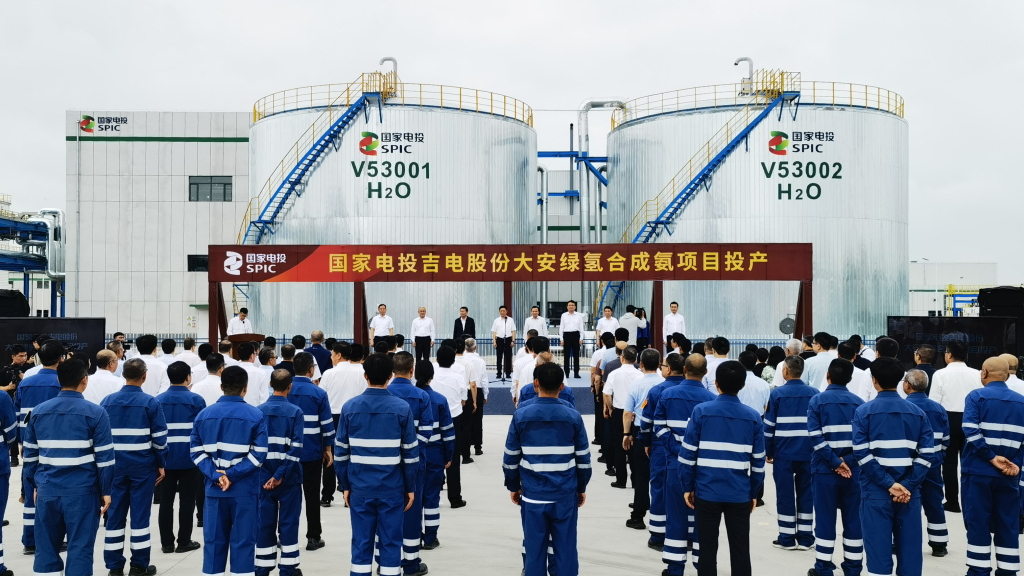
    China’s State Power Investment Corporation (SPIC) has shipped 3,750 tonnes of “HYGLOBAL” green ammonia from its Da’an integrated wind–solar–hydrogen–ammonia project in Jilin province to a South Korean buyer consortium, in what the company describes as the largest single-batch export of green ammonia globally.

    The cargo left Lianyungang port on 28 July and arrived in South Korea on 5 August, with certification and market recognition confirmed in Chinese state coverage on 11 August. Buyers are Korea Electric Power Corporation (KEPCO), Doosan Heavy Industries & Construction and Lotte Fine Chemical, which will use the volume for pure-ammonia and hydrogen-ammonia co-firing at thermal power plants.
    The cargo arrives just as Seoul cools on that use case. On 11 August we reported that South Korea removed coal–ammonia co-firing from its 2026 clean hydrogen power auction. The government is now focused on retiring coal plants, building out renewables and expanding the grid instead. That is likely to weaken medium-term Korean demand for green and blue ammonia in power generation.

    The shipment further solidifies China’s position as the leader in operating green ammonia capacity. It follows Envision Group’s inaugural China–Korea green ammonia shipment of 1,500 tonnes to Lotte Fine Chemical in September 2025 from its Chifeng site in Inner Mongolia, and takes cumulative green ammonia exports from China to South Korea above 5,000 tonnes.

    “The Da’an project is the first commercial-scale wind- and solar-to-green-ammonia demonstration project in the world,” said Jia Yurong, deputy director of the Hydrogen Energy R&D Center at SPIC Green Energy. “It also has the widest wind-solar power fluctuation adaptation range and the largest single-line production capacity.”

    Song Shulin, director of the Qingzhou Da’an green ammonia project at SPIC Green Energy, said the export “verifies the technical route of coupling large-scale renewable energy with green ammonia production” and opens a path to serial deliveries. The RMB 6.3 billion ($875 million) Da’an complex, commissioned on 19 July 2025, pairs 800 MW of wind and 200 MW of solar generation with 32,000 tonnes/year of green hydrogen capacity and a 180,000-tonne/year green ammonia synthesis unit — a facility SPIC positions as the world’s largest single-unit green ammonia production line.
    Envision Chifeng holds top spot for operating capacity

    The largest operating green ammonia plant by nameplate capacity is Envision Group’s Chifeng Net Zero Industrial Park in Inner Mongolia, at 320,000 tonnes/year commissioned in July 2025 and scaling to 1.5 million tonnes/year by 2028 under a long-term offtake with Japan’s Marubeni. “Located in the Chifeng Net Zero Industrial Park — the world’s largest zero-carbon industrial park — this project is a world-first in delivering green ammonia at industrial scale,” Envision said on commissioning. China Energy Engineering Group’s Songyuan “Qing Hydrogen One” project, also in Jilin, followed in December 2025 with 200,000 tonnes/year of green ammonia in phase one, scaling to 600,000 tonnes/year. The International Energy Agency’s Global Hydrogen Review 2025 puts China at about 65% of the world’s installed electrolyser capacity, with global low-emissions hydrogen production still under 1 million tonnes in 2025.

    Next step change comes from NEOM

    The next step change will come from Saudi Arabia. The $8.4 billion NEOM Green Hydrogen Complex at Oxagon, majority-owned by Air Products, ACWA Power and NEOM, has now completed construction and entered commissioning, with commercial operation and first green ammonia targeted for 2027 (see separate story). The plant is designed to produce 600 tonnes/day of green hydrogen — around 219,000 tonnes/year — converted into 1.2 million tonnes/year of green ammonia, an order of magnitude above today’s operating projects.

    Air Products holds the exclusive 30-year offtake and, on 4 August 2026, signed a marketing and distribution agreement with Yara International covering the volumes it does not crack back to hydrogen in Europe. “[Volumes] will be sold and delivered to Yara’s existing global supply chain,” Air Products chief executive Eduardo Menezes said, with Yara compensated on a commission basis.

    A separate ACWA Power project on the Red Sea coast, the Yanbu Green Hydrogen Hub, is being developed with Germany’s EnBW and is targeting more than 2.2 million tonnes/year of green ammonia, with commercial operations planned for 2030. The Yanbu project is currently in front-end engineering design, awarded to a Técnicas Reunidas–Sinopec Guangzhou Engineering consortium in July 2025.

    Latest in Asia