Nitrogen+Syngas 389 May-Jun 2024

31 May 2024
Market Outlook
Market Outlook

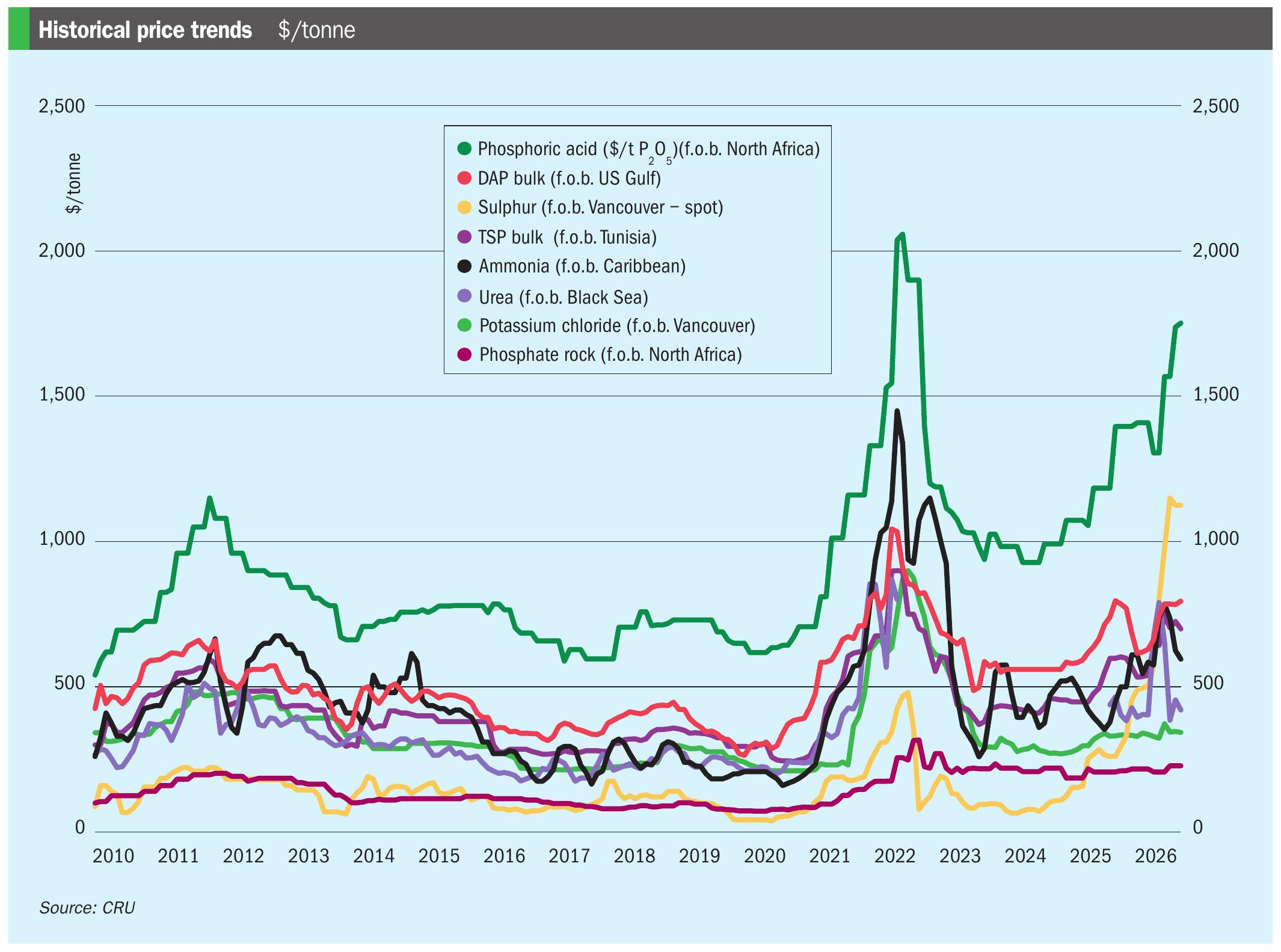
Historical price trends $/tonne
AMMONIA
- Prices in the West are unlikely to garner much support moving into the latter stages of Q2. The May Tampa ammonia settlement was settled by Yara and Mosaic at $450/t c.fr, down $25/t on the $475/t c.fr agreed for April. With seasonal domestic demand in the US drawing to a close 2H April, many had anticipated that either a rollover or a slight decline would be agreed.
- Prices in the Far East appear to have registered some support in recent weeks, the prospect of this tailwind lasting beyond June appears unlikely. Petronas says it would be commencing a 16-day maintenance at its 450,000 t/year Bintulu facility as of 4 May.
- In Saudi Arabia, Ma’aden said that the planned curtailment at its 1.1 million t/a Wa’ad Al Shamal Phosphate Company (MWSPC) II unit will begin in mid-May. Netbacks on the group’s latest contract shipments remain unchanged at around the $275/t f.o.b. mark, as it continues to receive healthy spot interest from Asia for June deliveries.
UREA
- The market is bearish with little to report on the demand side and length on the supply side of the equation. It is difficult to see which region will step in to soak up June tonnes. India is sitting on 10 million tonnes of inventory and is not expected back into the market any time soon.
- Small granular buyers in Southeast Asia are putting out soft bids at $320330/t c.fr which seemingly are too low to attract trader interest following a raft of purchases from Indonesia at $305306/t f.o.b.. Offers in the region have been in the low $330s to $340s/t c.fr.
- There are no fresh updates on China urea export restriction policy. Considering the current firm domestic prices, the export inspection approval time may be delayed to June-July 2024.
METHANOL
- Methanol prices have been rising in North America. Commercial production at the Methanex Geismar 3 plant, which will bring an additional 1.8 million t/a of production, has been delayed due to what the company describes as “complications” with the refractory bricks in the autothermal reformer, possibly until Q4 2024. Continuing strong demand in North America has contributed to the price rises, and the news comes after a series of production outages in the US during Q1.
- Availability was also tight in the Middle East, with supply constrained in Saudi Arabi in March. This had a knock-on effect on major importing regions such as India and China. There have also been plant shutdowns in the Asia-Pacific region, including Malaysia, continuing to tighten availability, and natural gas related production shortages in China and Iran.