Decarbonising gas processing
As all industries come under pressure to decarbonise, are there ways to reduce the carbon footprint of sulphur recovery operations?
Fertilizer International presents a global round-up of current potash projects.
RSK and its subsidiary ADAS have developed a sustainable solution for the disposal of sulphur waste generated from a natural gas processing facility in Iraq. C. Teulon of RSK reports on the research that was carried out to test whether the waste sulphur from a biological sulphur removal process could be applied in agriculture to increase the quality and quantity of crops in Iraq.
Nitrogen-rich wastewaters remain a major issue for fertilizer and other industries. Saipem’s new electrochemical technology, SPELL, is an important step towards the overall objective of zero industrial pollution. A complete engineering review of the technology, its alignment with all international applicable standards, and optimisation has now been concluded and the technology is ready for deployment for the removal of ammonium nitrogen from industrial waters and wastewaters. Saipem discusses the key features of SPELL and reports on the first two industrial references.
A detailed rain and wastewater concept is an important part of a urea plant to meet current stringent environmental standards. Wastewater can originate from the process reaction or from outside the process equipment. In order to optimise the wastewater system of a urea plant, both the amount and type of contamination need to be known. With this knowledge, non-contaminated rainwater as well as process drains can be kept separate as much as possible to minimise the amount of wastewater to be treated, saving costs and energy. Wastewater treatment concepts from thyssenkrupp Industrial Solutions and Toyo Engineering Corporation are described.
The latest developments in the recovery and commercialisation of fluorosilicic acid, rare earth elements (REEs) and uranium co-products associated with phosphoric acid production.
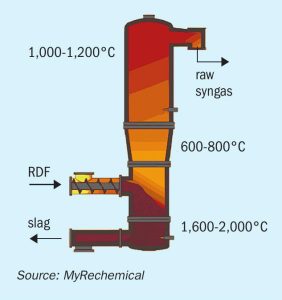
Johnson Matthey and MyRechemical have formed an alliance to commercially develop waste to methanol technology. In this article, two different approaches to waste disposal and chemical production are analysed: a post combustion scenario with waste incineration and hydrogenation of the CO2 recovered from flue gas to produce methanol, and a precombustion approach with waste gasification followed by conversion of synthesis gas into methanol.
New state-of-the-art equipment has been installed in the thermal stage of one of Europe’s largest Claus SRU units. Substoichiometric firing and a furnace designed with CFD calculations and a modern compact boiler system design based on detailed heat engineering and FEM calculations were key to the success of the retrofit. P. Foith of CS Combustion Solutions reports on the retrofit and how the novel combination of a CS low pressure swirl burner, additional mixing using a VectorWall™ and a new waste heat boiler design achieved the desired results.
Sulphur processing and handling equipment manufacturer IPCO has completed the commissioning of a groundbreaking new drum granulator in Italy that will serve as a global showcase for this patented system. C. Metheral of IPCO, describes the innovative approach and key features of the SG20 sulphur granulation system.
A consortium has unveiled plans to build one of the largest green hydrogen plants in the world in a bid to make Oman a leader in renewable energy technology. The $30 billion project is being developed by Oman’s state-owned oil firm OQ, green fuels developer InterContinental Energy and Kuwait government-backed renewables investor EnerTech. Construction is scheduled to start in 2028 in Al Wusta governorate on the Arabian Sea. It will be built in stages, with the aim to be at full capacity by 2038, powered by 25 GW of wind and solar energy. Two years has already been spent on solar and wind monitoring analysis for the development. According to the consortium, the site chosen has the optimal diurnal profile of strong wind at night and reliable sun during the day, and is also located near the coast for seawater intake and electrolysis.