• Skip to main content

    Tag: Urea

    Madras seeking approval for greenfield urea plant

    Madras Fertilizers Limited (MFL) has submitted a proposal for a new $1.1 billion greenfield ammonia-urea manufacturing project in Chennai, aimed at strengthening domestic fertiliser production and reducing import dependence. The company says that the project is aligned with the government’s broader push for self-reliance in critical agri-inputs and improved food security. The proposed plant will have a capacity of 1.3 million t/a of urea and is currently at the feasibility study stage, but MFL says that its existing 1970s vintage plant is already running at 120% of nameplate capacity, and that a new larger scale facility would see significant improvements in output and operating efficiency.

    Another price shock

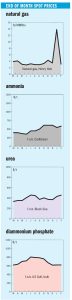
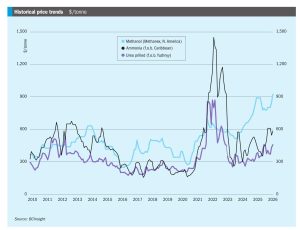
    In just its first two months, 2026 had already managed to be a rollercoaster of a year, but at the start of March, the onset of hostilities against Iran by the US and Israel has managed to deliver another huge shock to markets, particularly commodities. Iran’s strategy of widening the conflict to neighbouring states, including by attacking Qatar’s massive LNG facility at Ras Laffan, effectively shutting it down, has sent the LNG market into chaos, and attacks on several tankers and other ships have paralysed maritime insurance markets and by default achieved the long-feared closure of the Straits of Hormuz.

    Price Trends

    Ammonia sentiment was overtaken this week by the escalating Middle East conflict and the effective closure of the Strait of Hormuz, which left vessels unable to enter or exit the Arabian Gulf. With maritime trade frozen, price indications for prompt Middle East business largely stalled. In normal conditions, the sudden removal of Gulf export flows would point to sharply higher prices, particularly given the already-tight global availability and surging urea values, but participants said the absence of tradable cargoes made it difficult to pin down an indication. The immediate knock-on was felt East of Suez, where the supply shock pulled southeast Asian values back up to around $470-480/t f.o.b. Prevailing length in the market has been reportedly absorbed, with buying interest strongest from east Asia and India.

    Predicting the unpredictable

    The start of the new year has shown that 2026 is already proving to be a very eventful one, beginning with the US abduction of Venezuela’s president Nicolas Maduro, which has prompted questions over production at the country’s ailing nitrogen assets, as well as the potential for a future boost to gas supplies to Trinidad. Meanwhile the Iranian government faces its most sustained public challenge since the 1979 revolution, and possible US military intervention, threatening continued exports from the country. In Europe, the future of fertilizers’ inclusion in the Carbon Border Adjustment Mechanism (CBAM) has been thrown into doubt barely a week after the new regulations came into force, as France and Italy pushed for an exemption for crop nutrient imports.