• Skip to main content

    Tag: United States

    Woodside Beaumont produces first ammonia

    Woodside Energy says that its Beaumont New Ammonia (BNA) facility in southeast Texas has begun production of ammonia following the completion of systems testing, representing the first phase of operations commissioning of the facility. Commercial production of ammonia from BNA is expected to begin following the handover to Woodside Energy from OCI Global in early 2026. Production of lower-carbon ‘blue’ ammonia is targeted to start in the second half of 2026. Woodside says it has also finalised agreements with leading global customers to supply significant volumes of conventional ammonia from the BNA facility. Deliveries will commence in 2026 and continue through year-end, under contracts that reflect prevailing market prices. Additional agreements are being advanced to align with expected BNA output, including for lower-carbon ammonia.


    Synthetic natural gas project for Nebraska

    A consortium consisting of TotalEnergies, Osaka Gas, Toho Gas, and ITOCHU have signed a joint development and operating agreement, granting the Japanese companies a combined 33.3% stake in the Live Oak project – a large-scale facility to produce renewable synthetic natural gas, also referred to as e-NG or e-methane, initiated by TES and TotalEnergies and currently under development in Nebraska. Following the agreement, TES and TotalEnergies will each maintain a 33.35 % stake in the project.

    Travertine starts operation of demonstration plant

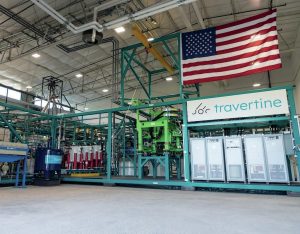
    Travertine Technologies, Inc., has began operations at its demonstration plant in New York state. The core Travertine process demonstrated at this plant combines three major unit operations: salt-splitting electrolysis, caustic direct air capture, and mineralisation. This process produces sulphuric acid, calcium carbonate, and green hydrogen from waste gypsum and carbon dioxide captured directly from the air. The demonstration plant will produce 125 t/a of sulfuric acid, 125 t/a of calcium carbonate, and 55 t/a of carbon dioxide sequestration. The plant will supply sustainable sulphuric acid for local partner Sabin Metal Corporation's precious metals recycling and refining business.

    Good COP, bad COP?

    As I write this editorial, the 30th meeting of the Conference of the Parties (COP) to the UN Framework Convention on Climate Change – aka COP-30 – is taking place in Brazil. It is fair to say that the attempt to try to restrict a large greenhouse gas-driven temperature rise across the planet has become one of the defining issues of our age, and particularly for an energy-intensive industry such as our own, responsible as it is for up to 2% of global carbon and carbon equivalent emissions. The move towards lower carbon intensity production of hydrogen, ammonia and methanol, via carbon dioxide capture and sequestration, gasification of biomass or waste, or electrolysis of water using renewable power, has come to dominate our news coverage, and in this issue we also carry articles on the state of play of both ‘blue’ and ‘green’ ammonia production, as well as technology for ‘cracking’ ammonia back to hydrogen and nitrogen for its potential use as a hydrogen carrier.

    Copper output begins at Rio Tinto-backed project

    Gunnison has started producing pure copper cathodes at its Johnson Camp Mine (JCM) in southeast Arizona, United States, from a solvent extraction-electrowinning (SX-EW) circuit and using leaching technology from Rio Tinto-owned Nuton. As well as giving Gunnison exclusive rights to deploy the proprietary process on run-of-mine ore, Nuton is a financial partner of the Phoenix-headquartered mine developer which has restarted copper production at past-producing JCM. The company’s next goal is to ramp-up to nameplate plant capacity of 25 million lbs/year (11,300 t/a) of finished copper.