Improving operations and monitoring in the acid industry
Metso describes how digital solutions can profit from the deep integration of using a digital process twin in sulphuric acid technology, helping to improve operation, monitoring and reporting.
The progressive closure of smelter capacity in Australia poses potential problems for acid consumers across the country.
Kazakhstan Zinc (KazZinc) is progressing with plans to reduce sulphur dioxide emissions from its Ust-Kamenogorsk site following an environmental audit in December 2024 as a result of smogs caused fugitive emissions which forced residents to stay indoors. The site has reduced emissions from 69,000 t/a in 2011 to 15,000 t/a, but plans to invest $210 million in in new technologies, including sulphur dioxide recovery systems and upgraded filters for solid particle capture. The key measure is the modernisation of gas purification units which is expected to reduce SO2 emissions by 2,200 t/a by 2026. Another important initiative is the construction of the “Hydropolimet” workshop at the KazZinc Ridder metallurgical complex, which aims to reduce sulphur dioxide emissions by 714 t/a.
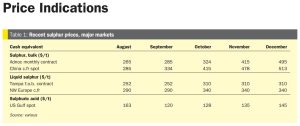
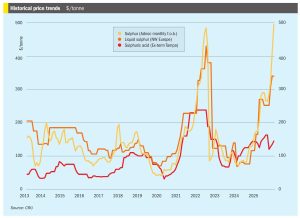
• Global sulphur prices are expected to experience decreases over the next few weeks. Buyers in Asia report that they are covered for contracted supply throughout July, and domestic prices in China are likely to decrease further, putting downward pressure on sulphur prices.
The mid-year negotiations between Antofagasta (AMSA) and Chinese smelters have concluded with a historic settlement of $0/0¢. While unprecedented, the outcome is not surprising, as it lands slightly above the midpoint of the believed negotiating range, from -$15/-1.5¢ proposed by Antofagasta +$10/1.0¢ from the Chinese smelters. Moreover, this result aligns with market participants' rumours circulating prior to the agreement. Separately, rumours suggest Q3 contract negotiations between one top miner and Chinese smelters concluded at levels ranging from -$25/-2.5¢ to (+)$5/0.5¢.
Ballance Agri-Nutrients, the New Zealand farmer and grower co-operative, says that it has entered into consultation on a proposal to cease manufacturing of sulphuric acid and single super phosphate (SSP) at its Mount Maunganui site. The proposals envisage net job losses of 62 roles, but the intention is for the co-operative to remain onsite utilising the proximity to the port for nutrient storage and distribution, and for its national support office. Ballance would continue to manufacture phosphates at its Awarua facility in Invercargill and urea at its Kapuni facility in Taranaki. Ballance CEO Kelvin Wickham says this proposal is part of a wider process the organisation has been going through over the past year to get ahead of changes in the sector and identify future opportunities to support New Zealand farmers and growers. “In the coming years, we expect to see an increased range of products and services that more efficiently and effectively deliver essential nutrients for farmers and growers, which will result in reduced overall demand for single super phosphate from historical peak volumes,” he said. “The number of existing facilities currently making this product in New Zealand means there is an overcapacity of supply. Our current facilities at Mount Maunganui also require substantial investment to keep them operating reliably and will face increasing regulatory constraints to be able to operate heavy manufacturing into the future.”
The S.A. Nyyazov Chemical Plant in Turkmenabat produced 115,850 tonnes of sulfuric acid during the first five months of this year, according to local press reports. The plant also produced 11,297 tonnes of mineral fertilizers over the same period, including 5,227 tonnes of nitrogen-based and 6,070 tonnes of phosphorus-based fertilizers. The Turkmenistan government recently approved the construction of a new plant at the facility to produce 350,000 t/a of superphosphate and 100,000 t/a of ammonium sulphate. South Korea’s Daewoo Engineering & Construction Co. has been awarded the EPC contract for the plant.
EuroChem says that it expects the Phase III expansion project at its Karatau phosphate development in Kazakhstan to be onstream by 2026. In its Annual Report, EuroChem says that it signed an agreement with the China National Chemical Engineering Co. in May 2024 for the engineering, procurement, construction and commissioning of the chemical complex, and construction is now underway. The company says that it has also had state permits for the construction of additional sulphuric acid production, where the installation of large-capacity equipment is already underway and the first product is expected in 2026. The fertilizer plant is expected to have a capacity of around 1 million t/a, with a construction cost of $1.1 billion for the project. Phosphate reserves at Karatau are put at 41 million tonnes.
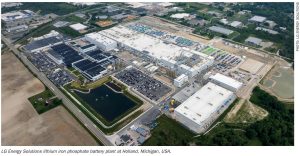
Guizhou Phosphorus Chemical Group has begun site clearing work in preparation for a major mining and downstream fertilizer and chemical project at Kaiyang in Guizhou province started. It is planned to complete the construction of the first phase of the 600,000 t/a lithium iron phosphate (LFP) production line by the end of 2025. The whole scheme is projected to cost $4.6 billion, with participation from the Guiyang Municipal Government and Guizhou Phosphorus (Group) Co., Ltd., China National Nuclear Huayuan Titanium Dioxide, China Mining Resources Group and other companies. The project comprises 1.4 million t/a of ferrous sulphate heptahydrate production, with co-production of 400,000 t/a of titanium dioxide, 600,000 t/a of iron phosphate, 600,000 t/a of lithium iron phosphate, 150,000 t/a of lithium carbonate, 10,000 t/a of lithium fluoride, 20,000 t/a of lithium hexafluorophosphate, 100,000 t/a of copper smelting, and phosphogypsum decomposition to produce sulphuric acid, with power cogeneration and other public utilities. Phosphate ore is processed to produce iron phosphate, which is then combined with ferrous sulphate, a byproduct of titanium dioxide production, to produce lithium iron phosphate, which is ultimately used in new energy vehicle batteries. It is expected that the first batch of production lines will be put into production in 2026 and the entire industry chain will reach full production in 2028. After completion, Guizhou will become the world's largest production base of phosphorus-based positive electrode materials, accounting for more than 30% of the national market share.
The end of June saw declines in sulphur prices in many regions amid subdued global demand across regions. Most import markets are sufficiently covered through July at least, resulting in limited activity while supply increases. These conditions have exerted downward pressure on prices as bearish sentiment spread across regions.