Sulphur recovery in the energy transition
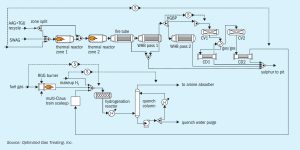
Fluor demonstrates how SRU/TGTU plants within sour gas facilities can facilitate the capture of CO2 and generate H2 by implementing advanced sulphur recovery technologies.
Lithium miner Ioneer Ltd has signed a non-binding Memorandum of Understanding with Shell Canada Energy for the supply of sulphur to Ioneer for its Rhyolite Ridge lithium-boron project in Esmeralda County, Nevada. Ionner said in a statement that “securing the supply of key reagents for ore processing is an important step along the critical pathway to developing the Rhyolite Ridge project”. Under the memorandum, Ioneer will purchase up to 500,000 t/a of high-quality sulphur from Shell, which would fulfil the estimated annual sulphur requirement for the Project.
CO2 emission abatement strategies have become increasingly important as the world strives to combat global climate change. RATE discusses carbon capture options available for sulphur recovery units.
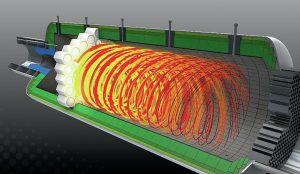
Enhancing the reliability of sulphur plant starts in the thermal stage. Matt Coady and Martin McCallister of Delta Controls report on a recently developed and launched insertable process camera that monitors the vessel interior of online Claus thermal reactors, providing valuable process data which will allow plants to make better informed operation decisions.
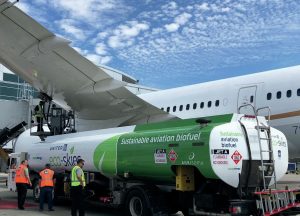
A move towards so-called ‘sustainable aviation fuels’ (SAF) could see refineries having to recast their operations. What might this mean for sulphur production?
Inshan S. Mohammed of Sulfur Recovery Engineering shares lessons learned from a recent SRU shutdown assistance programme involving an error with the tags used within the BMS system installed on a direct-fired reheater.
T he end of August saw a paper published in the Journal of the Royal Geographical Society by Dr Mark Maslin of University College London. Widely reported, it looked at the prospects for sulphur production in an era of declining fossil fuel use, concluding that there could be “a shortfall in the annual supply of sulphuric acid of between 100 and 320 million tonnes by 2040, depending on how quickly decarbonisation occurs”. It added that “unless action is taken to reduce the need for sulphuric acid, a massive increase in environmentally damaging mining will be required to fulfil this resource demand.”
Marco van Son and Frank Bela of Comprimo share lessons learned from SRU war stories, including: inadvertent NH3 destruction in an oxidising atmosphere, rich amine emulsion, SWS fixed valve trays, H2 spiking of SRU feed, rich amine flash drum early warning, V-ball fuel gas safety shutoff valves, TGTU methyl mercaptan, and commissioning and Murphy’s Law.
Temperature dependent rate constants for the hydrolysis of CS2 and COS across Claus Al2 O3 and TiO2 catalysts are valuable tools for the design and optimisation of new, as well as existing, sulphur recovery units. In this context, Alberta Sulphur Research Ltd (ASRL) has measured CS2 and COS hydrolysis rates over a range of temperatures for both Al2 O3 and TiO2 catalysts under start-of-run and, more recently, end-of-run first converter conditions. In this article Christopher Lavery, Dao Li, Ruohong Sui, and Robert A. Marriott of ASRL report on their methodology and the utility of the kinetics calculated from their data and draw comparisons between the start-of-run and end-of-run results.
The past couple of years have been quite the wild ride, with major global events dominating markets outside of the usual concerns of broad market supply and demand. It seems like a long time ago now, but this time last year, the price of a barrel of Brent crude was about $75. Go back two years, in the wake of the onset of covid restrictions, and that barrel would have cost you $40 (and just $25 a couple of months before that). In the wake of Russia’s attack on Ukraine, you could easily have paid $130, and it has been hovering around $110/bbl for the past few months. The last time oil spent any time at that level was in 2014, just before the Chinese economy ran out of steam and prices slumped by 70%.