African fertilizer producers and blenders
The last three years has seen a renaissance in fertilizer production and blending in sub-Saharan Africa. We highlight the expansion of capacity in Nigeria and other countries within the region.
Germany’s K+S is the world’s fifth-largest and Western Europe’s largest producer of potash products. The company manufactures a range of potassium sulphate (SOP) and SOP-based products at three production sites in Germany (Wintershall, Hattorf and Bergmannssegen-Hugo). These include KALISOP® , its granular SOP product range, and speciality products such as Patentkali® .
Enhanced efficiency fertilizers (EEFs) occupy a small but high-value segment of the overall fertilizer market, although their production and use is accelerating. This trend is unsurprising given that their higher costs are usually more than offset by better efficiency and lower application rates.
Sophisticated control of phosphates production is now possible thanks to the availability of real-time process analysers. We assess the range of technologies currently on the market and their key advantages.
Compass Minerals manufactures potassium sulphate (SOP) products from two locations in North America.
Belgium-headquartered Tessenderlo Kerley International, a business unit of Tessenderlo Group, has entered into a new partnership with Kemira of Finland. The two companies have signed a long-term off-take agreement for the marketing and distribution of premium SOP (sulphate of potash) fertilizers.
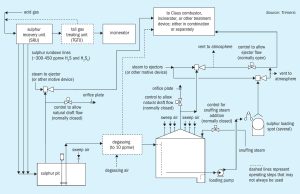
For the protection of nozzles in sulphur forming plants it is important to prevent larger particles from entering the forming machinery and possibly blocking the nozzles. In normal operation, pipeline strainers are used. Sulphurnet has designed a new system which is suitable for continuous or batch operations and has lower maintenance costs. J. Hermans of Sulphurnet introduces the self-cleaning sulphur strainer.
DuPont Clean Technologies has announced the successful startup and performance test of a 300,000 t/a STRATCO® alkylation unit licensed at the Hengli Petrochemical Company’s new refinery complex on Changxing Island in the Harbour Industrial Zone, China. The new alkylation unit enables Hengli to produce high-quality alkylate from a 100% isobutylene feed stream, catalysed by sulphuric acid. This first-of-a-kind unit was developed through DuPont research into the best ways to maximise product octane and minimise end point with this feedstock. Hengli had awarded DuPont the contract for the new alkylation unit as well as a MECS® sulphuric acid regeneration unit in 2015.
Do you remember Peak Oil? This was the theory, driven by research originally conducted by petroleum geologist M.K. Hubbert in the 1950s, that oil production inevitably followed a bell curve, with supply eventually peaking as easier reserves were exhausted, leading to an inflexion point in production and a long tailing off. Originally Hubbert was talking solely about US oil production, and he seemed to have been borne out by the evidence. But a lack of discoveries of new large fields in the 1990s led to a revision of the theory that predicted a global production peak in 2005-6, potentially leading to rapidly rising oil prices until demand destruction occurred.
In spite of continuing safety concerns due to the Beirut explosion, and the rise of the use of urea as a nitrogen fertilizer, ammonium nitrate demand continues to increase in several key markets.