
Fertilizer finishing: last but not least
New innovations and the latest equipment options from FEECO International, Casale, thyssenkrupp Fertilizer Technology and Eirich are helping to perfect the fertilizer finishing process.

New innovations and the latest equipment options from FEECO International, Casale, thyssenkrupp Fertilizer Technology and Eirich are helping to perfect the fertilizer finishing process.

With globalisation seemingly in retreat, the protectionist impulse is seeing a rise in barriers to trade, from quotas and tariffs to anti-dumping actions and domestic subsidies.

Topsoe has begun operations at a demonstration plant for the production of methanol from biogas. The aim is to validate the company’s electrified technology for cost-competitive production of sustainable methanol from biogas as well as other products. The project is supported by the EUDP Energy Technology Development and Demonstration Program and is developed together with Aarhus University, Sintex A/S, Blue World Technology, Technical University of Denmark, Energinet A/S, Aalborg University, and Plan-Energi. The demonstration plant is located at Aarhus University’s research facility in Foulum, and will have an annual capacity of 7.9 t/a of CO 2 -neutral methanol from biogas and green power and is scheduled to be fully operational by the beginning of 2022. It uses Topsoe’s eSMR ™ technology, which is CO 2 -neutral when based on biogas as feedstock and green electricity for heating. It also uses half the CO 2 that makes up about 40% of biogas and typically is costly to separate and vent in production of grid quality biogas.
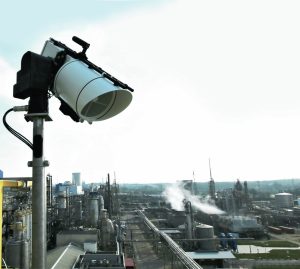
Scanfeld™ is the world’s first remote sensing solution for fully automated early-warning gas leak detection for chemical plants. Using FTIR spectroscopy, Scanfeld™ identifies hundreds of different gases in real time from kilometres away. With just a few Scanfeld™ sensor units, large production sites, tank farms, or gas loading areas can be monitored reliably. Gas leaks are quickly detected, and the formation of dangerous gas clouds is monitored, measured, and visualised. René Braun of Grandperspective discusses how the system works and how it is being applied in industry.

Although the number of new sour gas developments has slowed in recent years compared to the large boost of the previous decade, sour gas projects continue to be a major source of new sulphur production.
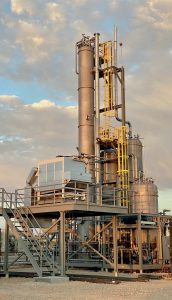
The Valkyrie™ process was first introduced as a reborn version of redox technology for treating H2 S in natural gas processing.In this article Streamline Innovations Inc. highlights some of the new developments and successful applications of the Valkyrie process and its redox technology, in both gas and water streams.
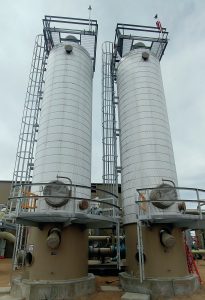
New low-cost metal oxide solid scavengers for hydrogen sulphide (H2 S) removal from wet and dry natural gas have been developed and deployed at commercial scale. The desulphurisation process uses a proprietary sorbent chemistry to achieve a high sulphur capacity and removal efficiency. G. Alptekin, F. Kugler and M. Schaefer of SulfaTrap LLC describe the new technology and its performance.
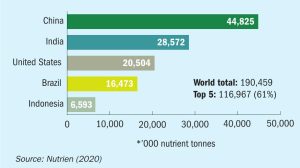
We report on the state of US fertilizer production and supply. The US industry – the second-largest finished phosphates producer and third-largest urea producer globally – has grown and developed alongside North America’s mature and sophisticated domestic farming sector.
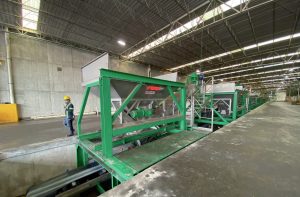
An update on the latest in fertilizer ship loading, handling, bagging and blending, including new contracts, company news and advances in technology.
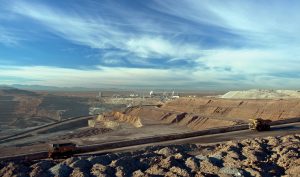
Boron is a key micronutrient required by fruit and vegetables and crops such as corn, cotton, rice, soybean and sugar cane. The agricultural importance of boron and the wide range of products on the market are described.