Fertilizer plant revamping: technology & projects
The refurbishment and modernisation of fertilizer plants offers the opportunity to reduce operating costs, raise production capacity, improve energy efficiency and cut emissions.
The phosphate fertilizer industry is turning to production methods that are able to consume low-grade phosphate rock and/ or generate pure gypsum as a by-product. Gypsum-free processes, and technologies that capture phosphorus from waste streams, are also on the rise.
The economic conversion of phosphogypsum waste into a valuable product has been pursued for decades. Although phosphogypsum is still generally disposed of as waste, industry attitudes are changing and greater use of phosphogypsum will be expected in a circular economy.
Fertilizer International presents a global round-up of phosphate rock, phosphoric acid and finished phosphates projects.
CRU Events will convene the 2022 Phosphates International Conference & Exhibition in Florida at the Tampa Marriott Water Street, 7-9 March.
Phosphate manufacturing is being enhanced thanks to process integration, digitalisation and other advances.
The feed phosphates industry is caught between conflicting trends currently, according to Alberto Persona of the Fertecon fertilizer team at IHS Markit. While the long-term demand-side fundamentals look broadly stable, there is still likely to be a fight for market share due to competition from substitute products and the emergence of new projects.
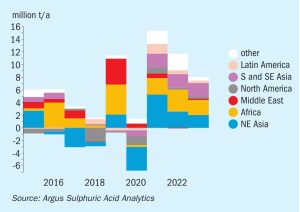
Meena Chauhan, Head of Sulphur and Sulphuric Acid Research, Argus Media, assesses price trends and the market outlook for sulphur.
The latest developments in the recovery and commercialisation of fluorosilicic acid, rare earth elements (REEs) and uranium co-products associated with phosphoric acid production.
As well as Morocco, Egypt, Algeria and Tunisia all have major phosphate industries, and all of these countries have plans to expand their capability to extract and process phosphates, though Algeria and Tunisia remain hampered by political instability.