SO2 emissions control
Legislation to control emissions of sulphur dioxide continues to tighten, via vehicle exhausts, and refinery and smelter emissions, leading to increased recovery of both sulphur and sulphur dioxide.
Do you remember Peak Oil? This was the theory, driven by research originally conducted by petroleum geologist M.K. Hubbert in the 1950s, that oil production inevitably followed a bell curve, with supply eventually peaking as easier reserves were exhausted, leading to an inflexion point in production and a long tailing off. Originally Hubbert was talking solely about US oil production, and he seemed to have been borne out by the evidence. But a lack of discoveries of new large fields in the 1990s led to a revision of the theory that predicted a global production peak in 2005-6, potentially leading to rapidly rising oil prices until demand destruction occurred.
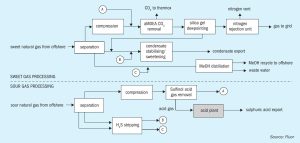
Fluor’s case study of recently constructed ultra-sour gas treating facilities provides new information about the operation of DGA-based AGRUs. B. Lynch and C. Graham of Fluor Corporation discuss how using this knowledge and leveraging the recent improvements to process simulators in the gas sweetening space, Fluor has developed an efficient, flexible, and cost effective solution in the two-stage absorption process to maximise mercaptan removal from ultra-sour gases with minimal equipment.
Fugitive dust emissions during the handling and storage of formed sulphur can result in negative environmental impacts and under specific conditions result in an explosion hazard. Enersul has developed a dust suppression system specifically targeted at controlling sulphur dust particles. The Enersul SafeFoam Transfer System (STS) reduces sulphur fines at critical transfer points throughout any sulphur handling system, resulting in a significantly safer and more environmentally friendly sulphur handling system.
IPCO provides an update on its latest activities, with flexible processes enabling IPCO’s project for the first drum granulation plant in Europe to remain on track despite unprecedented Covid-19 restrictions.
On June 30th, following clearance from the European Commission, Outotec completed the year-long merger of Metso’s Minerals business with Outotec via a partial demerger of Metso. The newly formed company, Metso Outotec, will focus on leadership in sustainable minerals and metals processing and recycling technologies. Headquartered in Finland, Metso Outotec employs over 15,000 professionals in more than 50 countries and its combined sales for 2019 were e4.2 billion.
“T here are,” Mark Twain once remarked, “three kinds of lies: lies, damned lies, and statistics.” It’s certainly difficult to know what to make of economic statistics and indicators at the moment, in the world turned upside down that the Covid-19 pandemic has delivered. Here in the UK, we are told that April and May saw the national economy contract by 25%, the largest fall in 300 years of the Bank of England’s economic record keeping, and the situation is very similar across much of the developed world. But how real is that figure? After all, we were all sent home in March, to ‘lock down’ and prevent the spread of the virus, and we are only now starting to move back towards some semblance of normality. Some of us, fortunately or not, have still been able to work from home, but for much of the economy, especially for much of the service sector; tourism, travel, restaurants and hotels, theatres and cinemas – there has been zero activity. Remove half of the largest sector of the economy for three months and surely a 25% fall in output is exactly what you’d expect? But is that real, or just a number? Has that activity gone for good, or, now that we are emerging, blinking into the sunlight again, can we switch the economy back on again as easily as we switched it off?
Sulphur ’s annual listing of new or recently completed sulphur forming projects worldwide covers both new sour gas and refinery sulphur forming projects as well as upgrades at existing units.
US crude production dropped rapidly during April and May, but figures released by the Energy Information Administration (EIA) showed that this had plateaued and there have been some well reactivations and drawdowns from crude stocks. Total production curtailments in North America were more than 2.5 million bbl/d in May. ConocoPhillips Chairman and CEO Ryan Lance said in remarks to the media that a return to pre-outbreak production levels of 13 million bbl/d looked “pretty difficult”, although a recovery to 11 million bbl/d or possibly as high as 12 million bbl/d would be possible, depending upon OPEC moves. About one third of the company’s production was shut in as of the start of June – some 400,000 bbl/d. Lance argued that low cost shale oil resources still exist in the US, but there will be pressure on companies to reduce capital spending. The Covid19 outbreak has had a major impact in investment announcements, with a large number of project delays in the US due to uncertainty over future demand levels. Planned US exploration and production expenditure is down by 50% for the second half of 2020, while the rig count was down 60% on February.
Although amine solution foaming problems have been studied and reported extensively, direct correlations about the root causes of foaming have not been completely established. This article approaches the problems of foaming from a different perspective, rather than theoretical discussions, the topic is centred exclusively on Amine Experts’ field-related experiences with amine foaming episodes.